

Dutch capital awaits Western Vietnamese shrimp: Funds are available, but mechanism is missing
1. Accessing Dutch Capital: Key Challenges
Core Question: How can Vietnamese businesses and shrimp farmers access capital from the Netherlands to scale sustainably?
Status at FMO (Dutch Entrepreneurial Development Bank):
-
Disbursed USD 15 million to Camimex (Ca Mau) via the DFCD Fund following 8 years of project preparation and 2 years of appraisal.
-
Funding Criteria: Minimum threshold of USD 10 million, long-term tenor (5–10 years). Requires a viable business model with measurable socio-economic impacts; direct commercial ties to the Netherlands or hard collateral are not mandatory if backed by credible off-take contracts.
-
Support: Provides technical assistance grants (requiring 1/3–1/2 company co-funding) or project development support over 1–2 years.
Status at Invest International:
-
Manages a EUR 1.8 billion fund, with zero seafood projects in Vietnam to date.
-
Mandatory Condition: Must feature a direct Dutch link (utilizing Dutch technology, equipment, or partners). Direct equity investment is unavailable without a Dutch shareholder, though equipment financing for Dutch machinery is eligible.
Bottlenecks to International Capital Flows:
-
Micro-disbursement: International funds cannot lend directly to smallholders; a local commercial intermediary bank is required.
-
Market Off-take: Requires binding contracts with international retailers willing to pay a premium for green credentials (especially for eco/mangrove shrimp).
-
Risk Management: Lenders such as Rabobank only allocate capital once disease and mortality rates are predictably managed through transparent data.
2. The Combi-Track Program & Ca Mau's Strategic Role
Combi-Track Program (2023–2026): Executed 35 public-private partnership (PPP) activities between Vietnam and the Netherlands, piloting initiatives such as ShrimpTech (net-zero emissions) and TomGoxy Zero (super-intensive farming paired with mangrove restoration).
Ca Mau – The Core Hub:
-
Accounts for 58% of the area (435,000 ha) and 45% of the output (577,000 tons) of Vietnam's farmed shrimp, generating USD 2.5 billion in export turnover (2025).
-
Proposed as the priority pilot region for standardization before nationwide expansion.
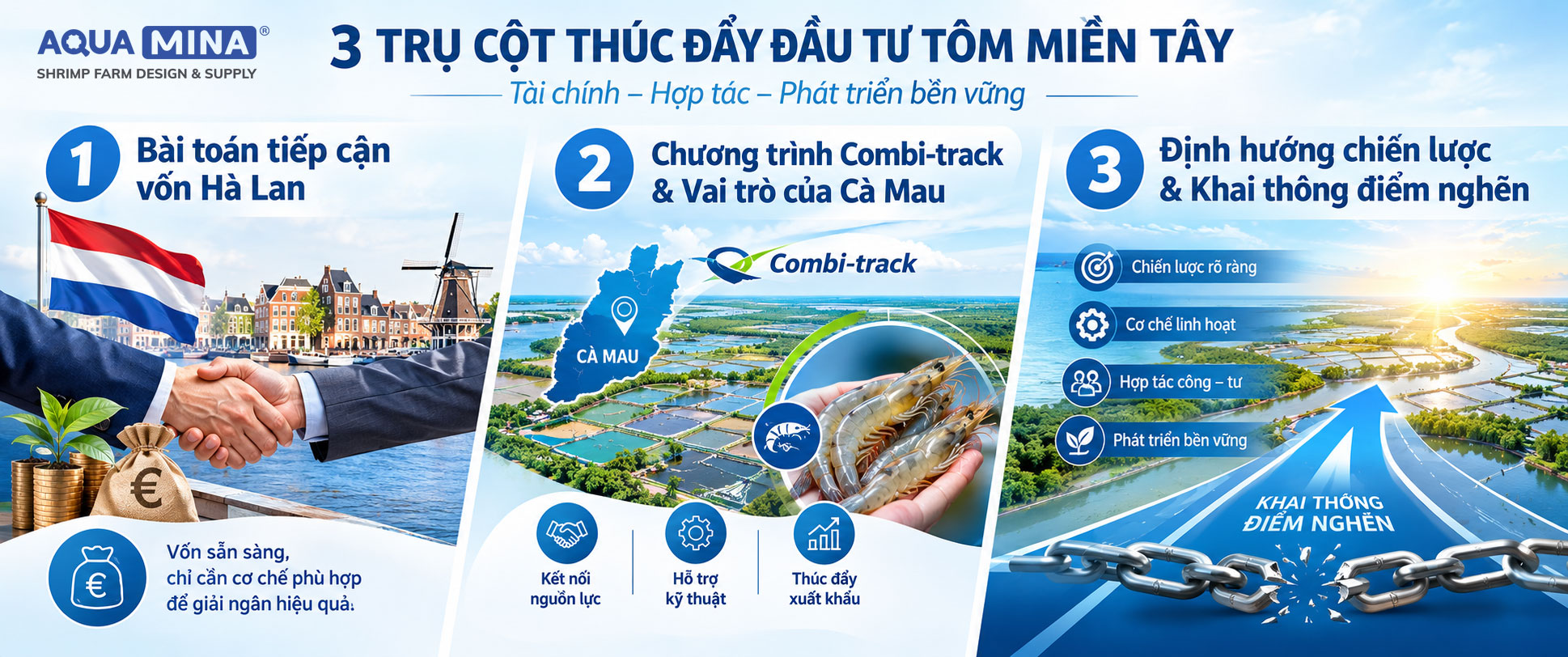
3. Strategic Directions & Unlocking Bottlenecks
-
Policy Framework: Resolution 57-NQ/TW creates an open corridor for importing technology and attracting green financing.
-
Agricultural Extension Solutions: Shifting from low-impact short-term training sessions to Training of Trainers (ToT) programs via universities/institutes to provide hands-on technical guidance to smallholders.
-
Core Message: Sustainability is no longer an optional add-on; it is the fundamental driver of competitiveness.
-
Next Steps: The Dutch Agricultural Counselor proposed convening an Aquaculture Finance Roundtable in Vietnam involving FMO, Invest International, Rabobank, World Bank, ADB, and key stakeholders to directly unblock capital access.
AQUA MINA CO., LTD
WE WORK FOR THE SUCCESS


How strictly is the chlorine gas management process controlled?
Building 48 Value Chains: Ca Mau Strives for Sustainable Shrimp Farming
Vietnam's shrimp industry is still struggling to achieve self-sufficiency in breeding stock.
EVFTA paves the way for Vietnamese seafood to conquer high-end markets
Russian importers are paying increasing attention to seafood supplies from Pakistan
Ca Mau, Can Tho and An Giang Play a Leading Role in Vietnam’s Shrimp Industry
Protecting rice-shrimp yields against environmental fluctuations caused by prolonged rain
AQUA MINA Turbo Blower: Quiet, Energy-Efficient Air Supply for Aquaculture Ponds
AQUA MINA has accompanied the experimental tank system project at Can Tho University from its very early days
AQUA MINA AMONG 20 OUTSTANDING PRESENTATIONS AT THE WORKSHOP ON APPLYING SCIENCE AND TECHNOLOGY TO IMPROVE THE QUALITY OF VIETNAM’S AQUATIC PRODUCTS
Vietnam’s Shrimp Farming Industry Enters the High-Tech Race
The U.S. market relies heavily on imported shrimp to bridge its domestic supply gap


.jpg)