


VIETNAM’S SHRIMP INDUSTRY: FROM RECORD EXPORTS TO THE RACE FOR EFFICIENCY AND VALUE
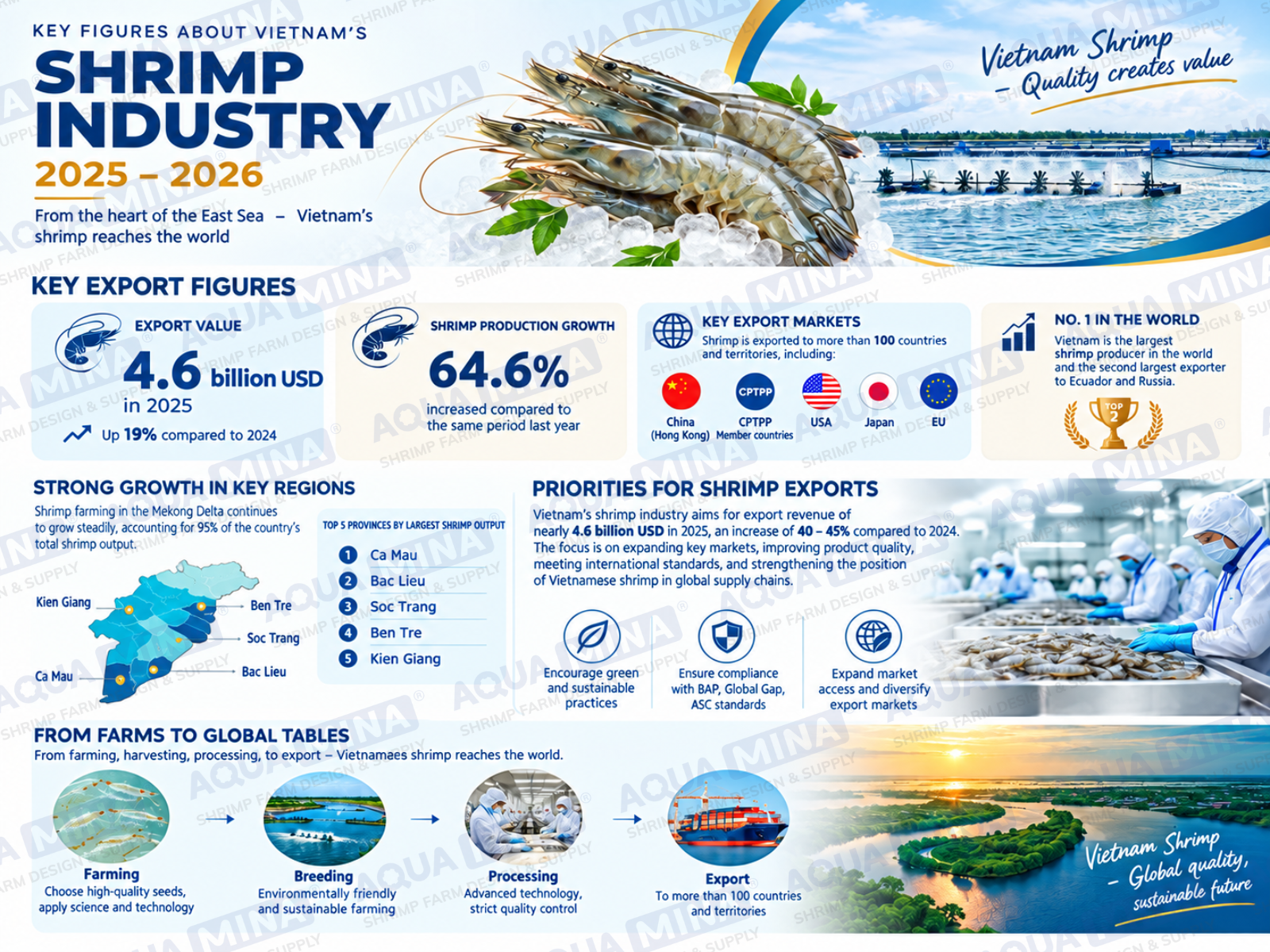
In 2025, Vietnam’s shrimp industry reached a new milestone, with export turnover reaching USD 4.6 billion, up 19% from 2024 and the highest level ever recorded. Behind this record figure, however, lies a notable shift: the shrimp industry is no longer competing on production volume alone, but increasingly depends on the ability to control costs, maintain quality, ensure traceability, and create added value.
1. SHRIMP REMAINS ONE OF THE PILLARS OF VIETNAM’S SEAFOOD INDUSTRY
Vietnam currently has more than 700,000 hectares of shrimp farming areas, with whiteleg shrimp and black tiger shrimp as the two main species. Farming activities are concentrated mainly in the Mekong Delta, with Ca Mau, Bac Lieu, Soc Trang, Ben Tre, and Kien Giang being key farming areas.
Vietnam’s advantage is not limited to its farming areas. The country also has a relatively complete value chain, from seed production and feed to commercial farming, processing, and export. This provides a solid foundation for the shrimp industry to maintain its important position in Vietnam’s seafood export structure.
In 2025, shrimp alone contributed approximately USD 4.6 billion, equivalent to around 41% of Vietnam’s total seafood export value.
2. WHITELEG SHRIMP REMAINS THE MAIN PRODUCT, BUT THE PRODUCT MIX IS CHANGING
Of Vietnam’s total shrimp export turnover in 2025, whiteleg shrimp accounted for approximately USD 2.98 billion, representing 64.6%, up 9.6% from the previous year.
Black tiger shrimp reached approximately USD 452.9 million, accounting for 9.8%, up 1.2%.
Notably, other shrimp products increased by nearly 67%, with live, fresh, and frozen shrimp recording strong growth, driven by the development of higher-value product lines, particularly in the Chinese market.
This indicates that the industry’s product structure is becoming more diversified. Alongside traditional whiteleg and black tiger shrimp production, higher-value and processed shrimp products are playing an increasingly important role.
3. EXPORT MARKETS ARE BECOMING MORE DIVERSIFIED
In 2025, Vietnamese shrimp continued to reach major markets around the world. The CPTPP market generated approximately USD 1.25 billion, up 28.8%, while the EU market reached approximately USD 579.8 million, up 19.9%. These are markets with stringent requirements for quality, certification, and traceability.
Entering 2026, market differentiation has become even more evident.
During the first eight months of 2026, shrimp exports reached approximately USD 3.3 billion, up 12% year on year. China and Hong Kong continued to be major growth drivers, reaching nearly USD 1.12 billion, up 35.9%.
Meanwhile, exports to the United States reached USD 436.1 million, down 11.7%; exports to the EU reached USD 355.3 million, down 3.6%. Japan increased by 6.1%, while the CPTPP market reached approximately USD 901 million, up 11%.
These changes show that market diversification is becoming an important part of shrimp companies’ strategies, rather than relying too heavily on a single market.
4. THE NEW COMPETITION STARTS AT THE FARM LEVEL
In the past, discussions about the shrimp industry often focused on expanding farming areas and increasing production. Today, the equation has changed.
Input costs, feed prices, disease risks, weather conditions, and increasingly stringent requirements from export markets are forcing farmers to pay greater attention to efficiency in every farming cycle.
According to VASEP, Vietnam’s shrimp production costs remain approximately 20–30% higher than those of major competitors such as Ecuador and India. This creates pressure to increase productivity, reduce costs, and strengthen control throughout the farming process.
As a result, greater attention is being given to investments in water environment management, biomass control, automation, operational support equipment, and more controlled farming models.
In other words, equipment on the farm is no longer simply a tool for production. It is increasingly becoming part of the strategy for managing risks and optimizing operating costs.
5. FROM “SUCCESSFUL FARMING” TO “EFFICIENT FARMING”
The development of the shrimp industry is also driving changes in how farms are designed and operated.
Farming models are increasingly focusing on:
- Proactively controlling water sources and farming conditions.
- Managing biomass at each stage of the farming cycle.
- Reducing manual operations and minimizing operational risks.
- Improving quality control and traceability.
- Optimizing electricity, water, labor, and operating costs.
- Developing farming processes that meet safety and sustainability requirements.
This is also why technology-driven farming, automation, and data management are receiving increasing attention. VASEP notes that the shrimp industry is accelerating the adoption of high technology, including AI and IoT, to improve production efficiency, reduce risks, and enhance traceability.
6. 2026: NOT JUST A RACE FOR PRODUCTION VOLUME
Entering 2026, Vietnam’s shrimp industry continues to have growth opportunities while also facing new requirements: price competition from low-cost producers, trade barriers, traceability requirements, food safety standards, and increasingly stringent environmental criteria.
During the first eight months of 2026, shrimp exports continued to grow, but the pace and performance varied across markets. This indicates that businesses and farmers need to prepare for a more dynamic market, where production efficiency, quality, and the ability to meet standards can be just as important as production volume.
VIETNAM’S SHRIMP INDUSTRY IS ENTERING A NEW PHASE
From an industry heavily focused on expanding production volume, Vietnam’s shrimp sector is gradually moving toward creating greater value across the entire value chain.
From seed production → farming areas → equipment systems → environmental control → processing → traceability → exports, every link plays a role in determining the ultimate competitiveness of Vietnamese shrimp products.
The USD 4.6 billion export record in 2025 is a notable milestone. But the bigger challenge for the coming years will be how to create greater value with more reasonable costs, better control, and more sustainable development.
This will provide the foundation for Vietnam’s shrimp industry to maintain its important position in the global seafood market.
REFERENCES: Vietnam Association of Seafood Exporters and Producers (VASEP), Vietnam Customs data.
AQUA MINA CO., LTD
– Address: 685 Le Duc Anh Street, Quarter 39, Binh Hung Hoa Ward, Ho Chi Minh City
– Phone: 1800 6071 (Toll-free hotline)
– Email: sales@aquamina.com.vn or oversea@aquamina.com.vn
– Aqua Mina’s Official Distributor in Japan: REX INDUSTRIES CO., LTD
– Address: 1-9-3 Hishiya-Higashi, Higashi-Osaka 578-0948, JAPAN
– Email: kimakubo@rexind.co.jp
– Phone: +81-(0)72-961-9893
– Website: www.rexind.co.jp/e/
WE WORK FOR THE SUCCESS
Ngày đăng : 25/09/2026
1705 View


Other Articles
Ca Mau, Can Tho and An Giang Play a Leading Role in Vietnam’s Shrimp Industry
Protecting rice-shrimp yields against environmental fluctuations caused by prolonged rain
AQUA MINA Turbo Blower: Quiet, Energy-Efficient Air Supply for Aquaculture Ponds
AQUA MINA has accompanied the experimental tank system project at Can Tho University from its very early days
AQUA MINA AMONG 20 OUTSTANDING PRESENTATIONS AT THE WORKSHOP ON APPLYING SCIENCE AND TECHNOLOGY TO IMPROVE THE QUALITY OF VIETNAM’S AQUATIC PRODUCTS
Vietnam’s Shrimp Farming Industry Enters the High-Tech Race
The U.S. market relies heavily on imported shrimp to bridge its domestic supply gap
The 2028 supply crisis: The shrimp industry is projected to face a 400,000-ton material shortage
High profits from high-tech shrimp farming come with persistent risks
Intensifying El Niño Effect: Climate Change Risks Threaten the Global Shrimp Supply Chain
Evaluating Gaps in the Circular Economy Value Chain of the Shrimp Industry
A Comprehensive Overview of the Vietnamese Shrimp Industry




.jpg)