

Evaluating Gaps in the Circular Economy Value Chain of the Shrimp Industry
On September 21, a Public-Private Partnership (PPP) Forum was held in Can Tho City to promote a circular economy framework for the shrimp sector in the Mekong Delta region.
Highlighting the sector's vital role, Mr. Vu Duc Dam Quang, Deputy Director General of the International Cooperation Department under the Ministry of Agriculture and Environment, affirmed that shrimp farming is a cornerstone industry in production, export, and livelihood creation for local communities, particularly in the Mekong Delta. In 2025, Vietnam’s shrimp export revenue reached approximately $4.6 billion, accounting for 35% to 45% of the country's total seafood export turnover.
However, the industry is currently confronting a new wave of structural challenges. Rising input costs—most notably feed, energy, and wastewater treatment—continue to exert heavy pressure on profit margins. Concurrently, adverse impacts from climate change, saltwater intrusion, disease outbreaks, and environmental fluctuations pose persistent, direct threats to farming operations.
Furthermore, international import markets are enforcing increasingly stringent requirements regarding product traceability, carbon footprint reduction, environmental responsibility, and supply chain sustainability.
These evolving demands present a clear mandate: the shrimp industry must revamp its production models, optimize resource efficiency, curb emissions, and enhance its capacity to meet the rising standards of the global market, Mr. Quang emphasized.
In this context, the representative from the Ministry of Agriculture and Environment noted that a circular economy offers an optimal adaptation strategy. This approach enables the shrimp sector to boost resource productivity, recycle water resources, fully utilize by-products, conserve energy, advance technology integration, and improve data transparency. Several practical and viable initiatives have already emerged, serving as a foundation to connect technology, finance, and market networks, thereby accelerating PPP collaborations and scaling up suitable solutions.
A Holistic Approach to Bridging Operational Gaps
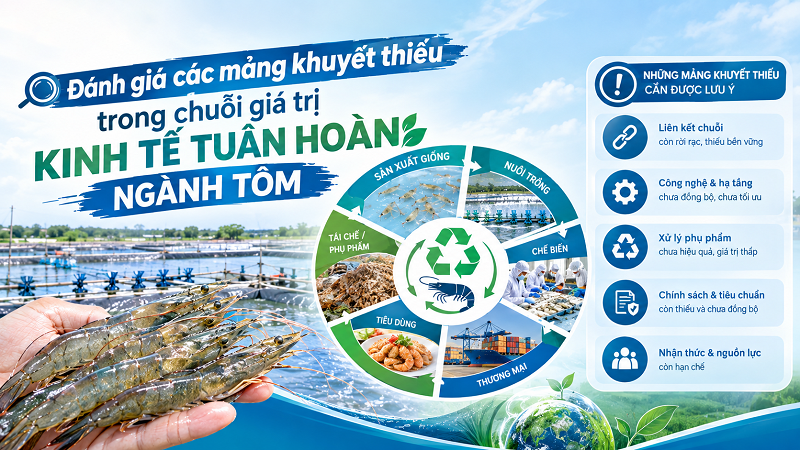
Sharing similar insights at the event, Mr. Ngo The Anh, Head of the Aquaculture Division under the Department of Fisheries and Fisheries Surveillance (Ministry of Agriculture and Environment), asserted that a circular economy in the shrimp sector is not merely about adopting isolated technologies, but rather restructuring the entire production ecosystem toward efficiency, circularity, and sustainability.
Notably, several critical gaps must be candidly addressed to enable this transition:
-
Institutional Policy & Governance: Although general policy orientations exist, detailed and specific regulations tailored to a circular economy in the shrimp sector remain incomplete.
-
Infrastructure & Capacity: The sector continues to face bottlenecks in physical infrastructure, standardized technology, comprehensive data systems, green financial markets, production organization, and implementation capacity among stakeholders.
According to Mr. Ngo The Anh, bridging these gaps is a prerequisite for transitioning the shrimp industry toward green production, higher added value, lower emissions, and long-term sustainability.
Achieving this requires seamless coordination among the government, business enterprises, shrimp farmers, research institutions, and relevant stakeholders to share responsibilities, resources, and benefits:
-
Public Sector: Must continue to refine the legal framework, support R&D and technology transfer, and strengthen implementation oversight.
-
Public-Private Alliances: Should collaborate to create value while clearly defining the roles of government agencies, enterprises, and farmers in resource management and sustainability assurance.
-
Investment Channels: Need to focus capital, advanced technology, management capabilities, standardized model development, value chain integration, and market expansion.
WE WORK FOR THE SUCCESS!


Ca Mau, Can Tho and An Giang Play a Leading Role in Vietnam’s Shrimp Industry
Protecting rice-shrimp yields against environmental fluctuations caused by prolonged rain
AQUA MINA Turbo Blower: Quiet, Energy-Efficient Air Supply for Aquaculture Ponds
AQUA MINA has accompanied the experimental tank system project at Can Tho University from its very early days
AQUA MINA AMONG 20 OUTSTANDING PRESENTATIONS AT THE WORKSHOP ON APPLYING SCIENCE AND TECHNOLOGY TO IMPROVE THE QUALITY OF VIETNAM’S AQUATIC PRODUCTS
Vietnam’s Shrimp Farming Industry Enters the High-Tech Race
The U.S. market relies heavily on imported shrimp to bridge its domestic supply gap
The 2028 supply crisis: The shrimp industry is projected to face a 400,000-ton material shortage
High profits from high-tech shrimp farming come with persistent risks
Intensifying El Niño Effect: Climate Change Risks Threaten the Global Shrimp Supply Chain
A Comprehensive Overview of the Vietnamese Shrimp Industry
CA MAU ACCELERATES MARINE AQUACULTURE DEVELOPMENT FROM 2026 TO 2030, WITH A VISION TO 2045

.jpg)