

Science and Technology: The New Growth Lever for the Shrimp Industry
Vietnam’s Shrimp Sector Seeks Breakthrough Growth Through Science, Technology, and Digital Transformation
In 2025, Vietnam’s shrimp export turnover reached approximately USD 4.65 billion, accounting for over 41% of the country's total seafood export value. This growth momentum continued through the first nine months of 2026, reaching USD 3.7 billion (an 11% year-on-year increase), reaffirming the sector's role as an economic pillar, particularly in the Mekong Delta.
However, behind these impressive figures lie significant bottlenecks hindering competitiveness. Currently, up to 80% of whiteleg shrimp broodstock must be imported, while production and disease prevention costs remain high. Notably, only 24.5% of brackish-water shrimp farms subject to mandatory registration have been granted farming area codes, creating major obstacles for data synchronization and traceability.
Addressing these challenges regarding seed quality, farming protocols, production costs, and data digitalization has become an urgent priority. These issues are also the central focus of the Conference on Science, Technology, Innovation, and Digital Transformation to Drive Agricultural Growth in the Southern Region, held on November 2 in Can Tho.
1. Export Growth Faces Internal Barriers
According to the Ministry of Agriculture and Environment, Vietnam recorded approximately 755,400 hectares of brackish-water shrimp farming in 2025, with a total output of 1.405 million tons. The Mekong Delta serves as the national production hub, accounting for 93.2% of the farming area and 87.2% of total output, featuring diverse models ranging from shrimp-forest and shrimp-rice to intensive and super-intensive farming integrated with processing and export chains.
A prime example is Ca Mau Province, which spans roughly 417,800 hectares of shrimp farming following administrative consolidation. In the first nine months of 2026, the province’s shrimp output reached 454,065 tons (up 9.7%), while processed seafood output hit 305,288 tons (up 16.8%), pushing seafood export turnover to USD 1.805 billion.
Despite overall growth, market performance in the first nine months of 2026 showed sharp divergence (according to VASEP): while exports to China surged by 37% (reaching nearly USD 1.2 billion), shipments to stringent markets declined, with the U.S. falling 15% (to USD 498 million) and the EU dipping 4.9% (to USD 406.4 million).
Beyond market fluctuations, the shrimp sector continues to grapple with core structural limitations:
-
Dependence on imported broodstock: Relying on imports for 80% of broodstock leaves businesses and farmers vulnerable regarding input supply and quality control.
-
High costs and disease risks: Dangerous diseases (such as White Spot Syndrome and Acute Hepatopancreatic Necrosis Disease—AHPND), alongside high costs for feed, electricity, supplies, and environmental treatment, weigh heavily on profit margins, compounded by unsynchronized water infrastructure and environmental monitoring.
-
Traceability gaps: By 2025, only 83,468 out of 340,765 eligible farms had been issued farming area codes. Fragmented data from hatchery to harvest fails to keep pace with increasingly strict technical barriers from importing markets.
2. Mastering Seed Technology and End-to-End Digitalization
To shift from volume-driven expansion to higher quality and added value, the Ministry of Agriculture and Environment is focusing on key technological solutions:
-
Self-reliance in high-quality broodstock: Prioritizing research and selective breeding of specific pathogen-free (SPF), fast-growing, and climate-resilient broodstock to gradually reduce import dependence.
-
Cost-optimizing farming technologies: Scaling up multi-phase farming, Biofloc technology, Recirculating Aquaculture Systems (RAS), and automated feeding tailored to each ecological zone. Technological efficiency will be measured directly via survival rates, Feed Conversion Ratio (FCR), utility costs, and production cost per kilogram of commercial shrimp.
-
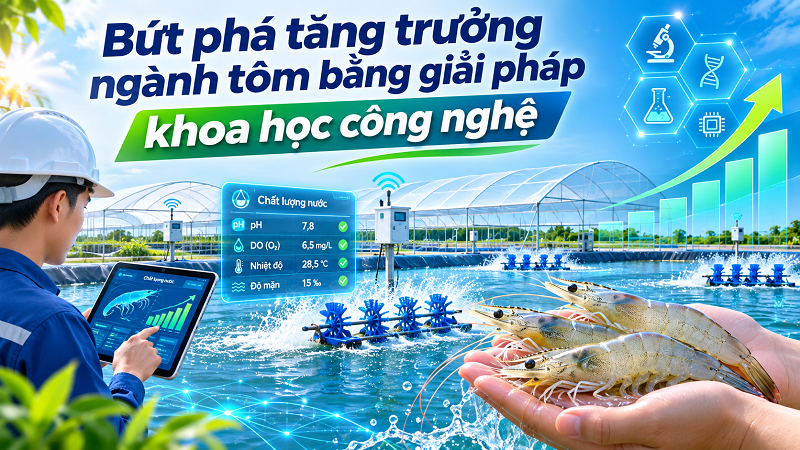
Proactive disease prevention and environmental monitoring: Shifting from reactive treatment to early prevention through diagnostic testing and automated monitoring of water parameters (temperature, salinity, pH, etc.) to adjust farming protocols promptly.
-
End-to-end digital transformation: Accelerating the issuance of farming area codes, digitizing farm logbooks, and integrating data across seed, feed, disease, environment, and harvest stages. Transparent data enables regulators to issue early risk warnings, businesses to control raw material quality, and farmers to optimize operations.
3. Practical Solutions from Localities and Enterprises
From a local production perspective, Ca Mau Province has determined that shrimp industry development must go hand in hand with restructuring raw material zones. During the 2026–2027 period, the province plans to pilot 3 to 5 tightly linked farming clusters connecting enterprises, cooperatives, and farmers under standardized technical protocols, digital data systems, and clear offtake contracts. Simultaneously, the province is promoting deep processing and by-product utilization to boost profit margins.

To realize these goals, a Four-House linkage model is proposed: Enterprises act as the central force commissioning and commercializing technology; research institutes and universities develop technical solutions; local authorities plan raw material zones and support scaling.
At the November 2 conference in Can Tho, keynote presentations from Ca Mau Province (on developing export shrimp value chains) and Viet Uc Group (on applying high technology and digital transformation in shrimp and pangasius seed production) are expected to define actionable priorities, creating a turning point for Vietnam’s shrimp industry to achieve sustainable breakthroughs in the global market.
AQUA MINA CO., LTD
WE WORK FOR THE SUCCESS


AQUA MINA TAKES PART IN LIVESTOCK & AQUACULTURE PHILIPPINES EXPO 2026
Spotlighting 7 industry giants owning Vietnam's leading high-tech shrimp farming models
Proper Cleaning and Maintenance Guide for AQUA MINA Turbo Air Blowers
Sharing the benefits of shrimp farming between ponds
Ca Mau Prepares to Launch a 5.3 Trillion VND High-Tech Aquaculture Project
AQUA MINA Welcomes International Delegation: Expanding Opportunities for Cooperation in the Aquaculture Industry
Secrets to Maintaining Optimal Water Color in Intensive Vannamei Shrimp Ponds During Hot Weather
Comparing Handheld vs. 24/7 Fixed Oxygen Meters for Aquaculture: Which Option Suits Your Pond Best?
AQUA MINA Oxygen Meter and Warning System for Shrimp and Fish: A Reliable Helper for Aquaculture Pond Monitoring
Portable Dissolved Oxygen, pH, and Temperature Meter: 3 Essential Parameters Integrated into One Device
AQUA MINA at the Japan Seafood Expo 2026: Vietnamese Equipment Makes Its Mark on the International Stage
Innovating Sturgeon Farming Models to Unlock New Economic Development Opportunities in Nậm Chày