

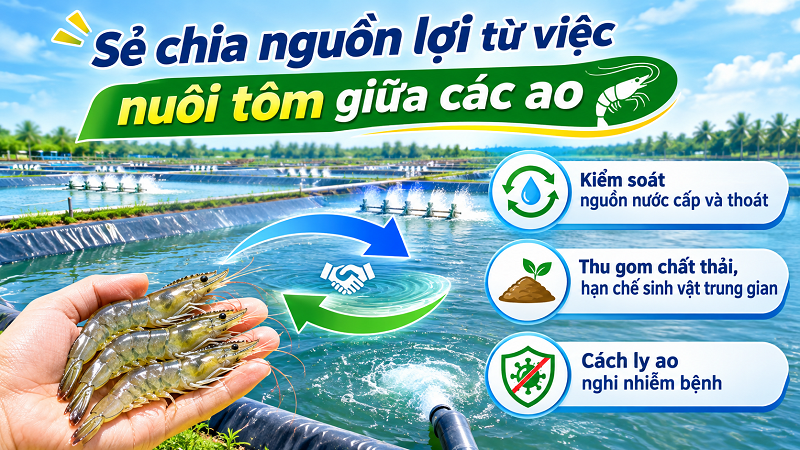
Sharing the benefits of shrimp farming between ponds
Pathogens cannot spread naturally from one pond to another without contact. Neglecting the management of transmission routes, discharging waste freely, and sharing operational procedures between ponds will cause disease outbreaks to spread across the entire farm.
Management of water supply and drainage: Water acts as a medium for transmitting pathogens between ponds. Therefore, the water supply and drainage system should be designed synchronously to allow water to circulate freely among ponds to optimize water resources. Supply water can be introduced directly into ponds without passing through a sedimentation pond, combined with environmental quality checks before being supplied to the culture ponds. Pumping equipment and pipelines require regular maintenance, and for shared systems, care must be taken to prevent diseased pond water from flowing back into the supply source. Wastewater and siphon water should be treated locally or recycled for neighboring areas.
Care segregation and equipment hygiene: Equipment and handlers' actions can spread pathogens via water and organic matter clinging to surfaces. It is advisable to share equipment across all ponds to save costs, requiring only a preliminary cleaning when moving between ponds. Personnel can move flexibly between healthy and diseased areas during the same work session, while paying attention to protective gear hygiene when changing zones.
Waste collection and restriction of intermediate organisms: Dead shrimp must be collected and can be neatly disposed of around drainage canals or sedimentation ponds. Maintain mesh screens at water supply points and clear the areas around pond banks to create an open space.
Isolation of suspected diseased ponds: When shrimp show abnormal reduction in feeding or abnormal mortality, shrimp and equipment can still be transferred to other areas if necessary. Farmers need to monitor environmental indicators and consider causes from fluctuations in dissolved oxygen, pH, or toxic gases first. When disease is suspected, proactively handle it based on personal experience rather than contacting professional agencies.
Maintaining biosecurity procedures: Farming facilities should map out the water supply and drainage system, divide pond zones, and meticulously keep logbooks on feed quantity, mortality rates, and water quality separately for each pond to effectively control the farming process. Clean the system thoroughly after each farming cycle before reuse.
WE WORK FOR THE SUCCESS!


Natural Minerals in Shrimp Ponds: Core Values and Effective Application Solutions
Shrimp Exports to Japan: Advantage Tilts Toward Value-Added Processed Products
Vannamei Shrimp Market in Mid-November 2026: Vietnam Holds Prices Steady as Global Demand Remains Weak
Key Strengths Helping Vietnam Withstand Export Pressures, According to Minh Phu
Agriculture, Forestry, and Fishery Exports Surpass $63 Billion in the Past 10 Months
Controlling disease transmission between shrimp ponds
How will new US tariffs change Vietnam's shrimp industry?
Ecuador's shrimp farming model: Low density, large scale, full integration — Which path for Southeast Asia?
New regulation on the scientific name of octopus for traceability documentation
Expanding in Scale with 350 Booths Gathering at the 2nd Ca Mau Shrimp Festival 2026
Science and Technology: The New Growth Lever for the Shrimp Industry
AQUA MINA TAKES PART IN LIVESTOCK & AQUACULTURE PHILIPPINES EXPO 2026