

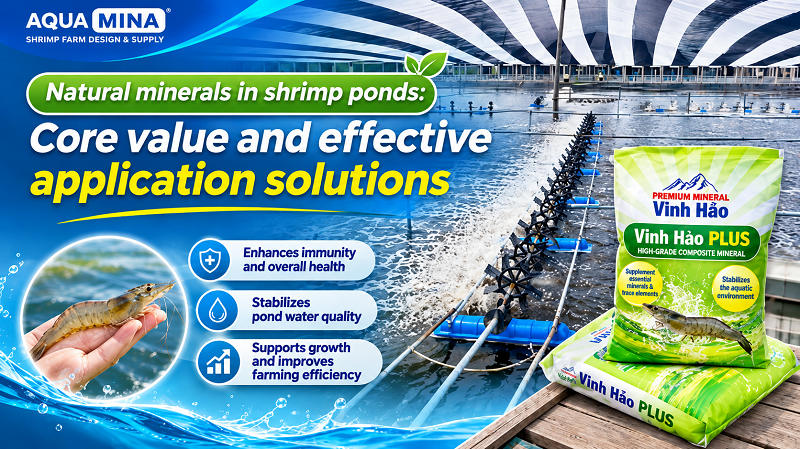
Natural Minerals in Shrimp Ponds: Core Values and Effective Application Solutions
At the workshop “Science and Technology in Aquaculture” organized by the Faculty of Fisheries (Vietnam National University of Agriculture) in Hanoi on October 5, 2026, Mr. Duong Van Thao – representative of Vinh Hao Mineral Company – presented solutions for applying natural minerals in shrimp pond ecosystem management.
1. The Multidimensional Role of Minerals in Ponds
Minerals play a dual role: balancing water ecology and building the shrimp's body structure. In the aquatic environment, minerals promote the growth of diatoms (siliceous algae) as a natural food source (requiring silica levels above 6.4 mg for diatoms to dominate), while stimulating beneficial microorganisms to decompose organic matter, reduce toxic gases, and purify the water.
For shrimp, minerals account for over 8% of dry body weight, forming the shell, hemolymph, nervous system, and muscle tissue. During a farming cycle, shrimp molt 23–30 times, shedding nearly 300 kg of shells per ton of harvested shrimp to grow and eliminate parasites. A hardened shell serves as the primary armor protecting shrimp against pathogens. Furthermore, minerals act as coenzymes that regulate metabolism and detoxification. With fast-growing shrimp strains, frequent molting demands abundant mineral reserves; a deficiency makes shrimp prone to liver failure or Translucent Post-larvae Disease (TPD) within the first 1–2 months, while reducing coloration and commercial value at harvest.
2. Absorption Mechanisms and Molting Cycles
Shrimp absorb minerals through three pathways: via the gills, the digestive tract, and osmosis through the shell post-molting. Because shrimp typically molt at night—when oxygen consumption doubles and mineral uptake peaks to harden the new shell—farmers should apply minerals in the evening for maximum efficiency. Depending on stocking density and shrimp size (from 1,500 pcs/kg at 1–7 days old to 60 pcs/kg at 61–90 days old), supplementation regimens must be tailored to each stage's molting rhythm.
3. Identifying Signs of Mineral Deficiency
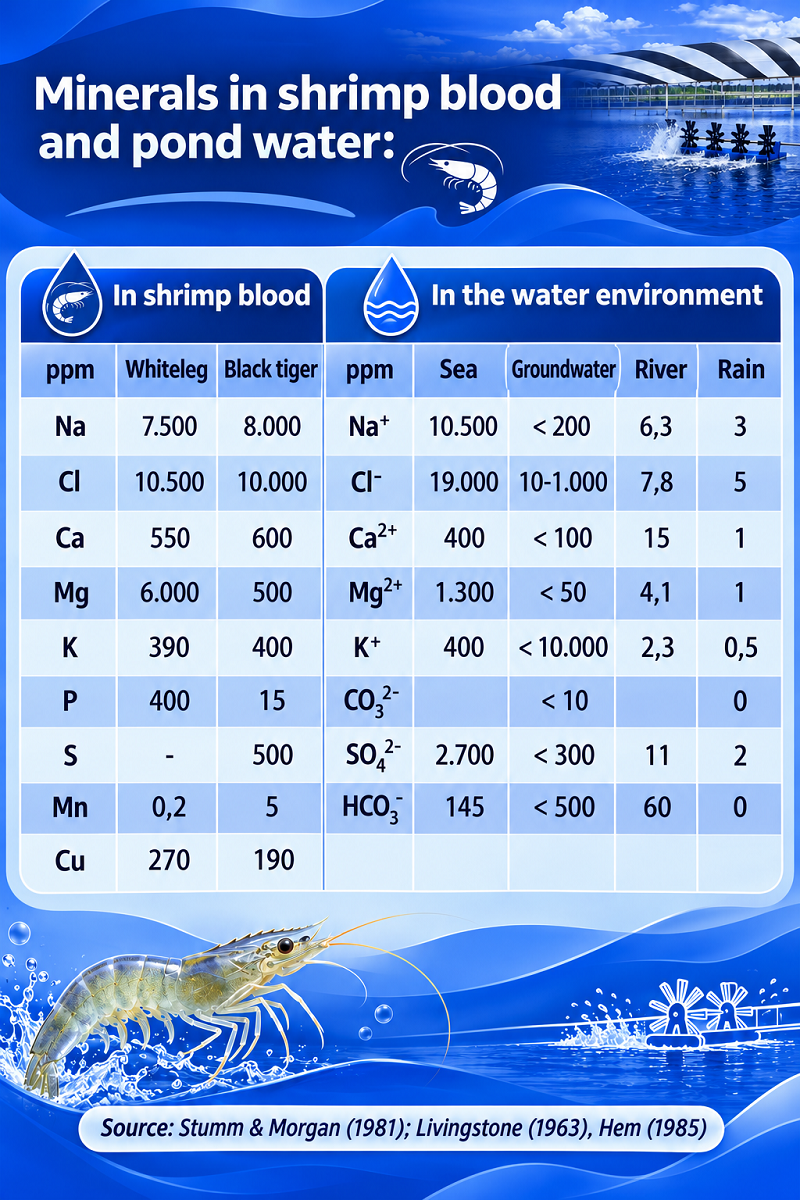
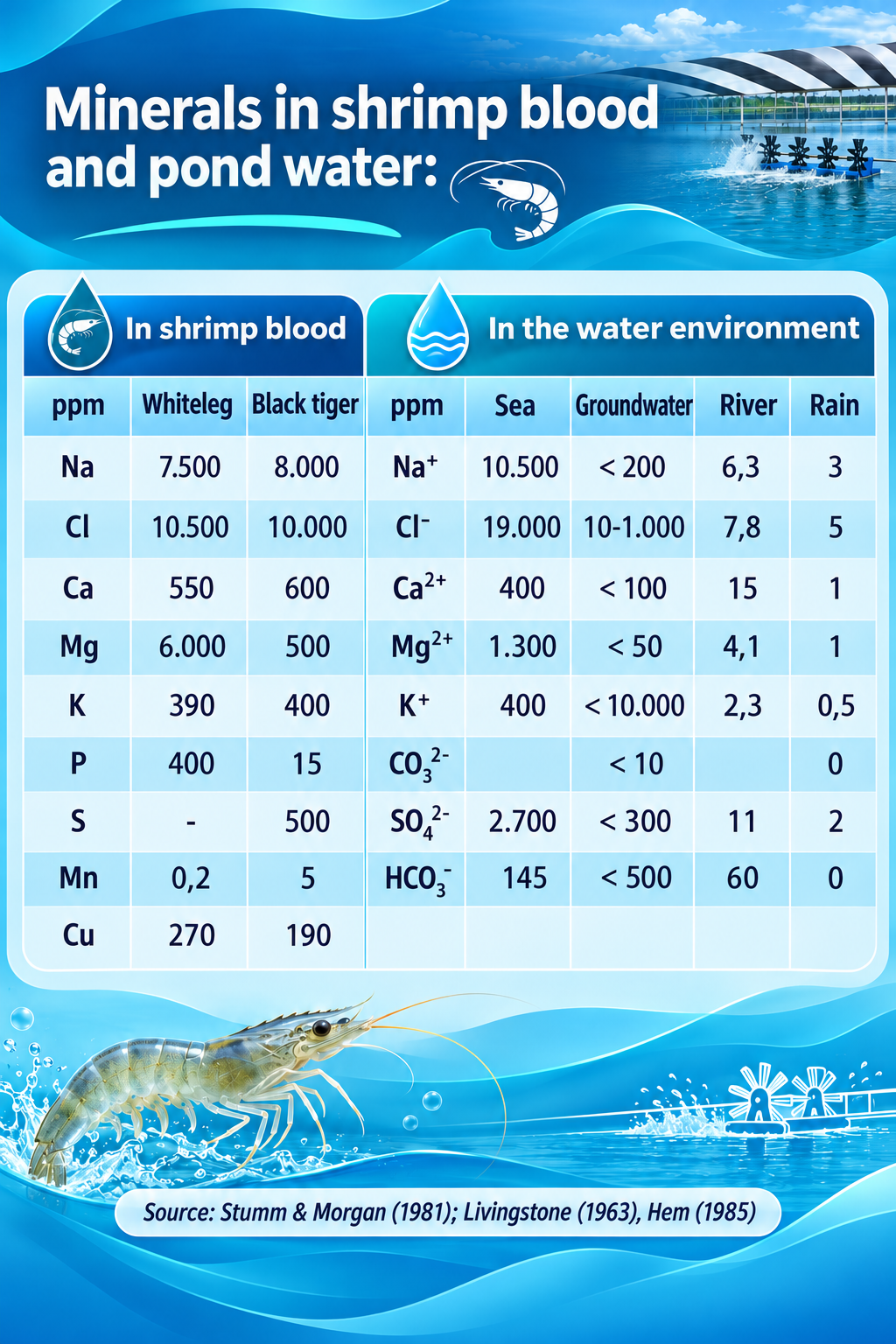
Mineral-deficient shrimp typically exhibit pale coloration (most visible when boiled), white muscle, cramped body, soft shells, loose shells, incomplete molting, black spots, bottom mortality, or muscle necrosis. Sudden algal crashes immediately following mass molting also signal mineral depletion in the pond. Biochemical analysis reveals that magnesium levels in whiteleg shrimp hemolymph reach up to 6,000 ppm (10 times higher than in black tiger shrimp and 10 times the calcium and potassium levels in whiteleg shrimp blood), proving that shrimp possess a strict osmoregulatory mechanism requiring a balanced supply of macro- and micro-minerals.
4. Practical Application of Natural Mineral Solutions
Current trends prioritize natural minerals mined from volcanic deposits or extracted from seawater due to their safety and sustainability:
-
Volcanic Minerals: Contain over 60 macro- and micro-minerals, over 60% silica, and natural bicarbonate. Using vacuum centrifugal grinding technology, ultra-fine mineral particles (32 microns) feature a honeycomb structure with a surface area thousands of times larger than conventional media, providing an ideal habitat for beneficial microbes.
-
Marine-Extracted Minerals: Crystalline calcium ($\text{CaSO}_4$) is 200 times more soluble than $\text{CaCO}_3$, effectively increasing water hardness and clarity. Meanwhile, liquid minerals (specific gravity > 1.3 kg/liter, non-sedimenting) combined with amino acids partially chelate the minerals into organic forms, delivering concentrated magnesium (100,000 mg/liter) and marine trace elements—especially effective in low-salinity ponds, rainy seasons, or nursery stages.
In practice, natural minerals create a buffer system that raises and maintains long-term alkalinity stability (overcoming the post-rain alkalinity drops common with industrial chemicals), restores nutrient-depleted pond bottoms, and stabilizes diatoms. For the shrimp, minerals harden shells, boost immunity, aid in acclimating post-larvae to low salinity, and improve survival rates during transport, yielding harvested shrimp with vibrant coloration and firm meat.
Since minerals cannot self-generate in closed pond systems, proactively applying natural minerals is the core solution for stabilizing the environment, preventing diseases, and maximizing economic efficiency for sustainable shrimp farming.
AQUA MINA CO., LTD
WE WORK FOR THE SUCCESS


Shrimp Exports to Japan: Advantage Tilts Toward Value-Added Processed Products
Vannamei Shrimp Market in Mid-November 2026: Vietnam Holds Prices Steady as Global Demand Remains Weak
Key Strengths Helping Vietnam Withstand Export Pressures, According to Minh Phu
Agriculture, Forestry, and Fishery Exports Surpass $63 Billion in the Past 10 Months
Controlling disease transmission between shrimp ponds
How will new US tariffs change Vietnam's shrimp industry?
Ecuador's shrimp farming model: Low density, large scale, full integration — Which path for Southeast Asia?
New regulation on the scientific name of octopus for traceability documentation
Expanding in Scale with 350 Booths Gathering at the 2nd Ca Mau Shrimp Festival 2026
Science and Technology: The New Growth Lever for the Shrimp Industry
AQUA MINA TAKES PART IN LIVESTOCK & AQUACULTURE PHILIPPINES EXPO 2026
Spotlighting 7 industry giants owning Vietnam's leading high-tech shrimp farming models