

Innovating Sturgeon Farming Models to Unlock New Economic Development Opportunities in Nậm Chày
1. Leveraging Natural Advantages to Develop Sturgeon Farming
In the mountainous commune of Nậm Chày, Lào Cai Province, where local livelihoods primarily depend on agriculture, developing production models suited to natural conditions is becoming an important strategy for increasing incomes and achieving sustainable poverty reduction.
Taking advantage of the cool climate and favorable water resources in certain areas, many ethnic minority households have proactively transitioned to sturgeon farming, gradually establishing a valuable economic activity alongside traditional agricultural production.
In Hỏm Trên Hamlet, the family of Ms. Vàng Thị Chía is among the pioneers of this farming model. On an area of approximately 1,500 m², her family has invested in seven sturgeon ponds and maintained farming operations for nearly two years.
According to Ms. Chía, the model currently generates annual revenue exceeding VND 150 million, helping improve her family's financial situation and providing opportunities for reinvestment. Rather than relying entirely on traditional crops and livestock, the family now has an additional livelihood option suited to local conditions.
In the same hamlet, the family of Mr. Vàng A Đấng has also achieved positive results after nearly three years of sturgeon farming. With five ponds covering approximately 1,000 m², the family earns nearly VND 100 million annually after deducting expenses.
According to Mr. Đấng, suitable climatic conditions and water resources provide significant advantages for sturgeon growth. However, sturgeon farming also requires relatively substantial initial investment, careful husbandry practices, and consistent control of water quality.
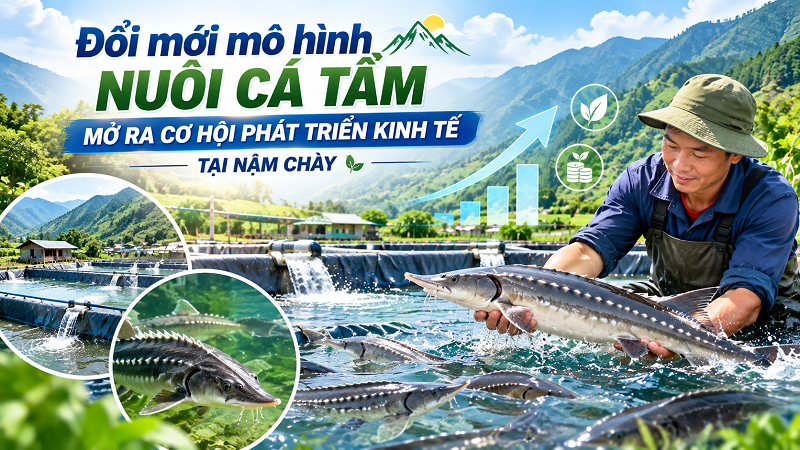
Farmers must regularly monitor water parameters, assess fish growth and health, implement proactive disease prevention measures, and carefully manage feed and labor costs. In addition, fluctuations in selling prices and market demand directly affect economic performance.
Drawing on his experience, Mr. Đấng advises new farmers to thoroughly understand farming techniques, assess their financial resources, learn from experienced producers, and identify reliable markets before expanding production.
The results achieved in Hỏm Trên Hamlet demonstrate that, by effectively utilizing natural advantages and adopting suitable production methods, sturgeon farming can become a promising economic development opportunity for mountainous communities.
2. Diversifying Livelihoods to Build a Foundation for Sustainable Poverty Reduction
According to local statistics, Nậm Chày Commune currently has 998 households with a population of 5,595. Among them, 185 households are classified as poor, accounting for 18.54%, while 144 households are near-poor, representing 14.43%. These figures highlight the need to develop effective livelihood models that match the resources and production conditions of individual households.
As part of its agricultural economic transformation, cold-water fish farming is gradually demonstrating its potential in the area. The commune currently has approximately seven hectares of farming area, with an average yield of 4.28 metric tons per hectare and annual production of approximately 30 metric tons.
According to Mr. La Xuân Thắm, Chairman of the Nậm Chày Commune People's Committee, local authorities are developing plans to organize training courses on farming techniques, fish care, disease prevention, and water quality management. The commune is also focusing on helping residents access market information, establish sales connections, and improve their ability to evaluate investment efficiency.
Sharing practical experience between successful farmers and new participants is also considered an effective measure to minimize production risks.
Despite the encouraging results, sturgeon farming should be developed selectively to avoid unplanned investment driven by short-term trends. In particular, households with limited resources need to carefully consider capital availability, farming area, water supply, and technical capabilities when determining an appropriate production scale.
Beyond production management, establishing stable market outlets plays a decisive role in long-term economic viability. Strengthening cooperation among farming households, purchasing businesses, and distributors will help farmers plan production more proactively while reducing risks associated with market fluctuations.
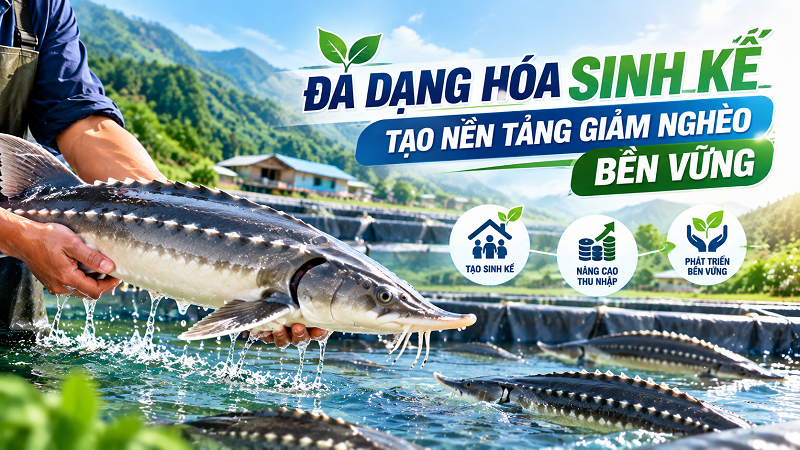
The experience of farming households in Hỏm Trên Hamlet shows that sturgeon farming is creating new economic opportunities for ethnic minority communities. However, maintaining and effectively expanding this model requires a coordinated approach involving natural conditions, farming techniques, financial resources, and market access.
Leveraging local advantages, applying appropriate farming techniques, and establishing stable distribution channels are essential foundations for the long-term development of sturgeon farming in Nậm Chày, contributing to higher incomes and sustainable poverty reduction.
WE WORK FOR THE SUCCESS!


Enhancing Adaptability Towards a Sustainable Shrimp Industry
VASEP and ABRAPES join forces to boost seafood trade between Vietnam and Brazil
How strictly is the chlorine gas management process controlled?
Building 48 Value Chains: Ca Mau Strives for Sustainable Shrimp Farming
Vietnam's shrimp industry is still struggling to achieve self-sufficiency in breeding stock.
EVFTA paves the way for Vietnamese seafood to conquer high-end markets
Russian importers are paying increasing attention to seafood supplies from Pakistan
Ca Mau, Can Tho and An Giang Play a Leading Role in Vietnam’s Shrimp Industry
Protecting rice-shrimp yields against environmental fluctuations caused by prolonged rain
AQUA MINA Turbo Blower: Quiet, Energy-Efficient Air Supply for Aquaculture Ponds
AQUA MINA has accompanied the experimental tank system project at Can Tho University from its very early days
AQUA MINA AMONG 20 OUTSTANDING PRESENTATIONS AT THE WORKSHOP ON APPLYING SCIENCE AND TECHNOLOGY TO IMPROVE THE QUALITY OF VIETNAM’S AQUATIC PRODUCTS