

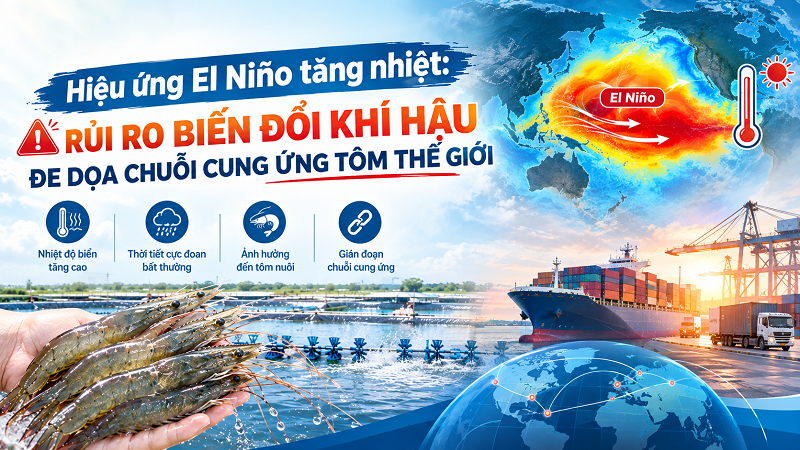
Intensifying El Niño Effect: Climate Change Risks Threaten the Global Shrimp Supply Chain
While stemming from the same climate phenomenon, El Niño manifests vastly different outcomes across various producing regions. Rising temperatures can accelerate shrimp growth under optimal conditions; however, they simultaneously deplete dissolved oxygen levels, fluctuate salinity, and heighten disease risks. Torrential rains cause flooding and dilute pond salinity, whereas prolonged droughts exacerbate salinity levels and strain water availability. Furthermore, El Niño exerts an indirect yet severe impact on feed costs through tightened supplies of fishmeal and fish oil.
El Niño Intensifies Across 2026–2027
According to NOAA’s Climate Prediction Center, the probability of a strong El Niño event persisting through the autumn and winter of 2026–2027 has exceeded 90%, with sea surface temperatures in the eastern equatorial Pacific exceeding 3°C above average and potentially extending into 2027. Rather than affecting the globe uniformly, this climate phenomenon alters atmospheric circulation, precipitation patterns, and local water conditions. The core challenge is not merely how much warmer it gets, but how water availability and salinity fluctuate, alongside the adaptive capacity of each region.
Country-Specific Impacts on Key Producing Hubs:
-
Ecuador: Higher temperatures promote growth within certain thermal thresholds; however, exceeding these limits reduces dissolved oxygen retention, creating stress on shrimp health. The primary risk lies in heavy rainfall causing pond inundation and sudden salinity drops. Consequently, organizations like the Sustainable Shrimp Partnership (SSP) and Ecuador's National Chamber of Aquaculture (CNA) have proactively shifted toward early risk preparedness (focusing on water quality management, algal blooms, and disease detection) rather than reactive responses.
-
India: Highly vulnerable due to erratic monsoon patterns or rainfall deficits triggered by El Niño. In 2026, severe drought and high temperatures in regions like Andhra Pradesh led to depleted dissolved oxygen, stunted shrimp growth, and elevated disease pressure, thereby driving up production costs.
-
Vietnam: The most critical bottleneck centers on the Mekong Delta, where reduced upstream flow from the Mekong River combined with prolonged drought intensifies saltwater intrusion. While shrimp can tolerate a specific salinity range, rapid fluctuations pose the real threat (as emphasized by meteorology expert Reinout van den Born at GSF 2026). This necessitates real-time monitoring of water resources, salinity, and temperature rather than relying on fixed environmental thresholds.
-
Indonesia, Thailand & the Philippines: Facing extended dry seasons, extreme heat, and water scarcity, which impose severe operational pressures on high-density pond management.
The Undercurrent in Shrimp Feed Costs
The most far-reaching impact of El Niño lies within the raw material supply chain for aquafeed. Peru, which typically accounts for roughly 20% of global fishmeal output, set its first-season anchovy quota for 2026 at 1.914 million metric tons. However, due to high proportions of juvenile fish and adverse sea conditions, catches reached only about 439,535 metric tons (23% of the quota) by late April.
According to the FAO, global supplies of fishmeal and fish oil tightened significantly during the first half of 2026. Premium-grade Peruvian fishmeal prices surged to approximately $2,500/ton by May 2026 (up from around $1,400/ton a year prior). Surging feed costs directly erode farmers' profit margins unless farmgate shrimp prices rise proportionally.
From Climate Forecasting to Proactive Farm Governance
El Niño does not yield exclusively negative outcomes; elevated temperatures can shorten culture cycles and boost growth in farming areas where water quality remains well-controlled.
Ultimately, the deciding factor between winners and losers in the shrimp sector during the 2026 El Niño cycle lies not in predicting climate intensity, but in translating climate data into early operational decisions:
-
Extreme Heat: Reduce stocking densities, adjust feeding regimes dynamically, and enhance aeration and oxygen management.
-
Drought & Heavy Rains: Proactively manage water storage, salinity control, and pond water levels.
-
Technology Adoption: Leverage environmental data systems and early warning tools to prevent crises rather than react to them.
For Vietnam, the priority extends beyond surviving a single El Niño event to building long-term resilience across the entire value chain. Sustainable competitive advantages will belong to enterprises capable of optimizing water management, hedging input costs, and making timely operational adjustments based on climate intelligence.
WE WORK FOR THE SUCCESS!


Ca Mau, Can Tho and An Giang Play a Leading Role in Vietnam’s Shrimp Industry
Protecting rice-shrimp yields against environmental fluctuations caused by prolonged rain
AQUA MINA Turbo Blower: Quiet, Energy-Efficient Air Supply for Aquaculture Ponds
AQUA MINA has accompanied the experimental tank system project at Can Tho University from its very early days
AQUA MINA AMONG 20 OUTSTANDING PRESENTATIONS AT THE WORKSHOP ON APPLYING SCIENCE AND TECHNOLOGY TO IMPROVE THE QUALITY OF VIETNAM’S AQUATIC PRODUCTS
Vietnam’s Shrimp Farming Industry Enters the High-Tech Race
The U.S. market relies heavily on imported shrimp to bridge its domestic supply gap
The 2028 supply crisis: The shrimp industry is projected to face a 400,000-ton material shortage
High profits from high-tech shrimp farming come with persistent risks
Evaluating Gaps in the Circular Economy Value Chain of the Shrimp Industry
A Comprehensive Overview of the Vietnamese Shrimp Industry
CA MAU ACCELERATES MARINE AQUACULTURE DEVELOPMENT FROM 2026 TO 2030, WITH A VISION TO 2045


.jpg)