

Vietnam’s Shrimp Farming Industry Enters the High-Tech Race
1. Vietnam’s Shrimp Farming Industry Enters a New Phase of Transformation
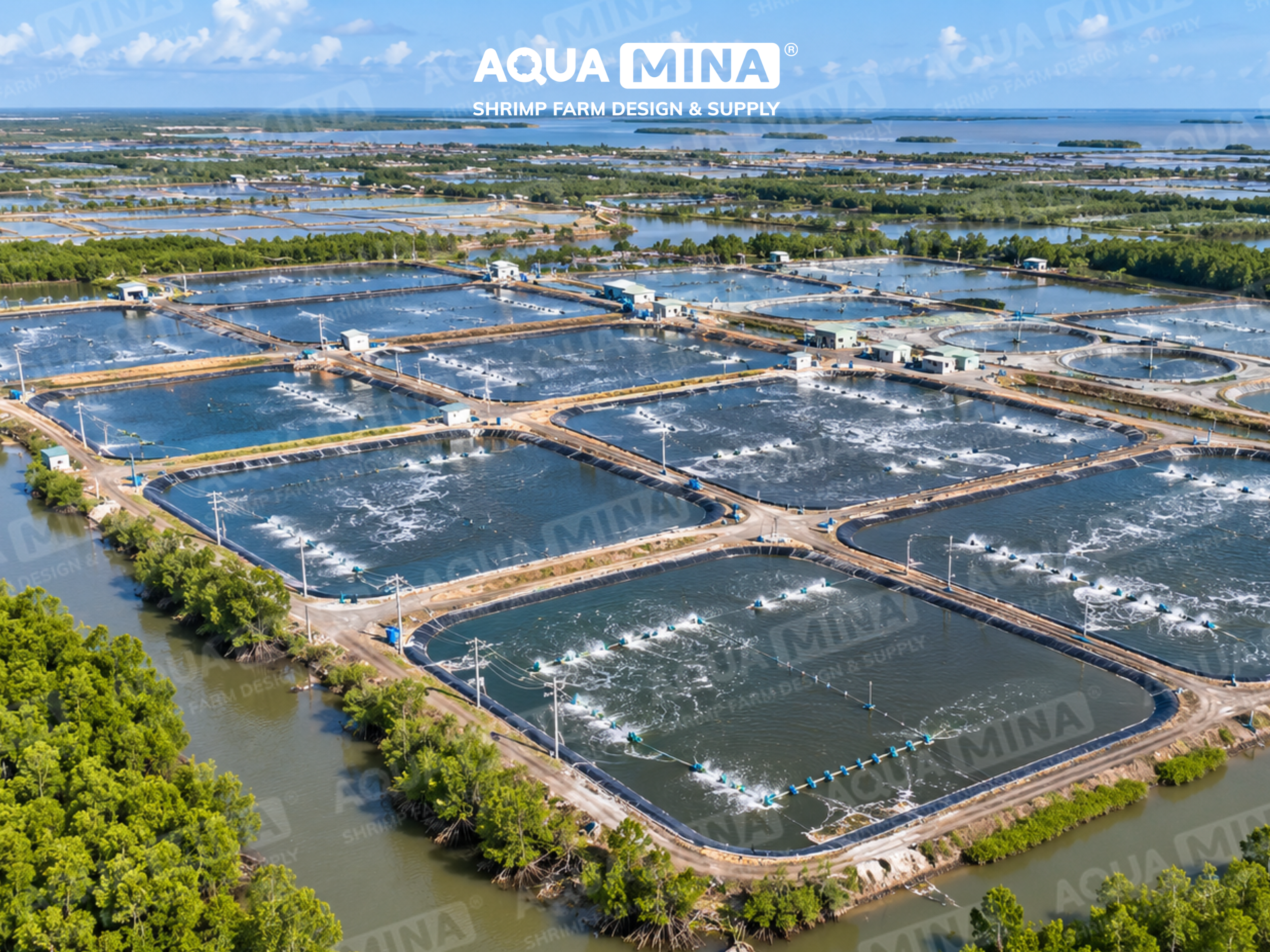
Vietnam’s shrimp farming industry is shifting from production models that rely heavily on natural conditions toward more proactive and better-controlled farming practices.
Unpredictable weather, fluctuating water quality, disease risks, and rising input costs mean that farmers are no longer focused solely on productivity. They are also placing greater emphasis on risk management and control throughout the farming cycle.
These factors are driving the development of high-tech shrimp farming models, particularly in the Mekong Delta. In intensive and super-intensive farms, settling ponds, treatment ponds, culture ponds, paddle wheels, air blowers, bottom aeration systems, automatic feeders, and environmental monitoring equipment are increasingly being invested in as integrated systems.
The goal of technology is not simply to increase stocking density, but also to maintain a stable farming environment, reduce risks, and improve production efficiency.
2. The Mekong Delta as a Key Shrimp Farming Region
.png)
Provinces such as Ca Mau, Bac Lieu, Soc Trang, and Kien Giang are gradually shifting toward farming models with a higher level of environmental and production control.
Ca Mau stands out for its diverse farming models, including intensive shrimp farming, super-intensive farming, shrimp–mangrove systems, and shrimp–rice systems. These models aim to improve economic efficiency while making use of local ecological conditions and adapting to climate change.
Bac Lieu and Soc Trang are focusing on intensive shrimp farming, with increasing adoption of environmental monitoring equipment, aeration systems, and automation technologies.
In Kien Giang, the transition is closely linked to efficient water resource management, environmental control, and improved adaptability to natural conditions.
A common feature across these localities is that technology is being integrated into multiple stages of the farming process rather than being used as isolated pieces of equipment.
3. Key Technologies in Shrimp Farming
.png)
3.1. Water Treatment and Recirculation Systems
Many farms have established separate settling ponds, treatment ponds, and water supply and drainage systems to reduce the risk of introducing uncontrolled water into culture ponds.
Some farming models also combine filtration and water recirculation technologies to reduce the amount of water that needs to be replaced and minimize external environmental impacts. Recirculating Aquaculture Systems (RAS) are also gaining attention in systems that require strict environmental control.
3.2. Biofloc Technology
Biofloc technology uses microbial communities to convert organic matter in the water into microbial biomass.
When properly managed, Biofloc can help improve water quality, reduce water exchange, and utilize part of the microbial biomass as a nutritional source for shrimp. However, this model requires stable aeration systems and frequent environmental monitoring by farmers.
3.3. Oxygen Generation and Aeration Equipment
Oxygen plays a critical role in high-density shrimp farming. As a result, equipment such as paddle wheels, air blowers, bottom aeration systems, and oxygen distribution pipes is becoming increasingly common.
Equipment selection should be based on pond area, stocking density, piping system design, and actual oxygen demand. Simply increasing equipment capacity without considering the pond system can increase electricity costs without necessarily improving overall efficiency.
3.4. Sensor-Based Environmental Monitoring
Sensors can monitor important parameters such as temperature, pH, dissolved oxygen, and salinity.
Data can be transmitted to smartphones or management systems, allowing farmers to detect abnormal changes early and take timely corrective action.
This provides a foundation for moving from experience-based pond management toward data-driven management.
3.5. Automation in Farm Operations
Automatic feeders, paddle wheel control systems, aeration equipment, and electrical control systems can reduce manual operations, save labor, and maintain more consistent farming processes.
For farms with multiple ponds, automation also helps standardize feeding, maintenance, and monitoring across different areas of the farm.
Why Is High-Tech Shrimp Farming Gaining Increasing Attention?
As stocking density increases, the amount of feed, waste, and oxygen demand in the pond also increases. If environmental conditions are not properly controlled, fluctuations in dissolved oxygen, pH, or toxic gases can directly affect shrimp health.
Technology enables farmers to take a more proactive approach to environmental monitoring, feed management, biomass control, and problem management.
High-tech farming models can also support water conservation, reduce labor requirements, improve traceability, and provide better control over production costs throughout each farming cycle.
However, technology investment also requires capital, technical expertise, and appropriate operating procedures. Even a modern system can increase costs without delivering proportional benefits if it is not properly designed for the farm’s actual requirements.
4. Future Trends in Shrimp Farming
High-tech shrimp farming in Vietnam is expected to continue developing in three main directions:
* Environmental control through water treatment systems and monitoring equipment.
* Greater automation in feeding, oxygen generation, and pond operations.
* Data-driven management of feed, biomass, environmental conditions, and production costs.
Vietnam’s shrimp farming industry is rapidly shifting from production methods that depend heavily on natural conditions toward more proactive, controlled, and technology-driven models.
Ca Mau, Bac Lieu, Soc Trang, and Kien Giang are among the regions where this transition is becoming increasingly visible. Water treatment systems, Biofloc, RAS, oxygen equipment, sensors, and automation are playing important roles in improving farm efficiency.
Going forward, the ability to control environmental conditions, optimize costs, and manage farming operations through data will be increasingly important to the competitiveness of Vietnam’s shrimp farming industry.
AQUA MINA CO., LTD
– Address: 685 Le Duc Anh Street, Quarter 39, Binh Hung Hoa Ward, Ho Chi Minh City
– Phone: 1800 6071 (Toll-free hotline)
– Email: sales@aquamina.com.vn or oversea@aquamina.com.vn
– Aqua Mina’s Official Distributor in Japan: REX INDUSTRIES CO., LTD
– Address: 1-9-3 Hishiya-Higashi, Higashi-Osaka 578-0948, JAPAN
– Email: kimakubo@rexind.co.jp
– Phone: +81-(0)72-961-9893
– Website: www.rexind.co.jp/e/
WE WORK FOR THE SUCCESS!
Ngày đăng : 13/10/2026
1651 View


Other Articles
How strictly is the chlorine gas management process controlled?
Building 48 Value Chains: Ca Mau Strives for Sustainable Shrimp Farming
Vietnam's shrimp industry is still struggling to achieve self-sufficiency in breeding stock.
EVFTA paves the way for Vietnamese seafood to conquer high-end markets
Russian importers are paying increasing attention to seafood supplies from Pakistan
Ca Mau, Can Tho and An Giang Play a Leading Role in Vietnam’s Shrimp Industry
Protecting rice-shrimp yields against environmental fluctuations caused by prolonged rain
AQUA MINA Turbo Blower: Quiet, Energy-Efficient Air Supply for Aquaculture Ponds
AQUA MINA has accompanied the experimental tank system project at Can Tho University from its very early days
AQUA MINA AMONG 20 OUTSTANDING PRESENTATIONS AT THE WORKSHOP ON APPLYING SCIENCE AND TECHNOLOGY TO IMPROVE THE QUALITY OF VIETNAM’S AQUATIC PRODUCTS
The U.S. market relies heavily on imported shrimp to bridge its domestic supply gap
The 2028 supply crisis: The shrimp industry is projected to face a 400,000-ton material shortage


.jpg)