

CA MAU ACCELERATES MARINE AQUACULTURE DEVELOPMENT FROM 2026 TO 2030, WITH A VISION TO 2045
Ca Mau is orienting marine and coastal aquaculture to become an important sector of the local marine economy during 2026–2030, with a vision to 2045. The strategy aims to capitalize on more than 310 km of coastline, create new livelihoods for local communities, reduce pressure on nearshore fishing, and increase the value of aquatic products.
.png)
1. Ca Mau has strong potential for marine aquaculture development
With three sides facing the sea, extensive marine areas, islands, and rich intertidal zones, Ca Mau has favorable conditions for developing diverse marine aquaculture models.
Priority aquaculture species
The province plans to develop species such as cobia, grouper, red drum, clams, blood cockles, oysters, and green mussels. Other high-value species, including squid and spiny lobster, will continue to be researched and tested.
Areas around Hon Chuoi and Hon Da Bac are oriented toward cage farming, while coastal intertidal areas are suitable for shellfish farming.
2. Development targets through 2030
Ca Mau aims to develop approximately 0.15 million m³ of marine cage farming capacity, with an estimated production of around 3,000 tons. Coastal shellfish farming is expected to cover approximately 2,200 hectares.
Developing high-tech aquaculture models
The province plans to establish concentrated aquaculture areas applying biosecurity practices and traceability systems, creating a foundation for commercial production and access to domestic and export markets.
3. Accelerating technology adoption in marine aquaculture
Marine aquaculture in Ca Mau is expected to gradually shift from traditional practices toward more controlled and technology-driven production models.
HDPE cages and recirculating aquaculture systems
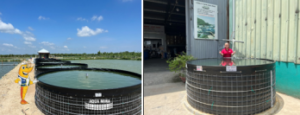
Traditional cages will gradually be replaced by HDPE cages with greater resistance to waves and harsh marine conditions. Onshore farming models may use concrete, composite, or HDPE-lined tanks combined with recirculating aquaculture systems (RAS).
Automatic feeding systems, environmental monitoring, IoT, and GIS are also being considered to monitor water conditions, identify risks, and improve operational efficiency.
Improving traceability
Concentrated farming areas are expected to be assigned farming area codes and adopt standards such as VietGAP, GlobalGAP, or appropriate organic farming standards. Data from seed production and farming to harvesting, transportation, and processing will be better controlled.
4. Marine aquaculture creates new livelihood opportunities for fishermen
Marine aquaculture development is linked to livelihood transition for a portion of nearshore fishermen, helping reduce pressure on natural aquatic resources.
Farming models for clams, blood cockles, and green mussels in coastal areas can be combined with co-management approaches, creating income while contributing to ecosystem protection.
The province also plans to support local communities through technical training, technology access, and financing opportunities for suitable aquaculture models.
5. Building a value chain from farming to market
Ca Mau aims to connect the entire value chain, from seed, feed, materials, and equipment to grow-out farming, harvesting, processing, logistics, and consumption.
The role of businesses and infrastructure
Greater participation from businesses is expected to help stabilize input and output markets while increasing product value. The province also plans to invest in electricity, water supply, communications, mooring facilities, and cold-chain logistics for concentrated aquaculture areas.
6. Vision to 2045
By 2045, Ca Mau aims to establish a modern marine aquaculture sector with concentrated production areas, synchronized infrastructure, and high-tech applications.
Building on its marine, island, and intertidal resources, the province is gradually shifting from extracting natural resources toward creating greater value from the sea. Technology, equipment, environmental management, traceability, and value-chain integration will play an increasingly important role in this development.
Reference: Directorate of Fisheries; Plan for Marine and Coastal Aquaculture Development in Ca Mau Province for 2026–2030, with a vision to 2045.
AQUA MINA CO., LTD
– Address: 685 Le Duc Anh Street, Quarter 39, Binh Hung Hoa Ward, Ho Chi Minh City
– Phone: 1800 6071 (Toll-free hotline)
– Email: sales@aquamina.com.vn or oversea@aquamina.com.vn
– Aqua Mina’s Official Distributor in Japan: REX INDUSTRIES CO., LTD
– Address: 1-9-3 Hishiya-Higashi, Higashi-Osaka 578-0948, JAPAN
– Email: kimakubo@rexind.co.jp
– Phone: +81-(0)72-961-9893
– Website: www.rexind.co.jp/e/
WE WORK FOR THE SUCCESS!
Ngày đăng : 26/09/2026
1632 View


Other Articles
Ca Mau, Can Tho and An Giang Play a Leading Role in Vietnam’s Shrimp Industry
Protecting rice-shrimp yields against environmental fluctuations caused by prolonged rain
AQUA MINA Turbo Blower: Quiet, Energy-Efficient Air Supply for Aquaculture Ponds
AQUA MINA has accompanied the experimental tank system project at Can Tho University from its very early days
AQUA MINA AMONG 20 OUTSTANDING PRESENTATIONS AT THE WORKSHOP ON APPLYING SCIENCE AND TECHNOLOGY TO IMPROVE THE QUALITY OF VIETNAM’S AQUATIC PRODUCTS
Vietnam’s Shrimp Farming Industry Enters the High-Tech Race
The U.S. market relies heavily on imported shrimp to bridge its domestic supply gap
The 2028 supply crisis: The shrimp industry is projected to face a 400,000-ton material shortage
High profits from high-tech shrimp farming come with persistent risks
Intensifying El Niño Effect: Climate Change Risks Threaten the Global Shrimp Supply Chain
Evaluating Gaps in the Circular Economy Value Chain of the Shrimp Industry
A Comprehensive Overview of the Vietnamese Shrimp Industry

.jpg)