

The farming of eels without mud using water recirculation technology helps increase profitability
In recent years, the mud-free eel farming model has become a promising direction in many provinces of the Mekong Delta. Without requiring large areas, making good use of local resources, being easy to manage, highly efficient, and especially applying water recirculation techniques, this model not only reduces fry mortality and disease outbreaks but also increases productivity, generating hundreds of millions of VND in income each year. In Chau Phong commune, An Giang province, Mr. Le Huu Huan invested in mud-free eel farming on an area of just 30 m² with two tanks. With 4,000 eel fry, after one year of care, he harvested over one ton of market-size eels, sold them, and earned a profit of more than 60 million VND. The highlight is that Mr. Huan applied modern water management techniques throughout the farming process, minimizing pathogens and improving eel survival rates. Meanwhile, in Phu Binh commune, Mr. Lam Van Xuan is well-known as an “eel millionaire.” Starting in 2018, he initially failed because he raised eels in nylon tanks with soil, which were difficult to clean and led to disease problems. Not giving up, he switched to mud-free farming in cement tanks lined with tiles, invested in a water exchange system combined with nighttime aeration, and applied probiotics regularly for disinfection.
Currently, Mr. Xuan owns 8 cement tanks for market eels and 10 tanks for fry on a 250 m² area. With stable output and a secure market, he earns more than 300 million VND each year from selling market-size eels and fry. According to Mr. Xuan, the key to mud-free eel farming is strict water quality control. He uses river water treated through a settling pond, changes water twice daily about two hours after feeding, and continuously aerates tanks from 8:00 PM to 5:00 AM. This ensures stable water conditions, keeping eels healthy and growing fast.
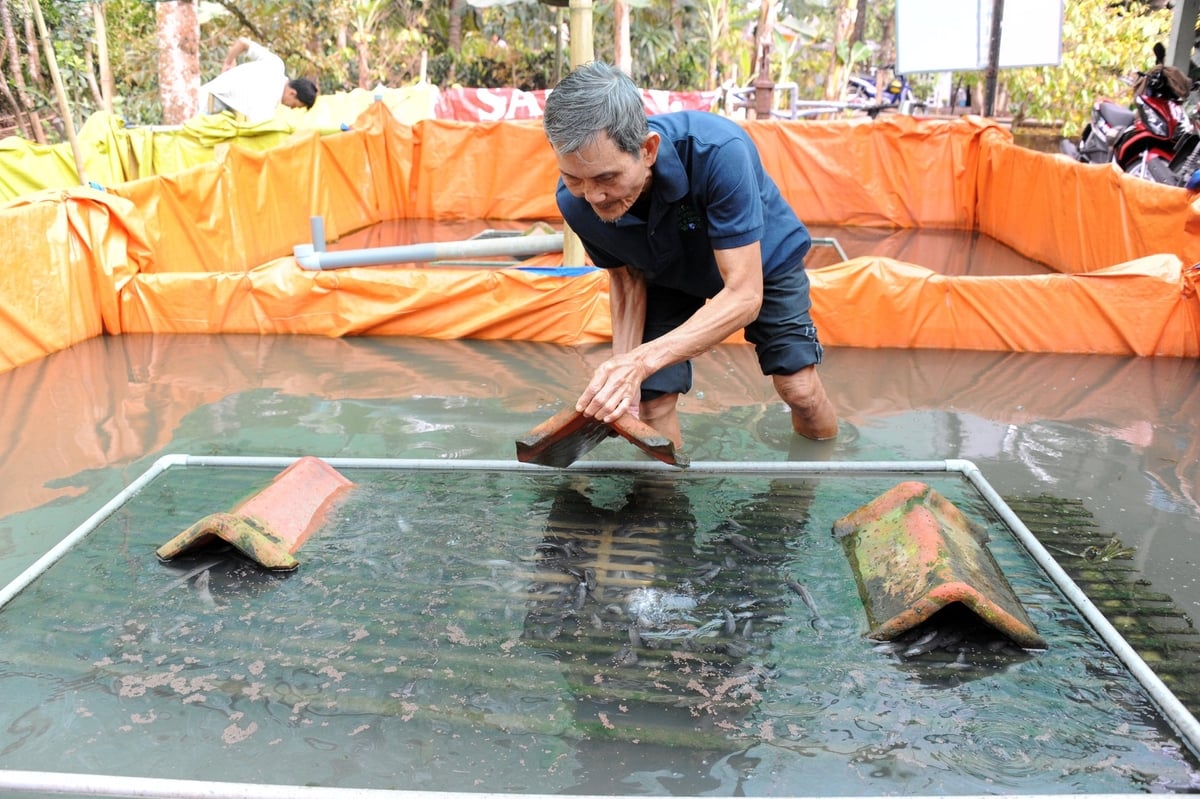
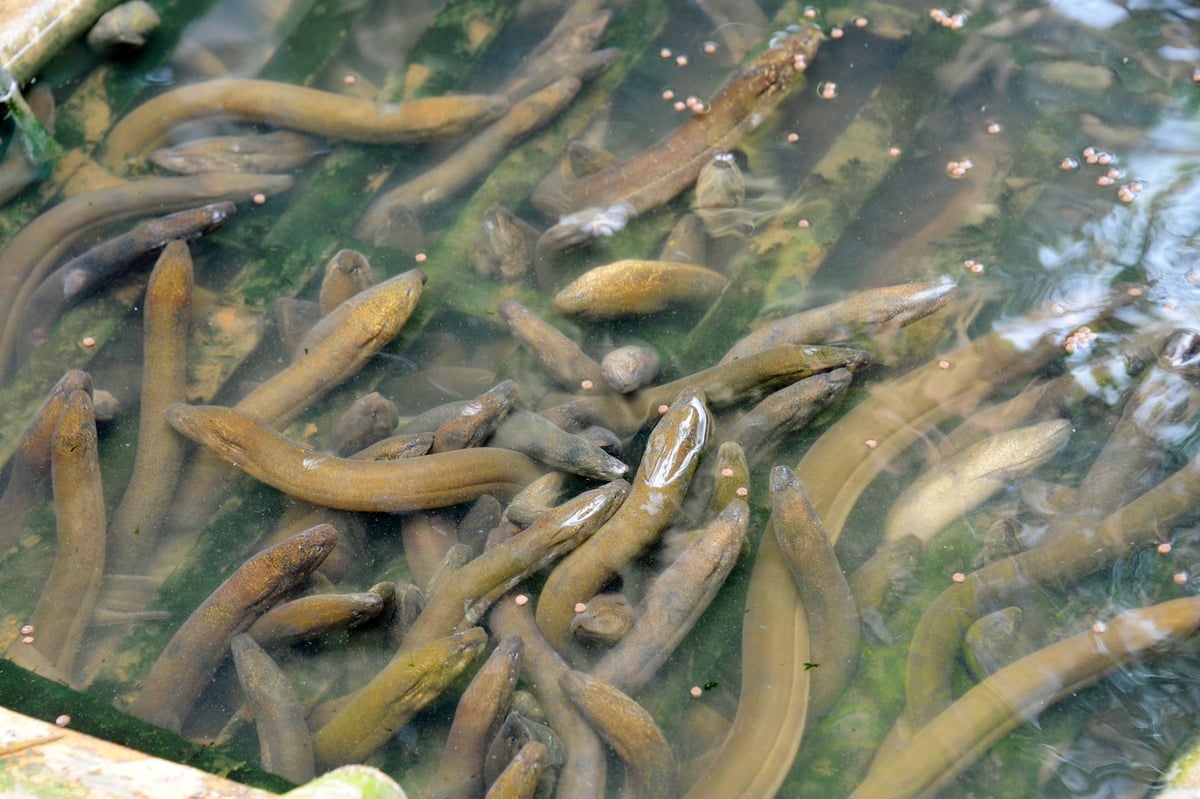
Additionally, he uses a three-layer bamboo raft substrate system, with each layer separated by a brick, creating a natural living space for eels while making cleaning easier. Fry are selected from semi-artificially bred eels with high quality and survival rates. Feed consists of industrial pellets with 40% protein during the first 6 months, then reduced to 30% to give the eels an attractive color at harvest. After 12–13 months of farming, eels reach 4–5 fish/kg, with an average selling price of about 220,000 VND/kg, generating higher economic efficiency compared to many other small-scale livestock models.
Ms. Huynh Dao Nguyen, Director of An Giang Agricultural Extension Center, said that the center has implemented many programs to support and train farmers, guiding them in building mud-free eel farming models following biosecurity principles, water-saving practices, and sustainable market linkages.
Currently, the An Giang Agricultural Extension Center is promoting the expansion of this mud-free eel farming model to gradually replace traditional methods, contributing to stable production, food safety assurance, and enhancing product value in both domestic and export markets.
Source: nongnghiepmoitruong
Aqua Mina's distributor in Japan: REX INDUSTRIES CO., LTD
- Address: 1-9-3 Hishiya-Higashi, Higashi-Osaka 578-0948 JAPAN
- Email: kimakubo@rexind.co.jp
- Phone: +81-(0)72-961-9893
- Website: http://www.rexind.co.jp/e/
WE WORK FOR YOUR SUCCESS!
Ngày đăng : 22/08/2025
2154 View


Other Articles
Ca Mau, Can Tho and An Giang Play a Leading Role in Vietnam’s Shrimp Industry
Protecting rice-shrimp yields against environmental fluctuations caused by prolonged rain
AQUA MINA Turbo Blower: Quiet, Energy-Efficient Air Supply for Aquaculture Ponds
AQUA MINA has accompanied the experimental tank system project at Can Tho University from its very early days
AQUA MINA AMONG 20 OUTSTANDING PRESENTATIONS AT THE WORKSHOP ON APPLYING SCIENCE AND TECHNOLOGY TO IMPROVE THE QUALITY OF VIETNAM’S AQUATIC PRODUCTS
Vietnam’s Shrimp Farming Industry Enters the High-Tech Race
The U.S. market relies heavily on imported shrimp to bridge its domestic supply gap
The 2028 supply crisis: The shrimp industry is projected to face a 400,000-ton material shortage
High profits from high-tech shrimp farming come with persistent risks
Intensifying El Niño Effect: Climate Change Risks Threaten the Global Shrimp Supply Chain
Evaluating Gaps in the Circular Economy Value Chain of the Shrimp Industry
A Comprehensive Overview of the Vietnamese Shrimp Industry


.jpg)