


Shrimp and Pangasius Exports Achieve Double-Digit Growth, but Challenges Are Mounting
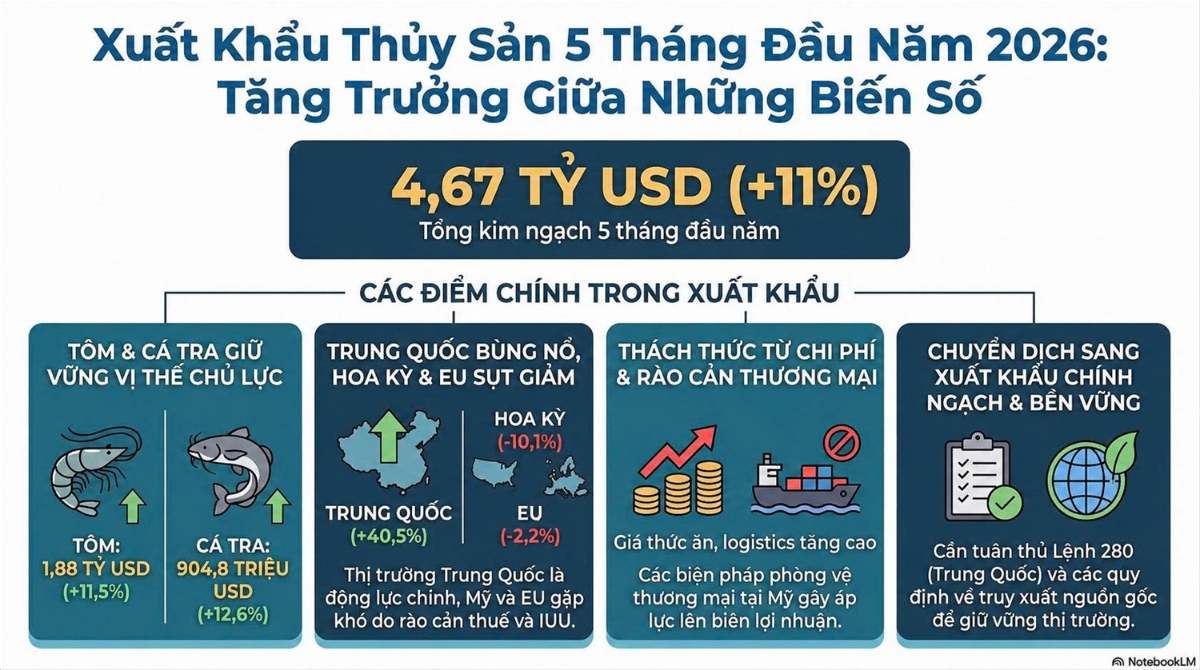
According to the Vietnam Association of Seafood Exporters and Producers (VASEP), Vietnam's seafood exports reached USD 1.02 billion in May 2026, up 0.6% compared to the same period last year. In the first five months of 2026, total seafood export turnover reached USD 4.67 billion, representing an 11% increase year-on-year.
1. SHRIMP REMAINS THE LEADING EXPORT PRODUCT BUT FACES GROWING CHALLENGES
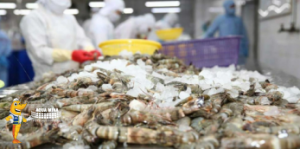
Shrimp continued to be Vietnam's leading seafood export product, generating USD 1.9 billion during the first five months of 2026, up 11.5% and accounting for approximately 40.4% of total seafood export value. Growth was driven by recovering demand in several Asian markets, increased consumption of processed shrimp products, and growing exports of lobster to China.
However, one of the industry's key concerns is the mismatch between domestic production and import demand. Many farming regions are increasingly focusing on large-sized shrimp to maximize product value, while demand in several major markets is shifting toward smaller shrimp for budget-conscious consumers.
At the same time, Vietnamese shrimp continues to face intense competition from Ecuador, India, and Indonesia. U.S. trade defense measures, including anti-dumping duties, countervailing duties, and periodic administrative reviews, are creating additional challenges for the industry.
A positive signal for the pangasius sector is the tightening global supply of whitefish. Pollock production has declined by approximately 30%, while rising fuel costs have pushed raw material prices up by 30–50%. This has increased concerns about supply shortages and may encourage buyers to shift toward farmed species with more stable supply sources, such as pangasius and tilapia.
VASEP reported that pangasius exports reached USD 905 million in the first five months of 2026, up 12.6% year-on-year. The sector benefits from stable supply, competitive pricing, and strong demand in value-oriented consumer markets.
Pangasius continues to show growth potential in China, ASEAN countries, the Middle East, the European Union (EU), and several emerging markets. As global consumers increasingly prioritize affordable food products, pangasius is expected to maintain its position among the leading whitefish species.
Nevertheless, the sector is facing increasing production costs. Fingerling prices have remained high since 2025, while feed, transportation, and other input costs continue to rise. As a result, farmers are becoming more cautious about expanding production. If this trend continues, farming costs may increase further, affecting raw material prices and processing companies' profitability.
2. TUNA EXPORTS DECLINE
In contrast to shrimp and pangasius, tuna exports fell 6% during the first five months of 2026, totaling USD 372 million.
The tuna sector has been heavily affected by shortages of domestic raw materials and increasingly stringent traceability requirements. U.S. regulations concerning marine mammal protection and the Seafood Import Monitoring Program (SIMP), along with EU regulations against illegal fishing, have increased compliance costs, extended documentation procedures, and negatively impacted the ability to secure new orders.
Several other seafood categories posted strong growth during the period. Squid and octopus exports reached USD 304 million, up 18%; crab and other crustacean exports totaled USD 160 million, up 19%; and shellfish exports reached USD 122 million, up 22.8%.
These products are expanding their market share in Japan, South Korea, China, the United States, and the EU, particularly in the processed, convenient, and value-added segments.
However, these categories remain highly dependent on wild-caught raw materials and legally imported seafood. Rising fuel costs, high logistics expenses, and stricter origin certification requirements continue to impact production volumes, raw material prices, and delivery schedules.
3. CHINA LEADS EXPORT GROWTH
China and Hong Kong remained the strongest growth drivers for Vietnam's seafood exports, with export value reaching USD 1.2 billion in the first five months of 2026, up an impressive 40.5% year-on-year.
Growing demand for shrimp, pangasius, crab, shellfish, and other high-value seafood products significantly contributed to the industry's overall performance.
However, the Chinese market is rapidly shifting toward formal import channels with stricter requirements regarding product quality, biosecurity, business registration, farming area codes, and traceability.
The implementation of Decree 280, effective June 1, 2026, replacing Decree 248, signals that future export growth to China will increasingly depend on compliance and standardization.
Vietnam's seafood exports to Japan increased by 0.4%, South Korea by 4%, and ASEAN countries by 16.8%. Meanwhile, exports to the United States declined 10% to USD 689 million, while exports to the European Union fell 2.2% to USD 435.6 million.
Both markets continue to impose significant pressures related to tariffs, trade defense measures, traceability, food safety standards, anti-IUU regulations, and sustainability requirements.
Based on the first five months' performance, VASEP forecasts Vietnam's seafood exports could grow by approximately 8–10% in 2026, pushing total export value beyond USD 12 billion.
To achieve this target, the seafood industry will need to maintain strong demand from China, strengthen pangasius competitiveness, improve shrimp sector performance, and address challenges related to illegal fishing (IUU), raw material certification, and traceability requirements for seafood products.
Source: VnEconomy

WE WORK FOR THE SUCCESS


Ca Mau, Can Tho and An Giang Play a Leading Role in Vietnam’s Shrimp Industry
Protecting rice-shrimp yields against environmental fluctuations caused by prolonged rain
AQUA MINA Turbo Blower: Quiet, Energy-Efficient Air Supply for Aquaculture Ponds
AQUA MINA has accompanied the experimental tank system project at Can Tho University from its very early days
AQUA MINA AMONG 20 OUTSTANDING PRESENTATIONS AT THE WORKSHOP ON APPLYING SCIENCE AND TECHNOLOGY TO IMPROVE THE QUALITY OF VIETNAM’S AQUATIC PRODUCTS
Vietnam’s Shrimp Farming Industry Enters the High-Tech Race
The U.S. market relies heavily on imported shrimp to bridge its domestic supply gap
The 2028 supply crisis: The shrimp industry is projected to face a 400,000-ton material shortage
High profits from high-tech shrimp farming come with persistent risks
Intensifying El Niño Effect: Climate Change Risks Threaten the Global Shrimp Supply Chain
Evaluating Gaps in the Circular Economy Value Chain of the Shrimp Industry
A Comprehensive Overview of the Vietnamese Shrimp Industry










.jpg)