

Smart Nutrition: Shaping the Future of Sustainable Aquaculture
Reporter: As the aquaculture industry enters its 4.0 transformation phase, how should smart nutrition be understood? What sets it apart from traditional nutrition solutions?
Dr. Nguyen Duy Hoa: Smart Nutrition is a new approach in aquaculture that combines precision nutrition science with data, sensor technology, digital tools, and artificial intelligence to build optimal diets tailored to the animal's biological needs and real farming conditions — aiming to simultaneously optimize productivity, animal health, economic efficiency, and sustainability across the whole value chain.
For years, the aquafeed industry focused mainly on meeting protein, lipid, vitamin, and mineral requirements. However, a smart nutrition solution must address more: Is the animal absorbing nutrients optimally? Is gut microbiota improving? Is resistance to stress and disease increasing? Is waste output and greenhouse impact being reduced? And ultimately, is the farmer's profitability being optimized?
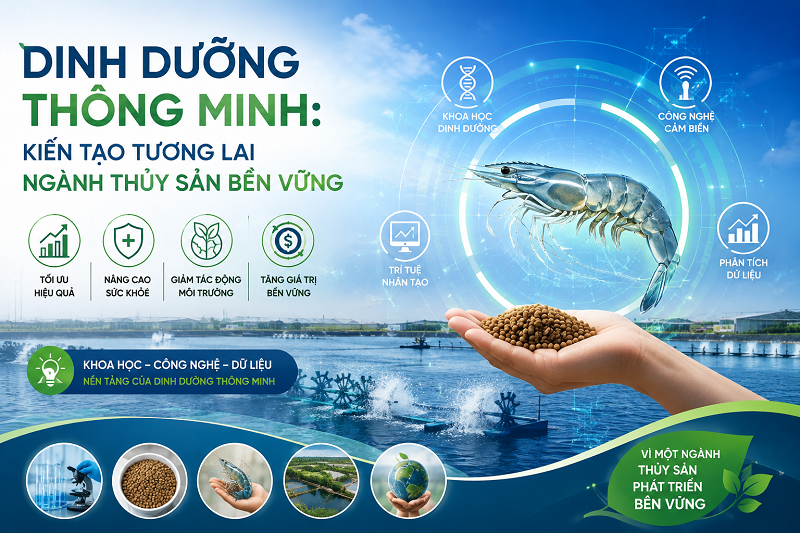
The core difference lies in approach. Traditional solutions optimize feed ingredient composition to meet nutritional needs while controlling formulation costs; smart nutrition instead targets the final outcome of the entire production system — requiring precision nutrition science, high-bioavailability ingredients, functional additives, modern production technology, and data analytics capability to generate maximum value per kilogram of feed used.
Reporter: For farmers, production efficiency isn't determined by feed price alone but by optimizing the whole farming process. How can smart nutrition improve economic outcomes?
Dr. Nguyen Duy Hoa: That's a very accurate and important point. In practice, feed accounts for about 50–60% of total farming costs, but farmers don't generate profit from buying cheaper feed — they generate it from producing more output at optimized cost. So what matters isn't the price per kilogram of feed, but the cost of producing one kilogram of market-size shrimp or fish.
A smart nutrition program can improve economic efficiency through multiple simultaneous factors: applying precision nutrition science, building feeding strategies grounded in animal biology, and integrating modern technologies like sensors, digital tools, and AI. These improve water quality, boost animal health, and increase nutrient utilization efficiency — ultimately raising yield per unit area and lowering production cost per kilogram of weight gain.
For shrimp, for example, nutritional science should focus especially on the first 45 days to improve survival rate through to harvest. A strong health foundation early in the crop also improves growth in later stages.
Notably, small improvements in survival rate or feed conversion ratio (FCR), when applied at scale across thousands of tons of feed or hundreds of hectares, can generate substantial economic value — which is why more businesses now evaluate a nutrition solution by Return on Investment (ROI) rather than just sale price.
Reporter: Export markets increasingly emphasize sustainability, traceability, and carbon footprint. How can nutrition contribute to reducing the industry's environmental impact?
Dr. Nguyen Duy Hoa: Carbon footprint reflects not just CO2 but also methane, nitrous oxide, and fluorinated gases, all converted into CO2-equivalent per unit of product. In aquaculture, carbon footprint results from multiple factors: feed, farming systems, production technology, and processing.
On the feed side, nutrition plays a key role — not only by reducing high-carbon-footprint ingredients in formulations, but also by building nutrition programs that improve digestion and absorption, thereby reducing waste output and greenhouse gas emissions.
This impact reduction should be viewed broadly: cutting greenhouse emissions, limiting nitrogen and phosphorus discharge, and reducing pressure on biodiversity and natural resources. For instance, although fishmeal has a lower carbon footprint than some plant proteins like soybean, the trend toward reducing fishmeal dependency continues, since overexploitation threatens wild fish stocks, ecosystems, and fisheries biodiversity.
Nutrition is therefore a key lever for industry sustainability. Choosing traceable, low-emission, responsibly sourced ingredients benefits the entire value chain. Precision nutrition also reduces nitrogen and phosphorus discharge — better digestibility means more efficient nutrient use, lower FCR, and less raw material needed per kilogram of seafood produced.
I believe that in the near future, every feed formula will come not just with a nutrient composition table but also carbon footprint metrics, traceability data, and ESG indicators — becoming a key competitive advantage internationally.
Reporter: Could aquaculture move toward a fully tailored nutrition model — solutions customized to each species, growth stage, and specific production condition?
Dr. Nguyen Duy Hoa: I believe this is an inevitable trend. Feed will no longer be a fixed product but a flexible solution optimized for specific production conditions.
The industry is shifting from one formula fits all to Precision Nutrition — designed around species, genetics, growth stage, environmental conditions, water quality, stocking density, farming system (intensive, semi-intensive, extensive), and technology (Biofloc, RAS, water-exchange systems, etc.).
As farm data is continuously collected and analyzed, feed formulas can be adjusted in real time to more precisely meet the animal's needs and production goals.
Reporter: How will data, AI, and automation reshape nutrition management and farm operations going forward?
Dr. Nguyen Duy Hoa: AI will drive a major shift in nutrition management and overall production operations, enabling farmers to monitor and manage operations remotely more effectively.
Sensors, underwater cameras, environmental monitoring systems, and automatic feeders will continuously supply data on water quality, feeding behavior, growth rate, and animal health. This data will feed into decision-support software combined with AI for real-time analysis — generating recommendations on feed amount, timing, and type, while forecasting stress or disease risk early. This reduces feed waste, stabilizes pond conditions, improves nutrient efficiency, and lowers production risk. In the future, feed will become part of a digital management ecosystem where nutrition, environment, and animal health are managed as one unified system.
Reporter: From a technical standpoint, what research trends in aquafeed nutrition are most likely to drive major changes ahead?
Dr. Nguyen Duy Hoa: Five key trends will shape aquaculture nutrition over the next decade:
- Next-generation innovative proteins — fermented protein, single-cell protein, insect protein, algae/seaweed protein, bacterial protein, and upcycled proteins — reducing dependence on marine resources while improving animal health and performance.
- Precision Nutrition — shifting focus from crude protein content to digestible amino acids, bioactive peptides, and real nutrient utilization efficiency.
- Functional nutrition — improving gut health, immunity, and stress resistance through postbiotics, antioxidants, natural antimicrobials, and targeted vitamin/mineral supplementation, reducing antibiotic reliance.
- Digital Nutrition — big data, AI, and predictive models supporting the development and real-time adjustment of farm-specific nutrition programs.
- Produce More with Less — the overarching goal: more output, fewer resources, lower emissions, and better economic efficiency — the path to long-term industry sustainability.
AQUA MINA CO., LTD
WE WORK FOR THE SUCCESS


Ca Mau, Can Tho and An Giang Play a Leading Role in Vietnam’s Shrimp Industry
Protecting rice-shrimp yields against environmental fluctuations caused by prolonged rain
AQUA MINA Turbo Blower: Quiet, Energy-Efficient Air Supply for Aquaculture Ponds
AQUA MINA has accompanied the experimental tank system project at Can Tho University from its very early days
AQUA MINA AMONG 20 OUTSTANDING PRESENTATIONS AT THE WORKSHOP ON APPLYING SCIENCE AND TECHNOLOGY TO IMPROVE THE QUALITY OF VIETNAM’S AQUATIC PRODUCTS
Vietnam’s Shrimp Farming Industry Enters the High-Tech Race
The U.S. market relies heavily on imported shrimp to bridge its domestic supply gap
The 2028 supply crisis: The shrimp industry is projected to face a 400,000-ton material shortage
High profits from high-tech shrimp farming come with persistent risks
Intensifying El Niño Effect: Climate Change Risks Threaten the Global Shrimp Supply Chain
Evaluating Gaps in the Circular Economy Value Chain of the Shrimp Industry
A Comprehensive Overview of the Vietnamese Shrimp Industry


.jpg)