



What is the difference between a butterfly valve and a knife gate valve?
1. Introduction: What are butterfly valves and knife gate valves used for?
In water supply and drainage, water treatment, and aquaculture systems, both butterfly and knife gate valves are used to open, close, or control flow. However, these two types of valves have different structures, operating mechanisms, and application scopes.
Choosing the right valve not only helps the system operate stably but also limits leaks, valve jamming, or maintenance difficulties. So, what is the difference between a butterfly valve and a knife gate valve? When should each type be used?
2. What is a butterfly valve?
A butterfly valve is a type of valve that uses a circular disc mounted on an axis to open or close the flow. When turning the lever, handwheel, or actuator, the disc rotates around the axis:
-
Valve open: The disc rotates parallel to the flow.
-
Valve closed: The disc rotates perpendicular to the flow.
Advantages of butterfly valves
-
Compact design.
-
Relatively lightweight.
-
Fast opening and closing.
-
Easy to install.
-
Suitable for many piping systems.
-
Available for various pipe sizes.
Limitations
Because the disc sits directly in the flow, a portion of it remains inside the pipe even when fully open. This can affect the flow cross-section and makes the valve less optimal for systems containing substantial solids or sediment.
3. What is a knife gate valve?
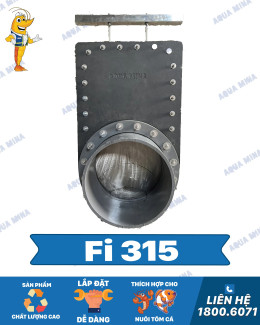
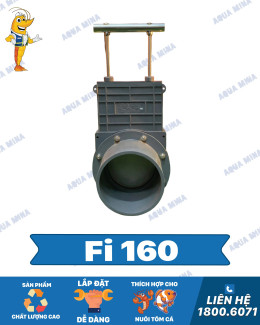
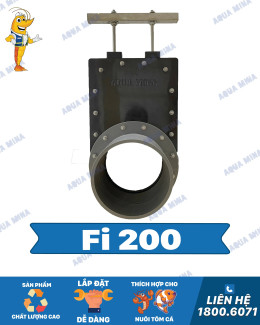
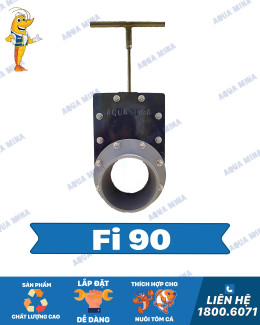
A knife gate valve uses a thin, blade-like gate that lifts or lowers to open and close the flow. Unlike butterfly valves, the gate moves vertically. When fully open, the gate is completely lifted out of the flow. When closed, the gate lowers to form a barrier.
Outstanding advantages of knife gate valves
-
Design suited for environments with sediment or solids.
-
Gate is completely removed from the flow path when fully open.
-
Ability to minimize material buildup at the opening/closing position.
-
Suitable for water treatment, sludge, waste systems, and specific aquaculture applications.
-
Wide range of material and size options.
Limitations
-
Opening/closing speed is usually slower than butterfly valves.
-
Requires clearance space along the lifting direction of the gate.
-
Not all types are suitable for continuous flow regulation.
4. Comparison: Butterfly Valve vs. Knife Gate Valve
| Criteria | Butterfly Valve | Knife Gate Valve |
| Opening/closing mechanism | Rotating disc | Lifting/lowering gate |
| Movement | Rotates around an axis | Vertical |
| Design | Compact | Valve body is typically taller |
| Opening/closing speed | Fast | Slower |
| Flow path | Disc remains in the flow | Gate is lifted out of flow when open |
| Sediment environments | Depends on the application | More suitable in many cases |
| Sludge/solids | Limited depending on design | Usually holds the advantage |
| Installation space | Space-saving | Requires extra overhead height |
| Common applications | Water, gas, standard pipelines | Sludge, wastewater, solids, specialized systems |
Note: Actual effectiveness also depends on the specific design, sealing material, pressure, temperature, pipe size, and fluid characteristics.
5. When should you choose a butterfly valve?
A butterfly valve is a suitable choice when the system requires:
-
Fast pipeline opening and closing.
-
A compact and space-saving design.
-
Handling of clean water or liquids with relatively little sediment.
-
High frequency of opening/closing operations.
-
Easy operation and maintenance.
Examples: Water supply systems, circulation pipes, or specific water treatment systems.
6. When should you choose a knife gate valve?
A knife gate valve is generally considered when the system transports media containing:
-
Sludge.
-
Sediment.
-
Suspended solids.
-
Wastewater.
-
Mixtures with a certain viscosity or solid content.
In aquaculture, knife gate valves can be applied in locations that require opening/closing water flows, discharging sediment, or separating pipeline routes depending on the system's design.
7. Which is better: Butterfly valve or knife gate valve?
There is no absolute answer as to which is better. Butterfly valves are ideal when prioritizing a compact design, fast operation, and standard piping systems. Meanwhile, knife gate valves hold the advantage when processing fluid streams containing sediment, solids, or wastewater, where the knife-like gate structure is highly effective.
Therefore, the most important criterion is not which valve is better, but rather which valve is best suited for the fluid and operating conditions of your system.
8. Factors to consider before choosing a valve
Before purchasing a valve, you should evaluate at least these factors:
-
1. Fluid Media: Clean water, wastewater, sludge, sediment, or environments with solids will have different requirements.
-
2. Pipe Size: You must select a valve that matches the diameter and connection standards of the system.
-
3. Working Pressure: Do not choose a valve based solely on size. Check the actual working pressure requirements.
-
4. Operating Frequency: If the valve must be opened and closed frequently, operating speed and the actuation mechanism are crucial considerations.
-
5. Material: The materials of the valve body, gate/disc, and seals must be compatible with the operating environment to increase durability and prevent corrosion.
9. Conclusion
Both butterfly and knife gate valves play a role in opening and closing flow, but they are not entirely interchangeable. If prioritizing a compact design, rapid operation, and use in standard pipelines, the butterfly valve is a strong candidate. If the system frequently handles sludge, sediment, wastewater, or solid-containing fluids, the knife gate valve offers distinct advantages due to its blade-like gate structure. Choosing the right valve from the start ensures stable system operation, reduces maintenance costs, and extends equipment lifespan.
FAQ – Frequently Asked Questions
-
Can a knife gate valve replace a butterfly valve? Not in all cases. The two valves have different structures and operating characteristics. The decision must be based on the fluid, pressure, pipe size, and intended use.
-
What is a knife gate valve used for? Knife gate valves are primarily used to open or close flow in systems that may contain sediment, sludge, solids, or wastewater.
-
Are butterfly valves suitable for shrimp farming systems? They can be suitable in standard water pipelines depending on the system design. However, if the water contains a lot of sediment or requires solid waste discharge, further evaluation is needed before selection.
-
Can a knife gate valve be used to regulate flow? Knife gate valves are fundamentally better suited for on/off functions. If continuous flow regulation is required, a valve specifically designed for regulation should be chosen.
AQUA MINA CO., LTD

WE WORK FOR THE SUCCESS


AQUA MINA Concludes 4-Day Training Course in Khanh Hoa – Promoting Effective Aquaculture Solutions
Day 3 | AQUA MINA continues to organize the training course on "HDPE Liner Floating Circular Ponds" in Dai Lanh, Khanh Hoa.
Day 2: AQUA MINA Continues Its Technology Transfer Journey, Accompanying Local Farmers in Khanh Hoa
Day 1: AQUA MINA Launches the Technical Training Series "Tarpaulin-lined Raised Circular Ponds" in Khanh Hoa
Whiteleg Shrimp Prices Plunge to Record Lows, Testing Even Veteran Farmers
Revitalizing underperforming shrimp farming areas for sustainable growth
Fish, shrimp, crabs… still have to bear the heavy burden of logistics costs.
AQUA MINA, in collaboration with the Department of Science and Technology of Khanh Hoa Province, organized a training workshop
9 Years of a Journey Reaching Further Every Day AQUA MINA
AQUA MINA spreads the spirit of sport – Together conquering the 10km distance at the VPBank Ho Chi Minh City Music Half Marathon 2026
Smart Nutrition: Shaping the Future of Sustainable Aquaculture
When should you upgrade to the new-generation oxygen aeration system?




.jpg)