

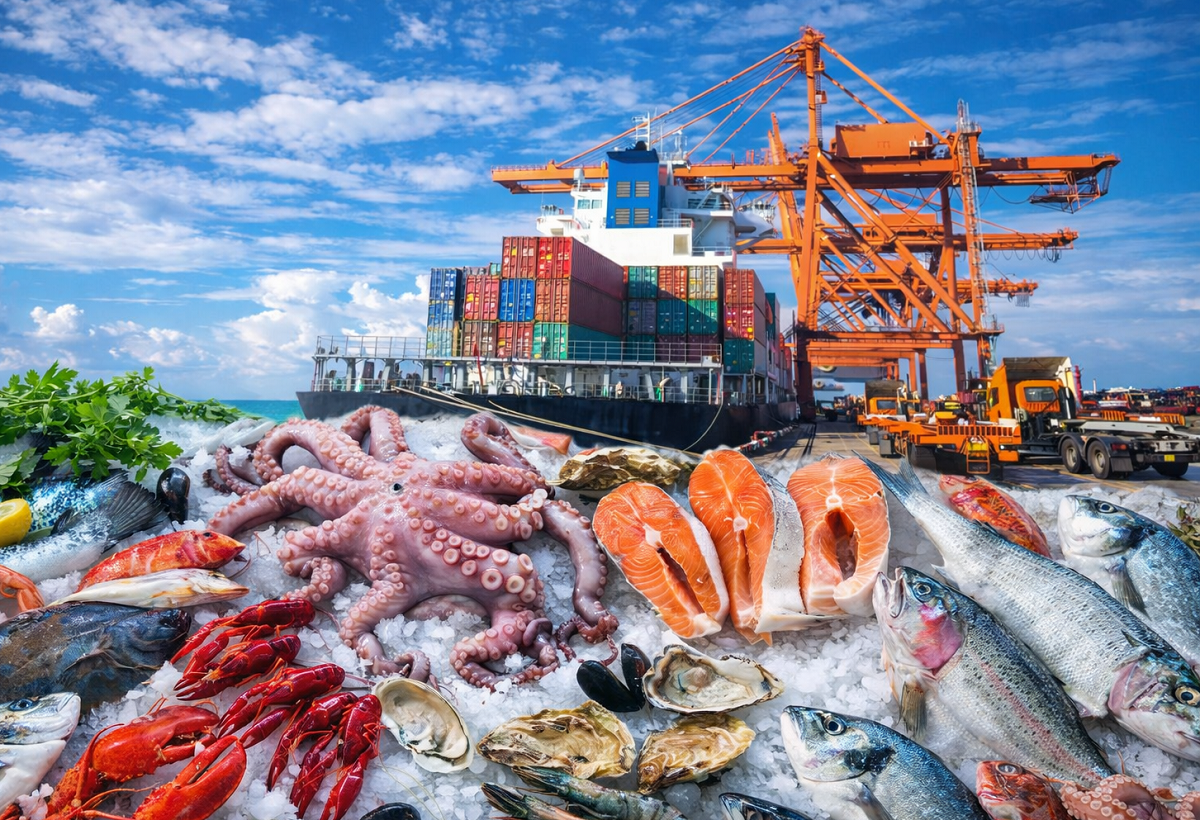
Seafood Exports Rise Over 10%, Crabs Gain Greater Access to the U.S. Market, Shrimp Continues to Face Pressure
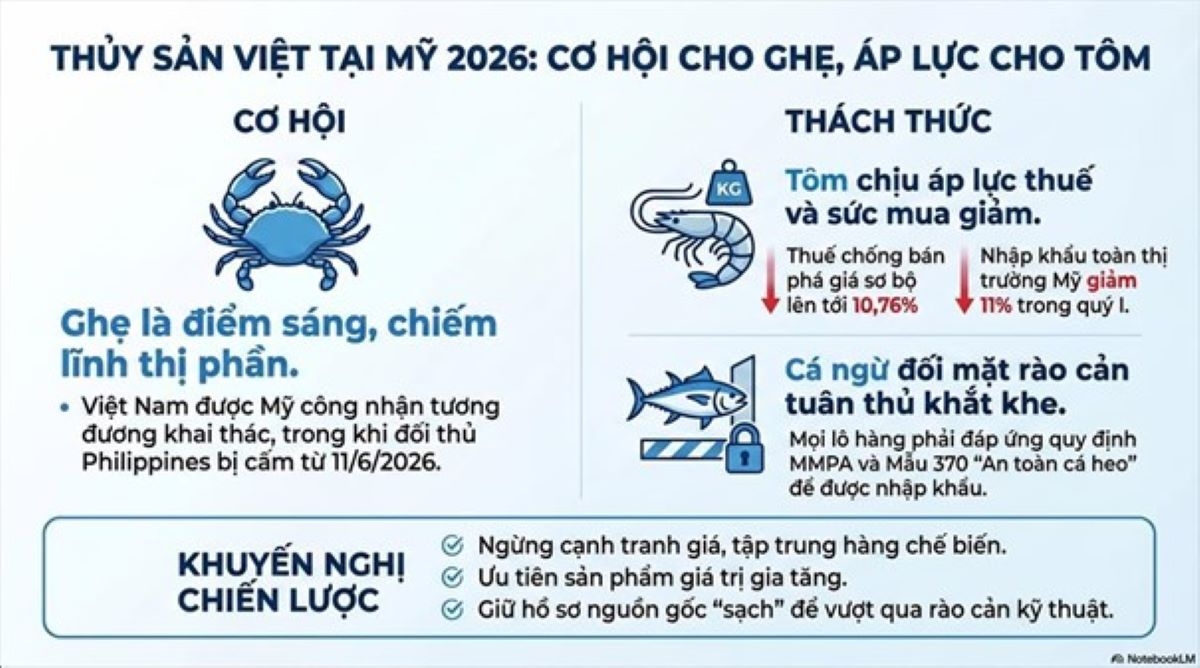
The Vietnam Association of Seafood Exporters and Producers (VASEP) reported that one of the most positive developments in May 2026 was the decision by the U.S. National Oceanic and Atmospheric Administration (NOAA) to recognize Vietnam’s crab fishery as equivalent to U.S. standards. As a result, crabs and crab products harvested from Vietnam can continue to be imported into the United States.
CRABS SEE MAJOR OPPORTUNITIES IN THE U.S. MARKET
Notably, while Vietnam received equivalency recognition, the Philippines did not obtain approval for its related crab fisheries and will face an import ban starting June 11, 2026. This creates a significant short-term opportunity for Vietnamese crab exporters, as U.S. importers are expected to shift sourcing toward approved suppliers such as Vietnam, Indonesia, and Sri Lanka.
Industry experts believe this is an ideal time for Vietnamese companies to secure contracts for the third quarter of 2026 while strengthening communication with U.S. partners regarding the legality of raw material sources, fishing vessel identification codes, and traceability documentation.
In contrast, shrimp remains the most challenged seafood product in the U.S. market. Preliminary results from the 20th administrative review released by the U.S. Department of Commerce on May 13, 2026, showed provisional anti-dumping duties of 10.76% and 6.30% for the two mandatory respondents, while companies eligible for separate rates face a duty rate of 7.56%.
Although these are not final results, the duty levels have increased pressure on price negotiations and affected purchasing sentiment among U.S. importers. This suggests that market demand has not recovered strongly enough to absorb rising costs and prices, leading importers to remain cautious about placing new orders.
For tuna and several other wild-caught seafood products, current challenges are driven less by supply and demand and more by U.S. regulatory requirements.
According to NOAA, all frozen or processed tuna shipments imported into the United States must be accompanied by Form 370, declaring that the products are “dolphin-safe,” along with supporting documentation. This requirement is enforced under the Marine Mammal Protection Act (MMPA). As a result, maintaining orders and market share depends heavily on companies’ capabilities in documentation management, traceability, and compliance with technical requirements.
Commenting on seafood export performance during the first five months of the year, Nguyen Hoai Nam, Secretary General of VASEP, noted that while the United States and the European Union (EU) are recovering slowly, China has become the most important growth driver, accounting for more than 70% of the additional growth achieved by Vietnam’s seafood industry in recent months.
“Vietnam’s seafood processing capacity is currently among the world’s leading levels, particularly in value-added products. This represents a significant competitive advantage compared to major exporting countries such as Ecuador and India,” Mr. Nam emphasized.
THREE KEY RECOMMENDATIONS TO ACHIEVE THE USD 12 BILLION EXPORT TARGET IN 2026
In early May 2026, VASEP submitted a report to the Ministry of Agriculture and Environment outlining 15 major challenges facing the seafood industry, including both external pressures and domestic bottlenecks.
According to Mr. Nam, one major issue is the complexity of export certification procedures required for shipments to the United States and the EU. In addition, anti-dumping investigations, countervailing duty cases, U.S. equivalency assessment programs, and tax-related issues continue to create obstacles.
Businesses have also raised concerns about new regulations under the Value-Added Tax (VAT) Law, effective July 1, 2025, which require exporters to pay VAT immediately when goods leave port. Meanwhile, tax refunds remain slow and difficult to obtain, increasing financial pressure on companies.
Another concern is the shrimp quota under the Vietnam–Korea Free Trade Agreement (VKFTA). The annual quota of 15,000 tons established in 2015 is no longer suitable, as Vietnam’s shrimp export capacity has increased four to five times since then. According to businesses, Korean importers seeking quota access must participate in bidding processes that cost between 16% and 18% of the shipment value—nearly equivalent to standard tariff rates.
Furthermore, the seafood industry faces a growing number of tariff and non-tariff barriers, including anti-subsidy and anti-dumping investigations, allegations related to forced labor, U.S. MMPA requirements, and the EU’s “yellow card” warning on Illegal, Unreported, and Unregulated (IUU) fishing.
To achieve the seafood export target of more than USD 12 billion in 2026, VASEP has proposed three key groups of solutions:
First, reform institutions and improve the business environment by shifting from pre-inspection to post-inspection, implementing risk-based management, and taking into account companies’ compliance histories to reduce administrative costs and processing times.
Second, focus on developing raw material supplies for export processing by expanding aquaculture areas, investing in infrastructure, improving seed quality and feed efficiency, and reducing production costs. At the same time, marine fishing plans should be reviewed, additional qualified fishing ports should be developed, and sustainable fishing activities should be supported to ensure stable raw material supplies.
Mr. Nam stressed:
“The development of science and technology and the expansion of value-added seafood products are irreversible trends. Vietnam’s seafood industry can no longer compete solely on volume or low prices. Instead, it must increase value per unit through deep processing and compliance with green and sustainable standards.”
Third, VASEP recommends that the Government, together with ministries and agencies such as the Ministry of Agriculture and Environment, the Ministry of Foreign Affairs, and the Ministry of Industry and Trade, continue strengthening market development efforts and international trade advocacy to remove tariff and non-tariff barriers while protecting the legitimate interests of Vietnamese seafood enterprises in global markets.
Source: vneconomy
AQUA MINA CO., LTD
– Address: 685 Le Duc Anh Street, Quarter 39, Binh Hung Hoa Ward, Ho Chi Minh City
– Phone: 1800 6071 (Toll-free hotline)
– Email: sales@aquamina.com.vn or oversea@aquamina.com.vn
– Aqua Mina’s Official Distributor in Japan: REX INDUSTRIES CO., LTD
– Address: 1-9-3 Hishiya-Higashi, Higashi-Osaka 578-0948, JAPAN
– Email: kimakubo@rexind.co.jp
– Phone: +81-(0)72-961-9893
– Website: www.rexind.co.jp/e/

WE WORK FOR THE SUCCESS
Ngày đăng : 06/06/2026
1380 View


Other Articles
Ca Mau, Can Tho and An Giang Play a Leading Role in Vietnam’s Shrimp Industry
Protecting rice-shrimp yields against environmental fluctuations caused by prolonged rain
AQUA MINA Turbo Blower: Quiet, Energy-Efficient Air Supply for Aquaculture Ponds
AQUA MINA has accompanied the experimental tank system project at Can Tho University from its very early days
AQUA MINA AMONG 20 OUTSTANDING PRESENTATIONS AT THE WORKSHOP ON APPLYING SCIENCE AND TECHNOLOGY TO IMPROVE THE QUALITY OF VIETNAM’S AQUATIC PRODUCTS
Vietnam’s Shrimp Farming Industry Enters the High-Tech Race
The U.S. market relies heavily on imported shrimp to bridge its domestic supply gap
The 2028 supply crisis: The shrimp industry is projected to face a 400,000-ton material shortage
High profits from high-tech shrimp farming come with persistent risks
Intensifying El Niño Effect: Climate Change Risks Threaten the Global Shrimp Supply Chain
Evaluating Gaps in the Circular Economy Value Chain of the Shrimp Industry
A Comprehensive Overview of the Vietnamese Shrimp Industry


.jpg)