

Thousands of Households in Quảng Ninh Granted Sea Areas for Aquaculture
Immediately after the typhoon, Vân Đồn District allocated over 6,000 hectares of sea surface to around 1,000 households needing to rebuild production. Deputy Chairman of Vân Đồn District, Mr. Đào Văn Vũ, stated that 50% of fish farming cages have been restored, and 300 hectares of oysters have been newly seeded. This year, the district plans to allocate an additional 7,000 hectares of sea surface to cooperatives and over 1,000 more households.
Granting sea surface areas is similar to issuing land ownership certificates onshore. It gives us peace of mind to invest and secure loans for aquaculture development, said Mr. Phạm Văn Thân from Cái Rồng Town, Vân Đồn District, who was allocated 5,000 m².
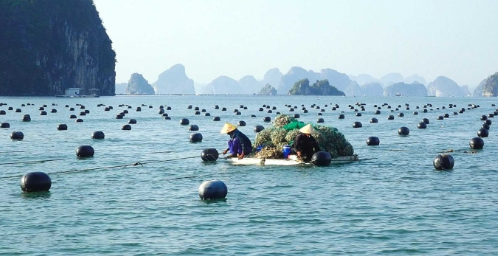
Aquaculture farmers in Vân Đồn have started deploying buoys for oyster farming after receiving their sea areas. Photo: Xuân Mai
Similar to Vân Đồn, Quảng Yên Town has allocated aquaculture areas to 164 households, each receiving 0.6 hectares, complete with locations and maps. By mid-November, Quảng Yên plans to complete the allocation of 865 hectares of water surface to over 400 households under the district’s management.
The allocation of sea areas for aquaculture is part of Quảng Ninh Province's policy, planned and implemented since 2018. However, many households continue spontaneous aquaculture, obstructing waterways, polluting the environment, and making it difficult for authorities to monitor. Unregulated farming households are also ineligible for production loans or compensation in case of natural disasters.
Therefore, following Typhoon Yagi, coastal districts and towns in Quảng Ninh accelerated the implementation of zoning plans and allocated water surfaces to aquaculture households. According to Quảng Ninh Provincial People's Committee, the province has zoned more than 45,240 hectares of sea area across nine districts for aquaculture development.
The fisheries sector contributes 50% of the province's agricultural structure. Hence, Mr. Cao Tường Huy, Chairman of the Provincial People's Committee, urged local authorities and credit institutions to accompany and implement solutions to support residents and businesses in resuming production and operations after Typhoon Yagi.
Quảng Ninh Province has also introduced policies to assist residents and businesses severely affected by Typhoon Yagi. These include urging credit institutions to reschedule, defer debts, reduce interest rates, and provide new loans to aquaculture households impacted by the typhoon.
By Lê Tân
Contact AQUA MINA for consultation and supply of aquaculture round tanks and aquaculture equipment for high-tech shrimp farming.
- Address: 685 National Highway 1A, Binh Hung Hoa Ward, Binh Tan District, Ho Chi Minh City
- Phone: 1800 6071 (Toll-free hotline)
- Email: sales@aquamina.com.vn or oversea@aquamina.com.vn
Aqua Mina's distributor in Japan:
REX INDUSTRIES CO., LTD
- Address: 1-9-3 Hishiya-Higashi, Higashi-Osaka 578-0948 JAPAN
- Email: kimakubo@rexind.co.jp
- Phone: +81-(0)72-961-9893
- Website: http://www.rexind.co.jp/e/
WE WORK FOR YOUR SUCCESS!
Ngày đăng : 27/12/2024
2957 View


Other Articles
Ca Mau, Can Tho and An Giang Play a Leading Role in Vietnam’s Shrimp Industry
Protecting rice-shrimp yields against environmental fluctuations caused by prolonged rain
AQUA MINA Turbo Blower: Quiet, Energy-Efficient Air Supply for Aquaculture Ponds
AQUA MINA has accompanied the experimental tank system project at Can Tho University from its very early days
AQUA MINA AMONG 20 OUTSTANDING PRESENTATIONS AT THE WORKSHOP ON APPLYING SCIENCE AND TECHNOLOGY TO IMPROVE THE QUALITY OF VIETNAM’S AQUATIC PRODUCTS
Vietnam’s Shrimp Farming Industry Enters the High-Tech Race
The U.S. market relies heavily on imported shrimp to bridge its domestic supply gap
The 2028 supply crisis: The shrimp industry is projected to face a 400,000-ton material shortage
High profits from high-tech shrimp farming come with persistent risks
Intensifying El Niño Effect: Climate Change Risks Threaten the Global Shrimp Supply Chain
Evaluating Gaps in the Circular Economy Value Chain of the Shrimp Industry
A Comprehensive Overview of the Vietnamese Shrimp Industry


.jpg)