


Shrimp Vein: To Remove or Not to Remove?
While it may not pose a major health risk—especially after cooking at high temperatures that kill bacteria—the vein is considered unclean and contains no nutritional value. Therefore, it’s recommended to remove it for better hygiene and peace of mind. If cooking shrimp for children, the vein should definitely be removed since their digestive systems are more sensitive.
Many people try to use toothpicks to pull out the vein, but this method isn’t always effective—especially with live shrimp—as the vein often breaks and some of it remains. Instead, you can try these four cleaner, more effective methods to remove the vein while keeping the shrimp intact:
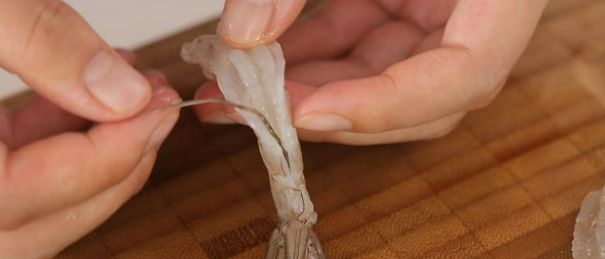
Method 1: Spoon Handle Trick
Hold the shrimp with the back facing up.
Insert the handle of a spoon gently into the gap between the shrimp's head and body.
Hook and pull out the waste and digestive vein. Since the waste sac is connected to the vein, it usually comes out easily in one go.
Method 2: Push-and-Pull Method
Hold the shrimp belly down to expose the back.
With one hand holding the head and the other holding the body (1–2 cm apart), gently bend the head downward.
Squeeze lightly to push the waste out from the head.
Grab and gently pull to remove the entire digestive vein.
This technique keeps the shrimp whole—ideal for dishes like boiled or steamed shrimp where presentation matters.
Method 3: Side Shell Release
Turn the shrimp belly-up. Hold the body with one hand.
Use the other hand to peel the shell on both sides of the head, carefully so the head doesn’t detach.
Once the shell is loosened, gently pull the head, and the vein and waste will come out together.
Method 4: Slit-and-Remove
First, remove the head and peel off the shell from the legs upward.
At the tail, grip it with two fingers and pull it off cleanly.
Place the peeled shrimp on a cutting board and use a knife to slit the back, exposing the vein.
Pull out the vein to finish.
Extra Tips
The vein and the shell contain no nutritional value and should be removed—especially for young children who could choke on shells.
The head of the shrimp should also be discarded as it often contains waste and toxins.
Source: doisongphapluat.com.vn
Aqua Mina's distributor in Japan: REX INDUSTRIES CO., LTD
- Address: 1-9-3 Hishiya-Higashi, Higashi-Osaka 578-0948 JAPAN
- Email: kimakubo@rexind.co.jp
- Phone: +81-(0)72-961-9893
- Website: http://www.rexind.co.jp/e/
WE WORK FOR YOUR SUCCESS!
Ngày đăng : 16/05/2025
2485 View


Other Articles
Ca Mau, Can Tho and An Giang Play a Leading Role in Vietnam’s Shrimp Industry
Protecting rice-shrimp yields against environmental fluctuations caused by prolonged rain
AQUA MINA Turbo Blower: Quiet, Energy-Efficient Air Supply for Aquaculture Ponds
AQUA MINA has accompanied the experimental tank system project at Can Tho University from its very early days
AQUA MINA AMONG 20 OUTSTANDING PRESENTATIONS AT THE WORKSHOP ON APPLYING SCIENCE AND TECHNOLOGY TO IMPROVE THE QUALITY OF VIETNAM’S AQUATIC PRODUCTS
Vietnam’s Shrimp Farming Industry Enters the High-Tech Race
The U.S. market relies heavily on imported shrimp to bridge its domestic supply gap
The 2028 supply crisis: The shrimp industry is projected to face a 400,000-ton material shortage
High profits from high-tech shrimp farming come with persistent risks
Intensifying El Niño Effect: Climate Change Risks Threaten the Global Shrimp Supply Chain
Evaluating Gaps in the Circular Economy Value Chain of the Shrimp Industry
A Comprehensive Overview of the Vietnamese Shrimp Industry


.jpg)