

Nghệ An, Việt Nam: Automatización de los factores ambientales en el cultivo de camarón en 3 etapas
The pilot research project “Application of scientific and technological advancements for automatic environmental management in 3-stage whiteleg shrimp farming,” led by the Nghe An Agricultural Extension Center, has brought initial success in promoting sustainable shrimp farming in the province.
According to MSc. Tran Nhat Phong, the water quality monitoring and alert system includes a central controller (E Sensor Master Aqua) using RF 433Mhz wireless waves, Wi-Fi, and GSM connectivity. It can send SMS alerts when parameters exceed preset thresholds. The system integrates sensors for pH, temperature, dissolved oxygen, ORP, and salinity:
– pH sensor: 0–14 range
– DO sensor: 0–20 mg/l range
– ORP sensor: +/- 2,000 mV
– Salinity sensor: 0–80 ‰
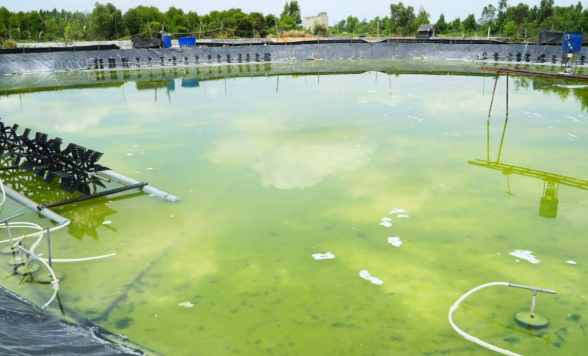
All sensors are powered by solar energy and connected to a mobile and desktop monitoring application that updates data every two minutes. The data is uploaded to the cloud, allowing farmers to monitor pond conditions remotely via smartphones or tablets. The system compares readings with pre-installed thresholds and sends alerts when anomalies are detected.
Mr. Phong shared that after two shrimp crops under this project, the application of automatic environmental management in 3-stage intensive farming has proven effective. It simplifies operations, reduces labor and costs, shortens grow-out cycles, and minimizes risks.
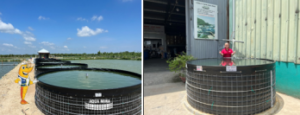
In the second crop of the project, Mr. Nguyen Viet Thang from Dien Trung commune, Dien Chau district, said the project was implemented on a 1-hectare site equipped with modern grow-out tanks, settling ponds, and wastewater treatment systems. The farm uses the automated monitoring system developed by Tep Bac, which monitors water quality indicators such as dissolved oxygen, temperature, pH, salinity, and ORP. It also sends SMS alerts when thresholds are exceeded, and regularly stores, analyzes, and retrieves historical farming data.
In the first crop, Mr. Thang applied the 3-stage intensive whiteleg shrimp farming model and achieved a 76% survival rate with a yield of 10.5 tons, earning over VND 1 billion in profit. In the second crop, despite cold weather prolonging the culture period, he maintained a 75% survival rate with an 8.5-ton yield and nearly VND 1 billion in profit. The third crop, also using the automated system, achieved a 77% survival rate and a 10.1-ton yield. Mr. Thang said the real-time monitoring system allowed him to promptly address environmental fluctuations and ensure healthy shrimp growth.
Mr. Ta Quang Sang, Director of the Nghe An Agricultural Extension Center, which implemented the project, stated that the application of science and technology for automatic environmental control in 3-stage shrimp farming provides farmers with the tools to produce high-quality shrimp at minimal cost. This enables them to sell at high market prices, improve productivity, and farm more efficiently while ensuring sustainable output growth for the province.
Source: aquaculture.vn
Póngase en contacto con AQUA MINA para obtener asesoramiento y suministro de tanques flotantes circulares, así como equipos acuícolas para granjas de camarones de alta tecnología.
Dirección: 685 Nacional 1A, P. Bình Hưng Hòa, Q. Bình Tân, Ciudad de Ho Chi Minh
Teléfono: 1800 6071 (Línea gratuita)
Correo electrónico: sales@aquamina.com.vn o oversea@aquamina.com.vn
Distribuidor de Aqua Mina en Japón:Compañía REX INDUSTRIES CO.,LTD
Dirección: 1-9-3 Hishiya-Higashi, Higashi-Osaka 578-0948 JAPAN
Correo electrónico: kimakubo@rexind.co.jp
Teléfono: +81-(0)72-961-9893
Sitio web: www.rexind.co.jp/e/
¡TRABAJAMOS PARA SU ÉXITO!
Ngày đăng : 03/08/2025
1797 ver todo


Ca Mau, Can Tho y An Giang desempeñan un papel clave en el sector camaronero de Vietnam
Protección del rendimiento de arroz y camarón ante las variaciones ambientales causadas por lluvias prolongadas
Soplador Turbo AQUA MINA: una solución silenciosa y eficiente para el suministro de aire en estanques acuícolas
AQUA MINA ha acompañado desde los primeros días el proyecto del sistema de tanques experimentales en la Universidad de Can Tho
AQUA MINA ENTRE LAS 20 PONENCIAS DESTACADAS DEL SEMINARIO SOBRE LA APLICACIÓN DE LA CIENCIA Y LA TECNOLOGÍA PARA MEJORAR LA CALIDAD DE LOS PRODUCTOS ACUÁTICOS DE
La industria camaronera de Vietnam entra en la carrera por la alta tecnología
El mercado estadounidense depende en gran medida del camarón de importación para cubrir el déficit local
La crisis de abastecimiento de 2028: Se proyecta que la industria del camarón sufra un déficit de 400.000 toneladas de materia prima
Las altas ganancias de la camaronicultura de alta tecnología vienen acompañadas de riesgos persistentes
El efecto de El Niño se intensifica: Los riesgos del cambio climático amenazan la cadena de suministro mundial del camarón
Evaluación de las deficiencias en la cadena de valor de la economía circular de la industria camaronera
Visión general de la industria camaronera de Vietnam


.jpg)