


What opportunities lie ahead for Vietnam’s seafood exports in 2026
Entering 2026, Vietnam’s fisheries sector is facing a period marked by both high expectations and new pressures. Following the strong recovery in 2025, production and export activities in the first quarter of 2026 demonstrate the notable adaptability of Vietnam’s seafood business community amid ongoing global trade volatility, intensifying international competition, and increasingly stringent compliance requirements in import markets.
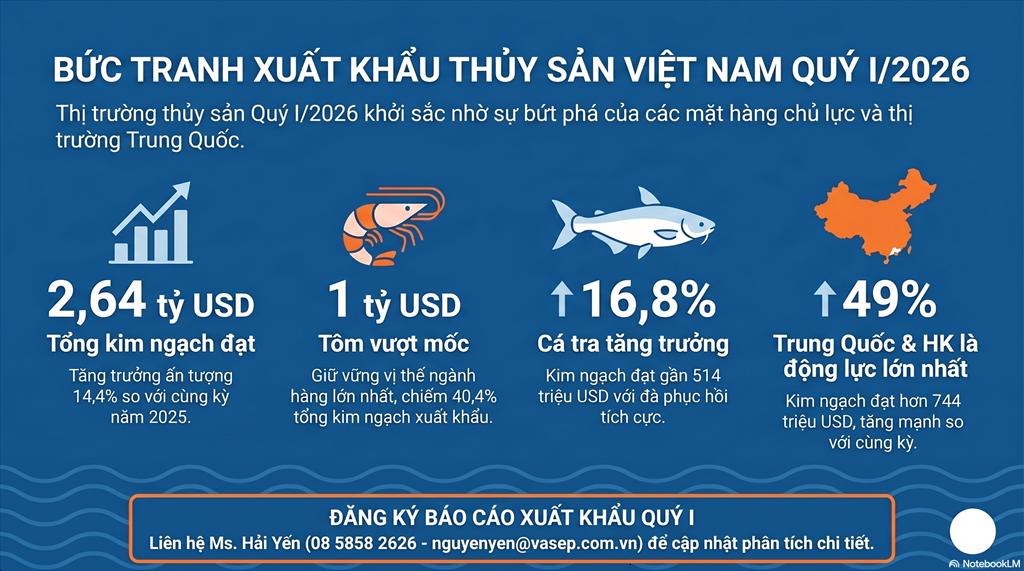
In the first quarter of 2026, Vietnam’s seafood exports reached USD 2.64 billion, up 14.4% compared to the same period in 2025. Several key product groups showed strong recovery, while the export structure is also undergoing noticeable shifts. Shrimp continued to be the largest segment with over USD 1 billion, accounting for 40.4% of total export value; pangasius reached nearly USD 514 million, up 16.8%. Squid, octopus, mollusks, crab, and other niche products also recorded solid growth.
Notably, some segments such as lobster, tilapia, scallops, and oysters experienced very strong growth, indicating significant potential for high-value products and rapid adaptation to market demand. On the other hand, tuna continues to face difficulties, reflecting weaker demand in some key markets and increasing pressure from fishing regulations, traceability, and compliance requirements.
Opportunities for Vietnam’s seafood exports in 2026
The market landscape in the first quarter also reveals several notable trends. China and Hong Kong remained the strongest growth drivers, with export value exceeding USD 744 million, up 49%, particularly in fresh and premium segments such as lobster, live crab, and certain marine fish products. Japan maintained its role as a stable market, albeit with modest growth; ASEAN and CPTPP markets continue to offer strong potential thanks to tariff advantages and demand for flexible, reasonably priced products.
Meanwhile, exports to the United States declined by 7.4%, and the EU saw only slight growth, clearly reflecting the impact of policy factors, cautious consumer sentiment, and intensifying competition.
In 2026, opportunities for Vietnam’s seafood sector still exist, but they come with conditions. Global demand for seafood remains, especially in import-dependent markets such as the U.S., EU, Japan, and China. Opportunities also arise from shifts in global consumption patterns, where buyers increasingly favor processed, convenient, high-value products with clear traceability.
Free trade agreements such as CPTPP, EVFTA, and UKVFTA continue to provide room for Vietnamese enterprises to enhance competitiveness if they effectively leverage rules of origin, tariff preferences, and market requirements. At the same time, supply shortages in certain regions—particularly for whitefish, mollusks, and premium seafood—are creating additional opportunities for Vietnam to expand its market share.
However, competition is becoming increasingly intense from major suppliers such as Ecuador, India, Indonesia, Thailand, and Canada, especially in key segments where Vietnam has strengths, including shrimp, whitefish, and high-value seafood.
The second challenge lies in the growing number of technical, trade, and environmental barriers: anti-dumping duties on shrimp in the U.S., MMPA regulations, COA requirements, import traceability programs, the EU’s new electronic catch certification system, and the continued presence of the IUU “yellow card.”
The third challenge comes from consumer markets themselves: buyers in the U.S., EU, and Japan are becoming more price-sensitive while simultaneously demanding higher standards in quality, convenience, and environmental and social responsibility.
In this context, VASEP has released the Vietnam Seafood Export Report for Q1 2026, providing a comprehensive, updated, and systematic overview of export developments in the first quarter. The report also offers in-depth analysis by product group, market, competitive trends, opportunities, challenges, and outlook for the coming quarters.
We expect this report to serve as a valuable reference for businesses, policymakers, research organizations, and domestic and international partners in shaping policies, developing business strategies, and promoting the sustainable development of Vietnam’s seafood industry in a context of deeper integration, fiercer competition, and increasing demands for adaptability.
Source:vasep
AQUA MINA CO., LTD
– Address: 685 Le Duc Anh Street, Quarter 39, Binh Hung Hoa Ward, Ho Chi Minh City
– Phone: 1800 6071 (Toll-free hotline)
– Email: sales@aquamina.com.vn or oversea@aquamina.com.vn
– Aqua Mina’s Official Distributor in Japan: REX INDUSTRIES CO., LTD
– Address: 1-9-3 Hishiya-Higashi, Higashi-Osaka 578-0948, JAPAN
– Email: kimakubo@rexind.co.jp
– Phone: +81-(0)72-961-9893
– Website: www.rexind.co.jp/e/

WE WORK FOR THE SUCCESS
Ngày đăng : 04/05/2026
1433 View


Other Articles
Ca Mau, Can Tho and An Giang Play a Leading Role in Vietnam’s Shrimp Industry
Protecting rice-shrimp yields against environmental fluctuations caused by prolonged rain
AQUA MINA Turbo Blower: Quiet, Energy-Efficient Air Supply for Aquaculture Ponds
AQUA MINA has accompanied the experimental tank system project at Can Tho University from its very early days
AQUA MINA AMONG 20 OUTSTANDING PRESENTATIONS AT THE WORKSHOP ON APPLYING SCIENCE AND TECHNOLOGY TO IMPROVE THE QUALITY OF VIETNAM’S AQUATIC PRODUCTS
Vietnam’s Shrimp Farming Industry Enters the High-Tech Race
The U.S. market relies heavily on imported shrimp to bridge its domestic supply gap
The 2028 supply crisis: The shrimp industry is projected to face a 400,000-ton material shortage
High profits from high-tech shrimp farming come with persistent risks
Intensifying El Niño Effect: Climate Change Risks Threaten the Global Shrimp Supply Chain
Evaluating Gaps in the Circular Economy Value Chain of the Shrimp Industry
A Comprehensive Overview of the Vietnamese Shrimp Industry






.jpg)