

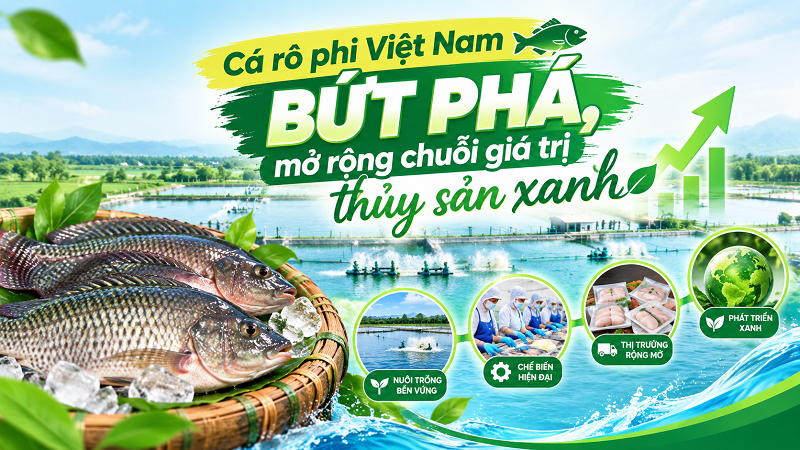
Vietnamese tilapia surges forward, expanding the green seafood value chain
1. Breakthrough Production and Immense Export Potential
In 2025, Vietnam's tilapia production is estimated to reach approximately 420,000 tons, a 33% increase compared to 2024, maintaining an average annual growth rate of 8.4% over the past decade. This remarkable expansion opens up significant opportunities for tilapia to become a strategic seafood commodity, actively contributing to the industry's total export turnover.
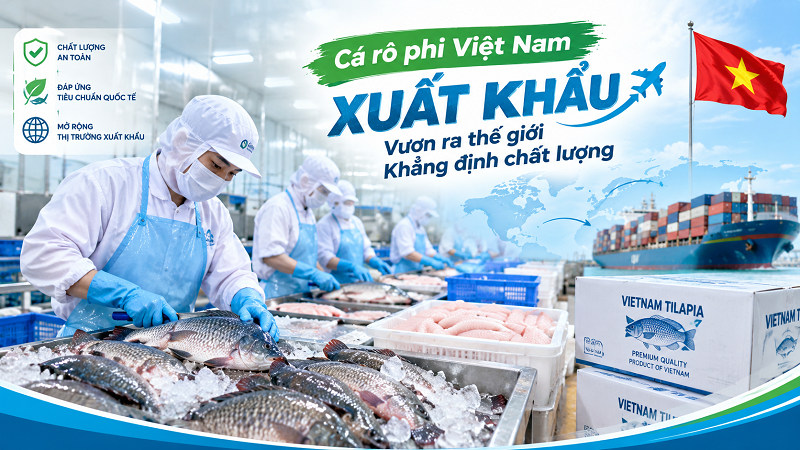
2. Strict Supply-Chain Food Safety Control
Hand in hand with expanding scale, standards for food safety, traceability, and quality control are becoming increasingly stringent:
-
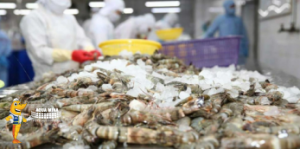
Farming-to-Factory Management: The National Authority for Agro-Forestry-Fisheries Quality, Processing and Market Development (NAFIQPM) coordinates the monitoring of chemical residues starting right from the raw farming stage. At processing plants, enterprises are required to apply comprehensive HACCP standards across all operational stages (sanitation, equipment, water supply, labeling, and storage).
-
Consignment Control and Enterprise Classification: Every shipment undergoes document verification, physical inspection, and sampling tests before export certificates are issued. Vietnam applies a prioritized mechanism for fully compliant businesses, while non-priority facilities must undergo strict batch-by-batch inspections. Currently, around 510 processing establishments meet the conditions to participate in the export tilapia chain.
3. Shift Toward Sustainable Models and Green Value
Volume growth is no longer the sole metric of success. To conquer demanding markets such as the US, EU, Japan, and the Middle East, the tilapia sector is shifting from volume-driven growth to quality-driven transformation. Environmental governance, supply chain transparency, and responsible production serve as the core foundation for businesses to enhance product value, minimize trade risks, and achieve long-term sustainability.
AQUA MINA CO., LTD
WE WORK FOR THE SUCCESS


How strictly is the chlorine gas management process controlled?
Building 48 Value Chains: Ca Mau Strives for Sustainable Shrimp Farming
Vietnam's shrimp industry is still struggling to achieve self-sufficiency in breeding stock.
EVFTA paves the way for Vietnamese seafood to conquer high-end markets
Russian importers are paying increasing attention to seafood supplies from Pakistan
Ca Mau, Can Tho and An Giang Play a Leading Role in Vietnam’s Shrimp Industry
Protecting rice-shrimp yields against environmental fluctuations caused by prolonged rain
AQUA MINA Turbo Blower: Quiet, Energy-Efficient Air Supply for Aquaculture Ponds
AQUA MINA has accompanied the experimental tank system project at Can Tho University from its very early days
AQUA MINA AMONG 20 OUTSTANDING PRESENTATIONS AT THE WORKSHOP ON APPLYING SCIENCE AND TECHNOLOGY TO IMPROVE THE QUALITY OF VIETNAM’S AQUATIC PRODUCTS
Vietnam’s Shrimp Farming Industry Enters the High-Tech Race
The U.S. market relies heavily on imported shrimp to bridge its domestic supply gap


.jpg)