

Building 48 Value Chains: Ca Mau Strives for Sustainable Shrimp Farming
Currently, the agricultural sector in Ca Mau Province records 437 active cooperatives, of which 347 operate effectively with 17,686 members. In parallel, the province features 851 collaborative groups in agriculture, forestry, fisheries, and salt production, attracting 21,272 participants. These collective economic models serve as the core in uniting farmers, standardizing production processes, and expanding market outlets for products.
For its two key sectors—shrimp and rice—Ca Mau has successfully built 75 value chains. Specifically, these include 48 shrimp linkage chains directly connecting Enterprises, Cooperatives, and Farmers, along with 27 rice linkage chains spanning a total cultivation area of over 53,300 hectares.
The development of these linkage chains provides shrimp farmers with direct access to quality inputs, advanced technical protocols, and stable consumption channels. At the same time, standardizing farming zones according to international benchmarks has enhanced the commercial value of raw shrimp while effectively meeting the stringent demands of export markets.
Among these efforts, Minh Phu Certified Shrimp Social Company Limited stands out as a pioneer in collaborating with cooperatives and local households to expand internationally certified farming areas. After a decade of implementation, the enterprise has extended this model across 14 communes, working closely with 18 local cooperatives.
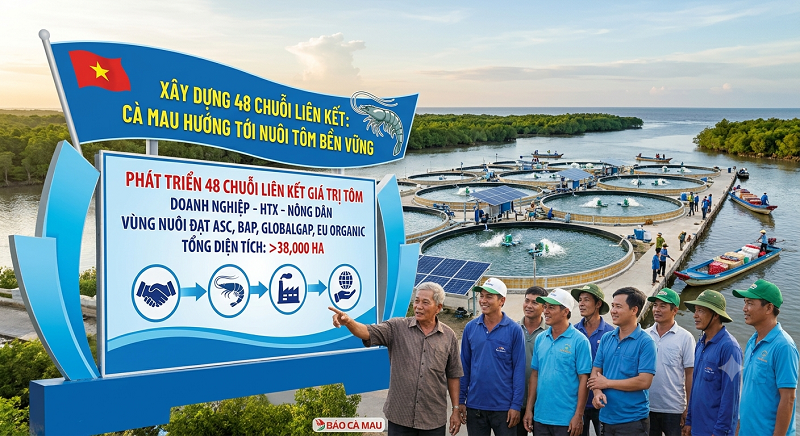
According to Mr. Lam Thai Xuyen, Director of the company, partnering through cooperatives as focal points enables enterprises to optimize management costs, save labor, and streamline production organization. For farmers, they not only receive technical assistance and seed stock support but are also guaranteed product off-take for certified shrimp at prices significantly higher than open-market rates.
Despite these positive outcomes, the area of internationally certified shrimp farming remains relatively modest compared to the province's total shrimp farming scale of approximately 418,000 hectares. This indicates substantial room for Ca Mau to further improve farming quality and expand certified cultivation areas.
To fully exploit this potential, the key lies in enhancing the management and operational capacity of cooperatives. This will help farmers reduce input costs, secure stable output, and integrate deeper into global value chains. Consequently, it provides crucial momentum for Ca Mau's shrimp industry to scale up internationally standardized production, enhance competitiveness, and achieve sustainable long-term development.
WE WORK FOR THE SUCCESS!


Vietnam's shrimp industry is still struggling to achieve self-sufficiency in breeding stock.
EVFTA paves the way for Vietnamese seafood to conquer high-end markets
Russian importers are paying increasing attention to seafood supplies from Pakistan
Ca Mau, Can Tho and An Giang Play a Leading Role in Vietnam’s Shrimp Industry
Protecting rice-shrimp yields against environmental fluctuations caused by prolonged rain
AQUA MINA Turbo Blower: Quiet, Energy-Efficient Air Supply for Aquaculture Ponds
AQUA MINA has accompanied the experimental tank system project at Can Tho University from its very early days
AQUA MINA AMONG 20 OUTSTANDING PRESENTATIONS AT THE WORKSHOP ON APPLYING SCIENCE AND TECHNOLOGY TO IMPROVE THE QUALITY OF VIETNAM’S AQUATIC PRODUCTS
Vietnam’s Shrimp Farming Industry Enters the High-Tech Race
The U.S. market relies heavily on imported shrimp to bridge its domestic supply gap
The 2028 supply crisis: The shrimp industry is projected to face a 400,000-ton material shortage
High profits from high-tech shrimp farming come with persistent risks