

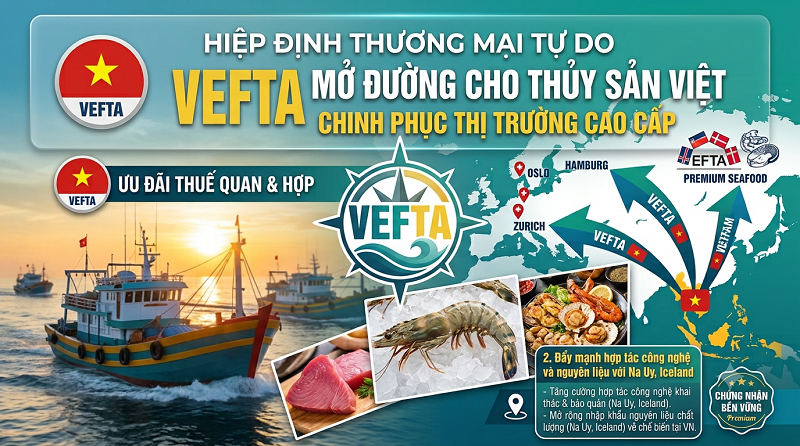
EVFTA paves the way for Vietnamese seafood to conquer high-end markets
Cooperation under VEFTA not only helps expand markets but also facilitates raw material diversification, technology transfer, and value creation for Vietnamese seafood products.
1. Opportunities in the High-End Swiss Market
Switzerland is a high-potential market for the premium segment, driven by high average income and strict standards regarding food safety, transparency, and sustainability. Notably, Vietnamese eco-certified mangrove-farmed shrimp holds a strong competitive advantage by combining high quality with mangrove forest ecosystem protection. To effectively capitalize on this, businesses must ensure full supply chain transparency, comply with sustainability certifications, carefully account for logistics costs, and accurately position their pricing to avoid direct competition with mass-market commodities.
2. Boosting Technological and Raw Material Cooperation with Norway and Iceland
The VEFTA agreement serves as a leverage to foster collaboration with Norway and Iceland—two nations with strong expertise in cold-water seafood (salmon, cod, mackerel, herring) and advanced technologies. Vietnamese enterprises can import raw materials from these countries for further processing and re-export, leveraging their existing deep-processing capacity. Simultaneously, Vietnam can adopt onboard preservation technologies, fisheries management practices, and advanced by-product processing techniques (heads, bones, skins) from Iceland to maximize value and minimize waste.
3. VASEP Recommendations and Commercial Outlook
Ms. Le Hang (Deputy Secretary-General of VASEP) noted that importing raw materials from EFTA for processing does not automatically entitle the end products to preferential tariff treatment in third-country markets; companies must thoroughly review rules of origin and technical standards. VASEP will step up market intelligence support, business matching, and bilateral trade promotion.
In 2025, Vietnam’s seafood exports to Switzerland reached $34.123 million (+15%), while exports to Norway reached $18.479 million (+95%). To turn VEFTA opportunities into tangible commercial results, enterprises need to optimize supply chain management, develop specialized product lines, and build long-term strategic partnerships.
WE WORK FOR THE SUCCESS!


Building 48 Value Chains: Ca Mau Strives for Sustainable Shrimp Farming
Vietnam's shrimp industry is still struggling to achieve self-sufficiency in breeding stock.
Russian importers are paying increasing attention to seafood supplies from Pakistan
Ca Mau, Can Tho and An Giang Play a Leading Role in Vietnam’s Shrimp Industry
Protecting rice-shrimp yields against environmental fluctuations caused by prolonged rain
AQUA MINA Turbo Blower: Quiet, Energy-Efficient Air Supply for Aquaculture Ponds
AQUA MINA has accompanied the experimental tank system project at Can Tho University from its very early days
AQUA MINA AMONG 20 OUTSTANDING PRESENTATIONS AT THE WORKSHOP ON APPLYING SCIENCE AND TECHNOLOGY TO IMPROVE THE QUALITY OF VIETNAM’S AQUATIC PRODUCTS
Vietnam’s Shrimp Farming Industry Enters the High-Tech Race
The U.S. market relies heavily on imported shrimp to bridge its domestic supply gap
The 2028 supply crisis: The shrimp industry is projected to face a 400,000-ton material shortage
High profits from high-tech shrimp farming come with persistent risks