

Vietnam's shrimp industry is still struggling to achieve self-sufficiency in breeding stock.
On the morning of October 18, in Khanh Hoa, the Ministry of Science and Technology, in coordination with the Ministry of Agriculture and Environment and the Provincial People's Committee, held a workshop titled Research on Mastering Technology for Marine Lobster Seed Production and Brackish-Water Shrimp Breeding in Vietnam. The event was chaired by Minister of Science and Technology Vu Hai Quan, bringing together approximately 150 delegates from regulatory agencies, the scientific community, and the business sector.
Massive Demand and the Pressure of Seed Dependence
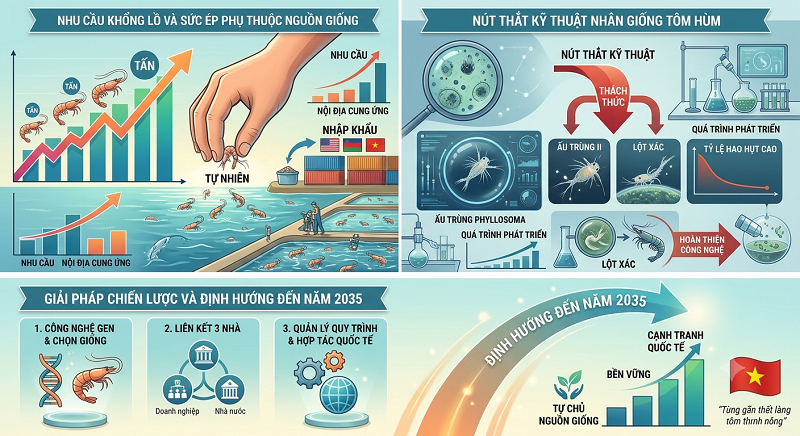
Vietnam currently boasts about 750,000 hectares of brackish-water shrimp farming, producing 1.29 million tons annually and contributing approximately USD 4.6 billion to export turnover (accounting for nearly 48% of the total seafood export value). The lobster segment also achieves an annual production of 14,537 tons. However, domestic seed stock self-sufficiency has failed to keep pace with this scale of development.
For brackish-water shrimp: The annual demand for commercial postlarvae reaches 150–160 billion. Nevertheless, whiteleg shrimp broodstock remains largely dependent on imports, while black tiger shrimp seed relies heavily on wild capture. The management of hatcheries remains inadequate, as many uncertified facilities continue to operate, and uneven rearing conditions pose significant risks regarding disease outbreaks and traceability control.
For spiny lobsters: The annual demand for seed stock stands at around 100–150 million larvae. Domestic supply meets only about 10% of the demand for scalloped spiny lobster, while tropical rock lobster seed is entirely dependent on imports and wild capture.
Technical Bottlenecks in Lobster Breeding
The industry's primary barrier today is the incomplete artificial lobster seed production process. The transition phase from Phyllosoma larvae to Puerulus postlarvae remains an unsolved technical bottleneck.
The larval rearing stage lasts 150–180 days across 20–22 molting cycles, requiring strict conditions regarding feed, water quality, microbiome balance, and water flow. High mortality rates and expensive operational costs present severe obstacles to commercialization and large-scale expansion.
Strategic Solutions and Orientation Towards 2035
At the workshop, Minister Vu Hai Quan outlined the direction towards 2035: focusing on genomic selection to breed fast-growing, disease-resistant shrimp lines adapted to climate change.
To realize this goal, the key agreed-upon solutions include:
Strengthening the Triple Helix Model (Research Institutes/Universities – Enterprises – State): Businesses must be involved right from the beginning (from defining needs and testing to assessing practical applicability) to bridge the gap between laboratory research and commercial farming areas.
Tightening Supply Chain Management: Enhancing coordination between local authorities and specialized agencies to inspect breeding facilities, enforce import quarantine, and mandate seed stock traceability.
Long-Term Investment & International Cooperation: Prioritizing financial resources for long-term research projects while actively acquiring advanced foreign technologies to progressively elevate the competitiveness of Vietnam's shrimp sector.
AQUA MINA CO., LTD
– Address: 685 Le Duc Anh Street, Quarter 39, Binh Hung Hoa Ward, Ho Chi Minh City
– Phone: 1800 6071 (Toll-free hotline)
– Email: sales@aquamina.com.vn or oversea@aquamina.com.vn
– Aqua Mina’s Official Distributor in Japan: REX INDUSTRIES CO., LTD
– Address: 1-9-3 Hishiya-Higashi, Higashi-Osaka 578-0948, JAPAN
– Email: kimakubo@rexind.co.jp
– Phone: +81-(0)72-961-9893
– Website: www.rexind.co.jp/e/
WE WORK FOR THE SUCCESS!
Ngày đăng : 22/10/2026
1010 View


Other Articles
Building 48 Value Chains: Ca Mau Strives for Sustainable Shrimp Farming
EVFTA paves the way for Vietnamese seafood to conquer high-end markets
Russian importers are paying increasing attention to seafood supplies from Pakistan
Ca Mau, Can Tho and An Giang Play a Leading Role in Vietnam’s Shrimp Industry
Protecting rice-shrimp yields against environmental fluctuations caused by prolonged rain
AQUA MINA Turbo Blower: Quiet, Energy-Efficient Air Supply for Aquaculture Ponds
AQUA MINA has accompanied the experimental tank system project at Can Tho University from its very early days
AQUA MINA AMONG 20 OUTSTANDING PRESENTATIONS AT THE WORKSHOP ON APPLYING SCIENCE AND TECHNOLOGY TO IMPROVE THE QUALITY OF VIETNAM’S AQUATIC PRODUCTS
Vietnam’s Shrimp Farming Industry Enters the High-Tech Race
The U.S. market relies heavily on imported shrimp to bridge its domestic supply gap
The 2028 supply crisis: The shrimp industry is projected to face a 400,000-ton material shortage
High profits from high-tech shrimp farming come with persistent risks