


United Kingdom: Promoting Land-Based Black Tiger Shrimp Farming Model
According to the research team, this model enables black tiger shrimp production at lower costs, significantly reduces environmental risks, and allows for scalable expansion aligned with circular economy principles. Notably, producing one ton of black tiger shrimp using this method requires up to 50 times less land than producing the same amount of beef or pork. This superior land-use efficiency gives the UK greater flexibility to allocate land for nature restoration initiatives such as reforestation, carbon sequestration, biodiversity enhancement, and flood risk reduction. The team emphasized that land-based shrimp farming helps cut production costs, limit environmental risks, and scale operations within a circular economy framework. Remarkably, producing one ton of shrimp requires only one-fiftieth of the land needed to produce an equivalent amount of beef or pork. High land-use efficiency is expected to create additional space for the UK to implement nature recovery solutions, including tree planting, increasing carbon absorption, improving biodiversity, and reducing flood risks. Some experts note that converting agricultural land entirely for nature restoration could reduce food self-sufficiency and shift environmental pressures to other countries. In this context, black tiger shrimp demonstrate the potential to generate nutrient-rich food on a very small land footprint while still meeting environmental and food security goals.
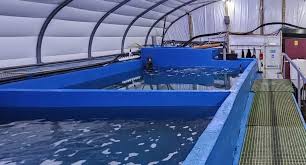
Professor Rod Wilson, Head of the UKSKPP project, stated that sustainable aquaculture will play a crucial role in the national food strategy as the UK population grows. “Our land-based black tiger shrimp model integrates a closed recirculating system, utilizes renewable energy, and minimizes waste, aiming to ensure that nothing is wasted,” he explained. The market value of black tiger shrimp in the UK currently exceeds £300 million annually. Replacing even a small portion of imports with domestic production would reduce environmental pressure, create jobs in rural areas, and shorten the fresh food supply chain. At a technical demonstration event held on November 14 at the University of Exeter, scientists, businesses, and policymakers toured the model firsthand. Andrew Whiston, Technical Director of Rastech and co-founder of Eden Valley Prawns—the only commercial land-based black tiger shrimp farm in the UK—shared that their farming system uses only seawater, feed, and renewable energy, with no antibiotics, no pesticides, no mangrove deforestation, and significantly reduced overseas food transport costs. However, for the model to develop into a nationwide industry, several barriers must still be addressed, including public awareness, skilled workforce training, technological and regulatory innovation, and the development of domestic hatchery systems. UKSKPP is currently working with businesses and regulatory authorities to establish technical frameworks, policies, and scientific data to overcome these challenges.
Source: nguoinuoitom

WE WORK FOR THE SUCCESS


Ca Mau, Can Tho and An Giang Play a Leading Role in Vietnam’s Shrimp Industry
Protecting rice-shrimp yields against environmental fluctuations caused by prolonged rain
AQUA MINA Turbo Blower: Quiet, Energy-Efficient Air Supply for Aquaculture Ponds
AQUA MINA has accompanied the experimental tank system project at Can Tho University from its very early days
AQUA MINA AMONG 20 OUTSTANDING PRESENTATIONS AT THE WORKSHOP ON APPLYING SCIENCE AND TECHNOLOGY TO IMPROVE THE QUALITY OF VIETNAM’S AQUATIC PRODUCTS
Vietnam’s Shrimp Farming Industry Enters the High-Tech Race
The U.S. market relies heavily on imported shrimp to bridge its domestic supply gap
The 2028 supply crisis: The shrimp industry is projected to face a 400,000-ton material shortage
High profits from high-tech shrimp farming come with persistent risks
Intensifying El Niño Effect: Climate Change Risks Threaten the Global Shrimp Supply Chain
Evaluating Gaps in the Circular Economy Value Chain of the Shrimp Industry
A Comprehensive Overview of the Vietnamese Shrimp Industry








.jpg)