



The world's thirst for shrimp is killing Ecuador's mangroves
As the tide recedes, Johana Carolina Cruz Potes wades through the mudflats around Costa Rica Island, part of Ecuador’s Jambelí archipelago. Carrying a bucket in one hand and a small iron hook in the other, she weaves through the tangled root system of a mangrove patch, meticulously searching for black clams (concha negra) hidden beneath the thick mud.
Cruz Potes has been doing this since she was nine years old, when she first accompanied her father to scrape the mud. However, shellfishing—often the only safety net for families here—is becoming increasingly precarious as clam beds shrink and yields plummet disastrously.
1. Local residents also catch crabs when the tide recedes. Photo: Vicente Gaibor
At 32, Cruz Potes has no doubt about who is behind this tragedy. Pointing toward a massive reservoir, she says tight-lipped: When the shrimp farms arrived, they clear-cut the trees to dig the pools. But these black clams rely on the roots to live. When the trees die, the clams disappear too.
Over the past decade, Ecuador’s shrimp production has surged nearly fourfold, officially dethroning oil to become the country's top non-oil export. Nearly all of it is shipped to China, the United States, and Europe. Thanks to lifted tariff barriers, export revenues have skyrocketed fivefold.
Yellowish foam floats around shrimp ponds during the wastewater discharge process on Costa Rica Island. Photo: Vicente Gaibor
However, the expansion of this industry has pushed farms deeper into lands already scarred by deforestation. Between 1969 and 1999, Ecuador lost 43% of its mangrove forests. Today, the surface area of shrimp ponds is 1.5 times larger than the remaining mangrove cover.
Although cutting down mangroves is now strictly banned, and industry leaders claim that the forest-to-pond conversion rate has dropped near zero despite skyrocketing production, locals and scientists expose a different reality: the ecological slaughter has not stopped.
People think mangrove destruction is a thing of the past. It’s absolutely not, says Eduardo Rebolledo Monsalve, a researcher at the Catholic University in Esmeraldas.
Data from Trase—a supply chain transparency initiative—indicates that 427 hectares of mangroves were converted into shrimp ponds between 2014 and 2018, mostly in Guayas province, the country’s shrimp capital. Another study based on satellite imagery revealed that 2,900 hectares of forest vanished over the following four years, with nearly half located within core conservation zones.
In January 2024, a naval patrol reportedly discovered a 10-hectare patch of mangrove clear-cut inside the Manglares Don Goyo reserve. Located deep within the Gulf of Guayaquil, this area is recognized as a wetland of international importance under the Ramsar Convention.
Luis Ángel Flores Ramírez, a crab catcher in the southern province of El Oro (the cradle of shrimp farming), revealed that pond owners now nibble away at the forest by clearing small areas under the guise of pruning branches, digging water channels, or reinforcing dikes.
Further north along the coast, Pablo Roberto Demera, leader of the Asopesanjocha artisanal fishermen's association, paints a similar picture: Every time they repair a dike, they encroach another two meters into the forest, and then another two meters. He adds that locals usually discover the damage after the fact, when patrols spot expanding pond walls or freshly butchered patches of forest.
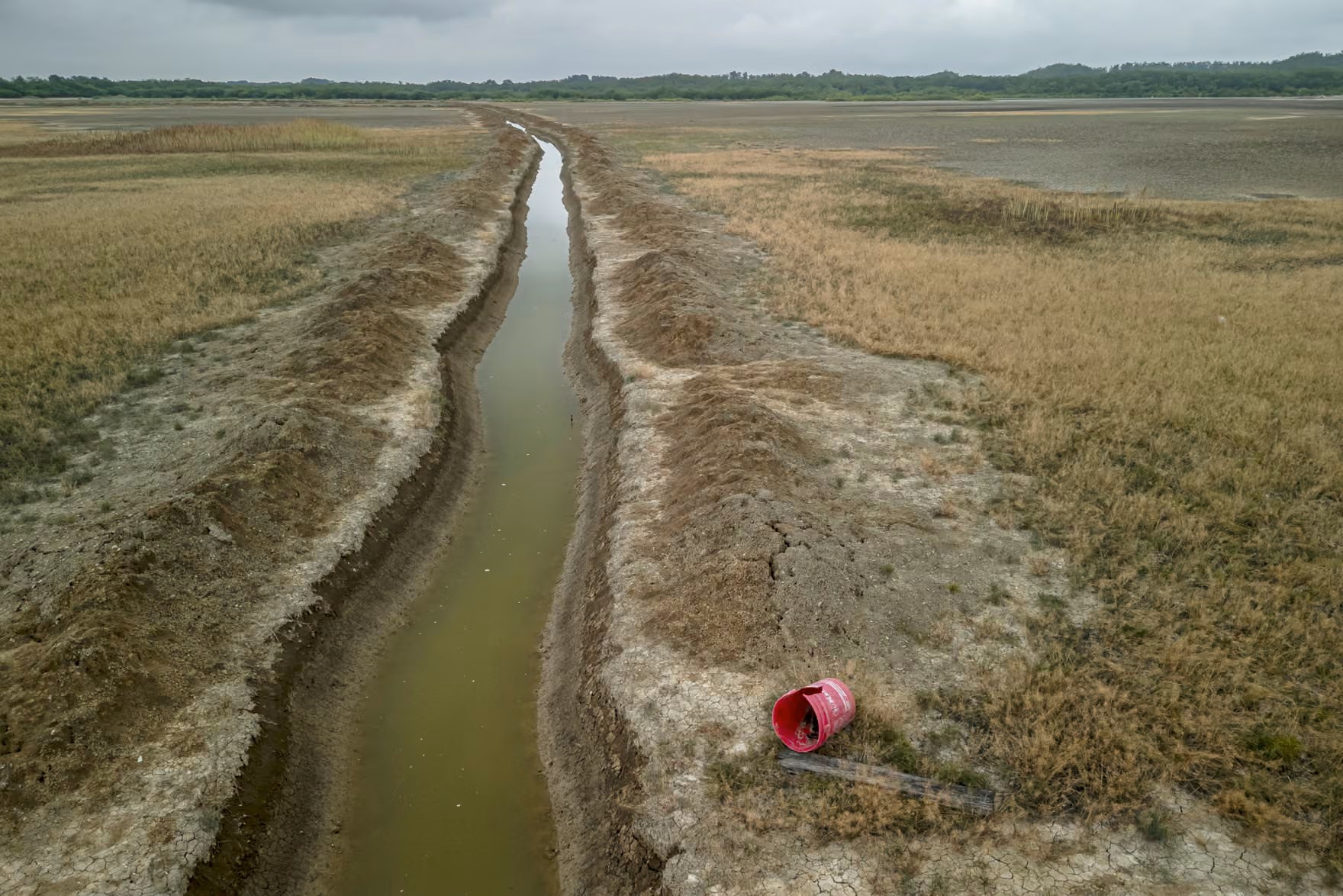
2. The barren, cleared land that once housed shrimp farms on Costa Rica Island. Photo: Vicente Gaibor
The consequences go beyond felled trees. Shrimp ponds choke the tidal flow—the vital pulse that keeps mangrove soil hydrated and oxygen-rich. Rebolledo Monsalve explains: When the system of dikes and canals cuts off water circulation, the mud hardens, salinity shifts, and the remaining trees eventually dry up and die.
Furthermore, shrimp farms dump wastewater back into the estuaries. Ecuadorian law strictly prohibits discharging untreated waste—which is packed with organic matter, leftover feed, shrimp feces, and fertilizers. Yet, a 2023 study exposed a grim reality: the mangrove ecosystems around farms in Esmeraldas showed ammonium and phosphorus concentrations 2.5 times higher than normal. Seafood Watch estimates that more than half of the waste from farming ponds is discharged directly into the environment.
A former shrimp farm worker in La Libertad shudders as he recalls being forced to flush pond water straight into the estuary: Everything just poured into the river. The entire water surface was covered in white foam.
Another common chemical is sodium metabisulfite, used to preserve shrimp after harvest to maintain freshness. For Mauricio Cruz, a crab fisherman in Huaquillas, these chemicals are a nightmare, especially when the ponds flush their waters. Seeing dead fish floating belly-up is a common sight.
3. A drainage pipe discharging wastewater directly into a canal on Costa Rica Island. Photo: Vicente Gaibor
Máximo Jordán, president of an artisanal crab and fish catching association in Puerto Roma (a village besieged by over 150 shrimp ponds in the Gulf of Guayaquil), said crab catchers have discovered pipes designed to pump dredged sludge deep into the mangroves. Why don't they dump it into their own canals? he asks angrily. They blast the mud up to 300 meters into the forest. It poisons the trees and kills all the crabs.
Wendy Chávez-Páez, an environmental researcher at the German Institute of Development and Sustainability, believes the pollution issue is being ignored. Funding to fully investigate these impacts is a drop in the bucket. And political will is thin, simply because the shrimp sector plays such a massive role in the economy, she stresses.
Despite the wave of outrage from communities and activists, José Antonio Camposano, president of Ecuador’s National Chamber of Aquaculture, firmly denies accusations that association members cause pollution. If water quality is poor, oxygen is low, or toxins are present, the shrimp will get stressed, fall ill, grow slowly, and stop eating, he argues. In other words, forcing an animal to live in a toxic environment makes no sense, as it only invites disease.
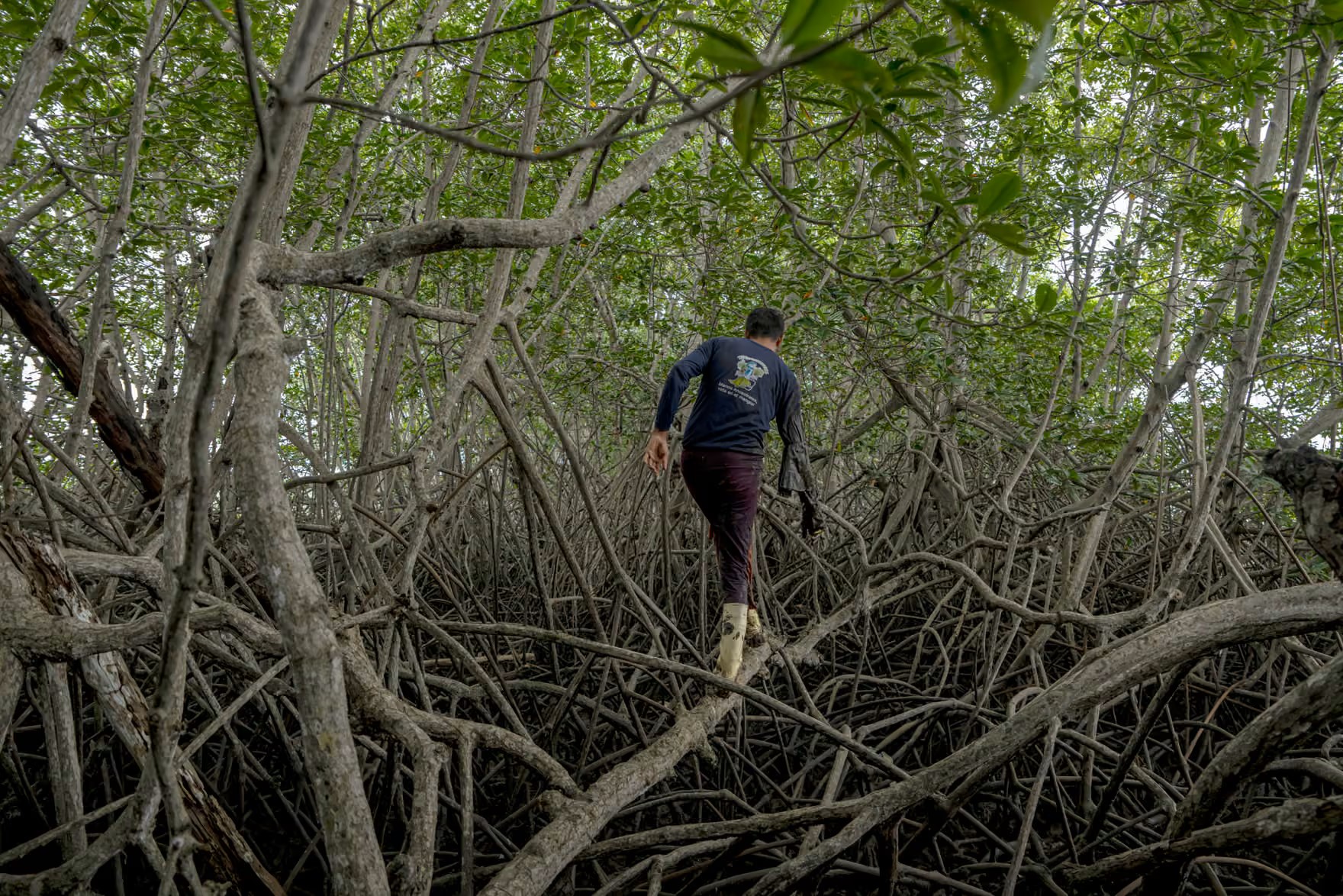
4. As the tide recedes, men hunt for crabs among mangrove roots on Costa Rica Island. Photo: Vicente Gaibor
Tragically, the regulatory system is too weak to detect and stop violations. In Esmeraldas, home to more than 200 shrimp farms, there is only one fisheries inspector, who isn't even provided with a vehicle.
Under the Mangrove Concession Agreements (in effect since 2000), communities have the right to report violations. However, these complaints rarely yield a penalty. The 15 de Enero Association, which guards 3,330 hectares of forest in El Oro, has filed 17 complaints since 2019.
Bitterly, those files just go to the ministry's legal department and gather dust, sighs former president Flores Ramírez. No one is held accountable. In one rare case, authorities fined an illegal pond. But as he recalls: That pond was never filled back in, and the mangrove was never restored.
Ecuador’s Ministry of Environment confirmed it had received 44 complaints in El Oro since 2019, but remained silent when asked about specific sanctions.
Jordán says his association denounced the dumping of waste sludge in Guayas; authorities did inspect the site, but to date, no official response has been issued.
According to Flores Ramírez, whistleblowers even face looming dangers. When you file a complaint, they target you. You are gambling with your life. Another crab catcher in El Oro shares the same dread: They will come to your doorstep to intimidate you. But if we stay silent, we risk having the ministry strip away our fishing rights in the very area we make a living.
Researcher Chávez-Páez assesses that this reality exposes a fatal flaw in the concession agreements. They are powerful tools, but they dump the burden of forest protection onto the shoulders of poor, marginalized locals, instead of the state and corporations—the parties who actually hold the power and resources, she analyzes.
Last year, the Aquaculture Stewardship Council (ASC), French food group Labeyrie Fine Foods, and Ecuadorian producer Omarsa launched a project to restore 10 hectares of forest in Cerrito de los Morreños. The project uses seedlings from a nursery that Omarsa says it funded for the community.
However, atonement projects from the industry are nothing new. A 2011 report by the Swedish Society for Nature Conservation exposed a previous Omarsa project that restored only a fraction of what was initially promised.
5. Crab fisherman Mauricio Cruz inspects newly replanted mangrove trees. Photo: Vicente Gaibor
Nadia Romero Salgado, who studies ecological conflicts caused by Ecuador's shrimp industry, warns that while these programs have positive aspects, they can easily turn into greenwashing tactics for an industry that still evades responsibility for past destruction.
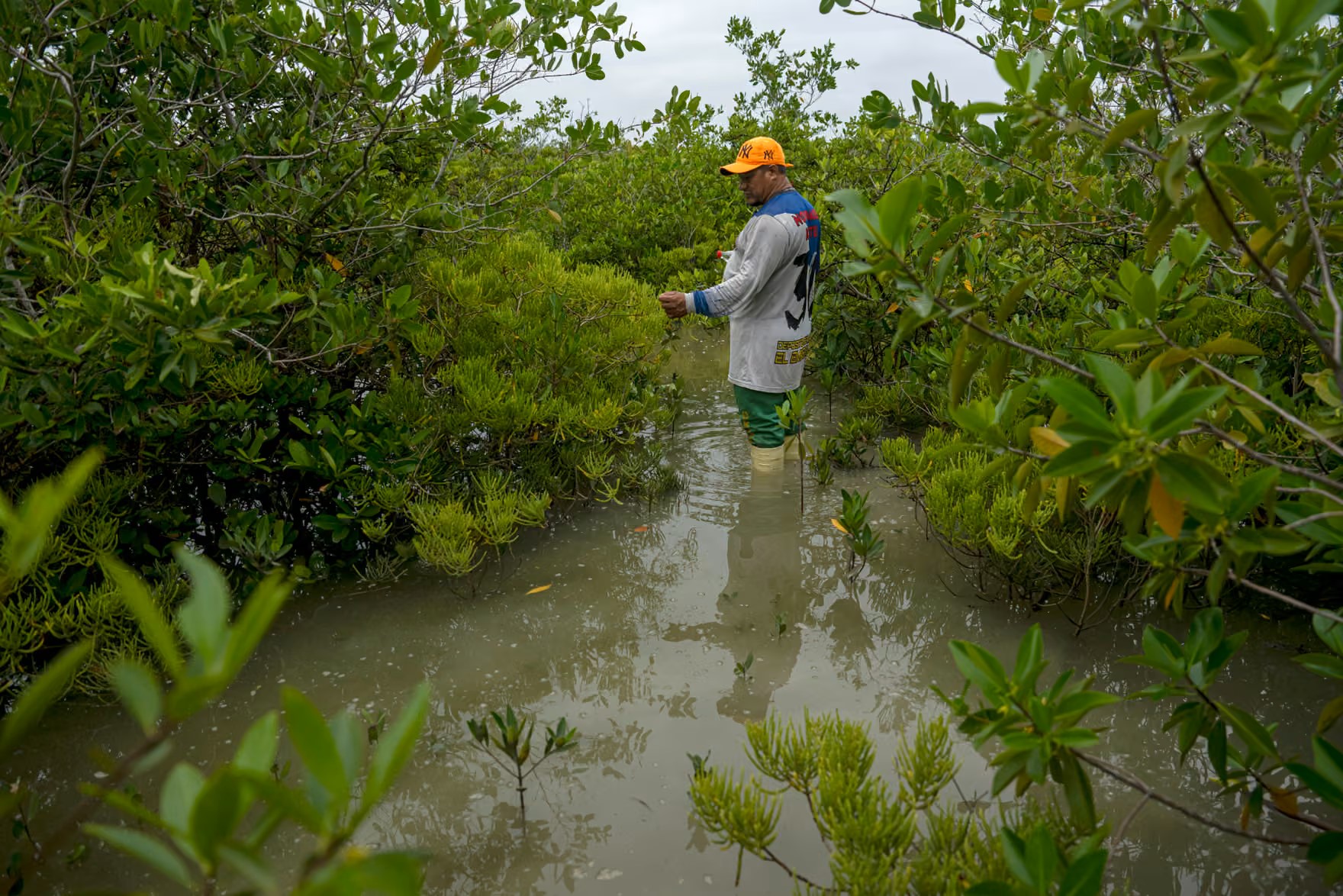
On Costa Rica Island, the restoration effort feels like a quiet, spontaneous resistance by the locals. Alexander Alvarado Reyes (36), president of the local mangrove association, says residents are hand-planting green shoots on land that was once a bustling clamming ground.
A few saplings have taken deep root in the mud; others were swept away by the tide or eaten by snails. But where the green shoots endure, Alvarado Reyes notes with hope that the mud has begun to soften. If luck is on their side, the black clams will soon return.
Source: tepbac
AQUA MINA CO., LTD

WE WORK FOR THE SUCCESS


Ca Mau, Can Tho and An Giang Play a Leading Role in Vietnam’s Shrimp Industry
Protecting rice-shrimp yields against environmental fluctuations caused by prolonged rain
AQUA MINA Turbo Blower: Quiet, Energy-Efficient Air Supply for Aquaculture Ponds
AQUA MINA has accompanied the experimental tank system project at Can Tho University from its very early days
AQUA MINA AMONG 20 OUTSTANDING PRESENTATIONS AT THE WORKSHOP ON APPLYING SCIENCE AND TECHNOLOGY TO IMPROVE THE QUALITY OF VIETNAM’S AQUATIC PRODUCTS
Vietnam’s Shrimp Farming Industry Enters the High-Tech Race
The U.S. market relies heavily on imported shrimp to bridge its domestic supply gap
The 2028 supply crisis: The shrimp industry is projected to face a 400,000-ton material shortage
High profits from high-tech shrimp farming come with persistent risks
Intensifying El Niño Effect: Climate Change Risks Threaten the Global Shrimp Supply Chain
Evaluating Gaps in the Circular Economy Value Chain of the Shrimp Industry
A Comprehensive Overview of the Vietnamese Shrimp Industry








.jpg)