

2026 Shrimp Farm Design Trends: From Traditional Ponds to Recirculating Aquaculture Systems
1. How is Shrimp Farm Design Changing?
In the past, farm design usually focused on pond area, dikes, and basic water supply and drainage systems. However, as intensive and high-tech farming models evolve, the design approach has shifted.
A modern farm requires more than just good culture ponds; it demands synchronized planning for water sources, aeration, waste management, power supply, piping, and operational zones.
The goal is no longer simply to construct as many ponds as possible, but to build an easily controllable, stable, and scalable system.
2. From Pond Design to System Design
One of the clearest trends in modern shrimp farm design is moving away from an item-by-item approach toward holistic engineering.
-
2.1. Water Systems Planned Right from the Start
Intake water, treatment areas, settling ponds, reservoir ponds, grow-out ponds, and discharge zones must be arranged in a clear sequence.
Piping layouts must also factor in flow rates, distances, pump locations, and ease of cleaning and maintenance.
A well-thought-out design minimizes costly retrofits once the farm is operational.
-
2.2. Aeration Systems Tailored to Farming Scale
Paddlewheel aerators, blowers, pure oxygen injection, and air distribution lines should be calculated based on the actual demand of each zone.
Under-designing compromises operations, while over-designing inflates capital expenditure and electricity bills without adding measurable value.
3. High-Tech Shrimp Farm Design: Focused on Control
High technology is not just about using more equipment; the core value lies in gaining better control over factors affecting the culture environment.
Modern farms are increasingly incorporating automation into:
-
Water intake and discharge
-
Aeration, pump, and oxygen controls
-
Water quality monitoring
-
Feeding regimes
-
Energy management
-
Alarm systems
Appropriate automation reduces manual labor, enhances system stability, and helps operators detect potential issues early.
4. Recirculating Aquaculture Systems (RAS) Gain Traction
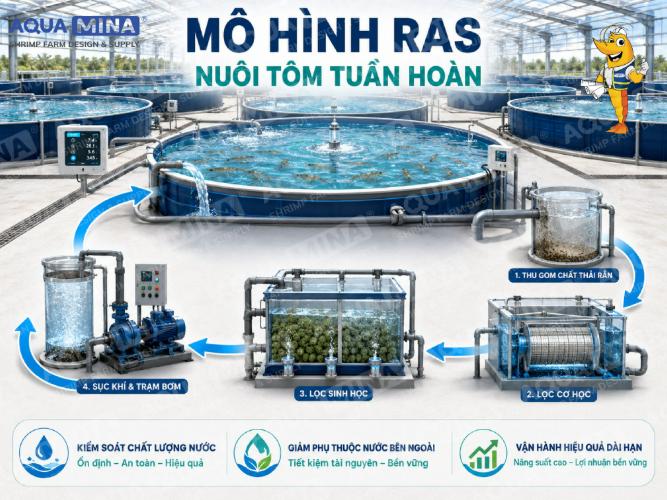
In Recirculating Aquaculture Systems (RAS), water is collected, treated, and reused rather than constantly replaced.
Consequently, the design is more complex than conventional pond setups, as it must seamlessly integrate:
Culture pond/tank → Water collection → Filtration/treatment → Waste management → Water recirculation.
The primary advantage of this approach is enhanced water quality control and reduced reliance on external water sources.
However, RAS demands higher capital expenditure, greater energy usage, specialized equipment, and advanced technical skills. Thus, full-scale implementation may not be necessary for every farm.
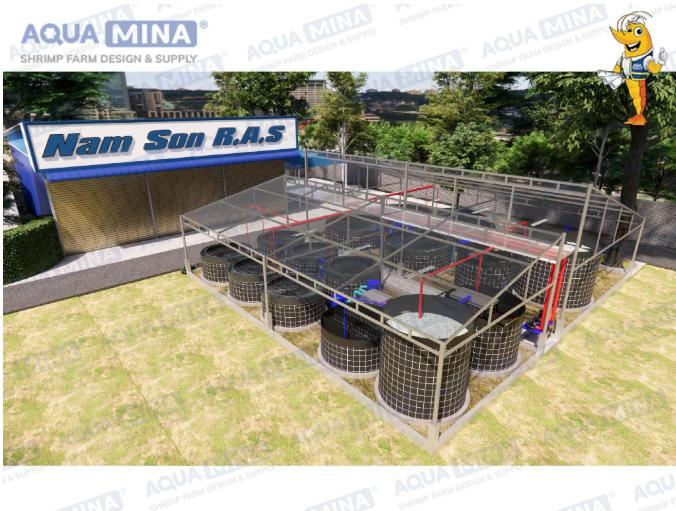
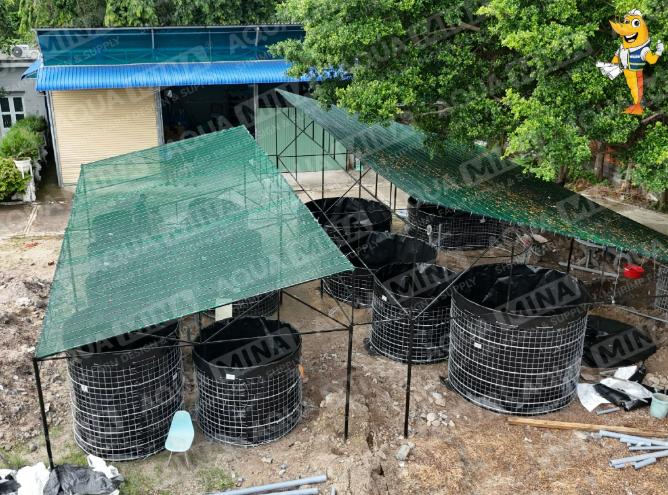
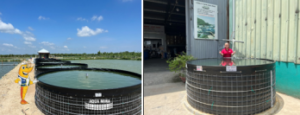
Project under construction by the Aqua Mina team
5. Waste Management as a Core Design Element
A modern farm should look beyond simple water in, water out logistics.
Culture waste must be effectively collected and treated directly within the system design.
Separating water lines, setting up dedicated treatment zones, and managing sludge effectively alleviate load on the system and prevent contaminants from recirculating back into the culture area.
This is a key reason farm design is moving toward comprehensive water-and-waste-stream management.
6. Energy Efficiency Factored in at the Blueprint Stage
Electricity accounts for a major portion of operational expenses in intensive farming.
Therefore, current design practices extend beyond asking does the equipment have enough capacity? to evaluating:
-
Is the equipment tailored to actual demand?
-
Can power output be adjusted dynamically?
-
Does the piping network cause unnecessary head loss?
-
Is the machinery easy to service?
A rationally designed system helps curb hidden costs throughout its operational lifespan.
7. Farm Design Is Not About The More High-Tech, The Better
High technology does not mean installing as many devices as possible. An optimal design strikes a balance between:
Capital Expenditure (CapEx) – Operational Expenditure (OpEx) – Control Capacity – Yield – Scalability.
For example, a medium-scale farm might only need to automate high-value stages rather than investing in a fully automated setup from day one.
Most importantly, the design must align with the farm’s actual scale, available capital, workforce capabilities, and farming model.
8. 2026 Shrimp Farm Design Trends: Designing for Long-Term Operation
The emerging trend is not just building a modern farm, but engineering one for years of sustainable efficiency.
An effective blueprint integrates from day one:
-
Water treatment & distribution
-
Aeration & energy efficiency
-
Waste treatment
-
Automation
-
Maintenance accessibility
-
System scalability
When all components are designed synchronously, farms can control costs easily, minimize costly redesign risks, and expand capacity with confidence.
Modern shrimp farm design is not about making the largest investment, but about arranging the right systems for peak operational efficiency.
AQUA MINA CO., LTD
WE WORK FOR THE SUCCESS


Ca Mau, Can Tho and An Giang Play a Leading Role in Vietnam’s Shrimp Industry
Protecting rice-shrimp yields against environmental fluctuations caused by prolonged rain
AQUA MINA Turbo Blower: Quiet, Energy-Efficient Air Supply for Aquaculture Ponds
AQUA MINA has accompanied the experimental tank system project at Can Tho University from its very early days
AQUA MINA AMONG 20 OUTSTANDING PRESENTATIONS AT THE WORKSHOP ON APPLYING SCIENCE AND TECHNOLOGY TO IMPROVE THE QUALITY OF VIETNAM’S AQUATIC PRODUCTS
Vietnam’s Shrimp Farming Industry Enters the High-Tech Race
The U.S. market relies heavily on imported shrimp to bridge its domestic supply gap
The 2028 supply crisis: The shrimp industry is projected to face a 400,000-ton material shortage
High profits from high-tech shrimp farming come with persistent risks
Intensifying El Niño Effect: Climate Change Risks Threaten the Global Shrimp Supply Chain
Evaluating Gaps in the Circular Economy Value Chain of the Shrimp Industry
A Comprehensive Overview of the Vietnamese Shrimp Industry


.jpg)