

Application of Round Tanks in Recirculating Aquaculture Systems (RAS): A Breakthrough Solution for Productivity
Application of Round Tanks in Recirculating Aquaculture Systems (RAS): A Breakthrough Solution for Productivity
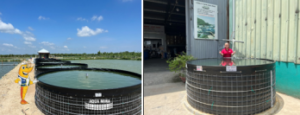
In the context of the aquaculture industry strongly shifting towards high-tech applications, Recirculating Aquaculture Systems (RAS) have become a gold standard thanks to their ability to control diseases, save water, and protect the environment. In a complete RAS, the shape of the rearing tank plays an extremely crucial role, directly determining operational efficiency.
Currently, round tanks are prioritized by top experts and large-scale farms. So why are round tanks so highly evaluated? Let's find out in detail through the article below.
1. Excellent Self-cleaning Mechanism
The biggest difference and also the most outstanding advantage of round tanks is the ability to optimize hydrodynamics.
Eliminating dead zones: Unlike rectangular or square tanks, round tanks have absolutely no corners. This prevents water stagnation, eliminating areas where waste can settle and generate toxic gases (NH3, NO2).
Centrifugal effect for waste collection: When water is pumped into a round tank at a tangential angle, it creates a continuous circular vortex. Centrifugal force combined with bottom resistance will sweep all feces, uneaten feed, and suspended solids to a single point at the center of the bottom (where the central drain is located).
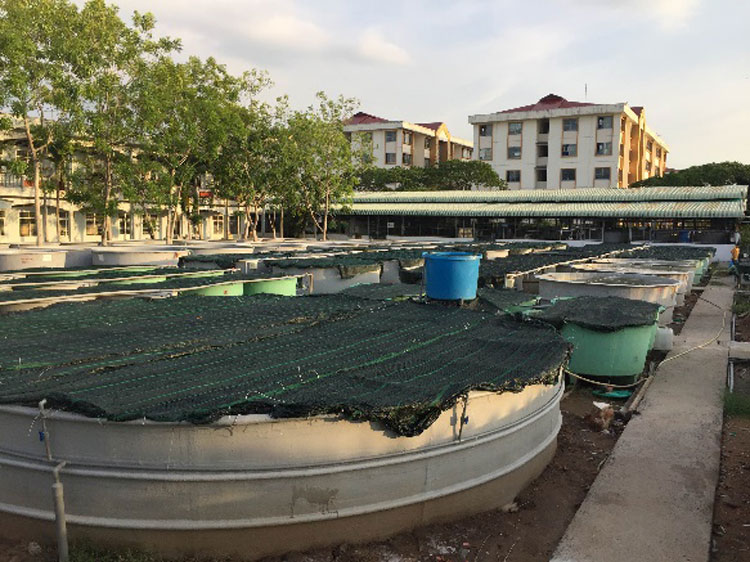
Reducing the load on the filtration system: Thanks to the rapid and thorough physical waste collection right at the central drain, the water sent to the biofilter will be much cleaner, helping the recirculating system operate smoothly and durably.
2. Maintaining Uniform Water Quality and Dissolved Oxygen Levels
The continuous water circulation and the absence of obstacles in round tanks help create a homogeneous living environment for aquatic animals.
Maximum oxygen diffusion: Dissolved oxygen (DO) from aeration systems will be distributed evenly throughout all positions in the tank by the flow. Not a single shrimp or fish will suffer from localized oxygen depletion.
Stabilizing environmental parameters: Temperature, pH, or alkalinity are always maintained at a balanced level throughout the tank space, minimizing the risk of environmental shock to the farmed animals.
3. Optimizing Space and the Growth of Farmed Animals
Many fish and shrimp species have the habit of swimming continuously or in schools.
Endless swimming space: Round tanks simulate the natural flow of rivers and streams, creating an endless track. Farmed animals can swim and exercise continuously, resulting in firmer flesh and enhanced disease resistance.
Controlling swimming speed: By adjusting the water pumping rate, farmers can easily control the flow velocity, ensuring the animals get just enough exercise without consuming too much energy, which would reduce the feed conversion ratio (FCR).
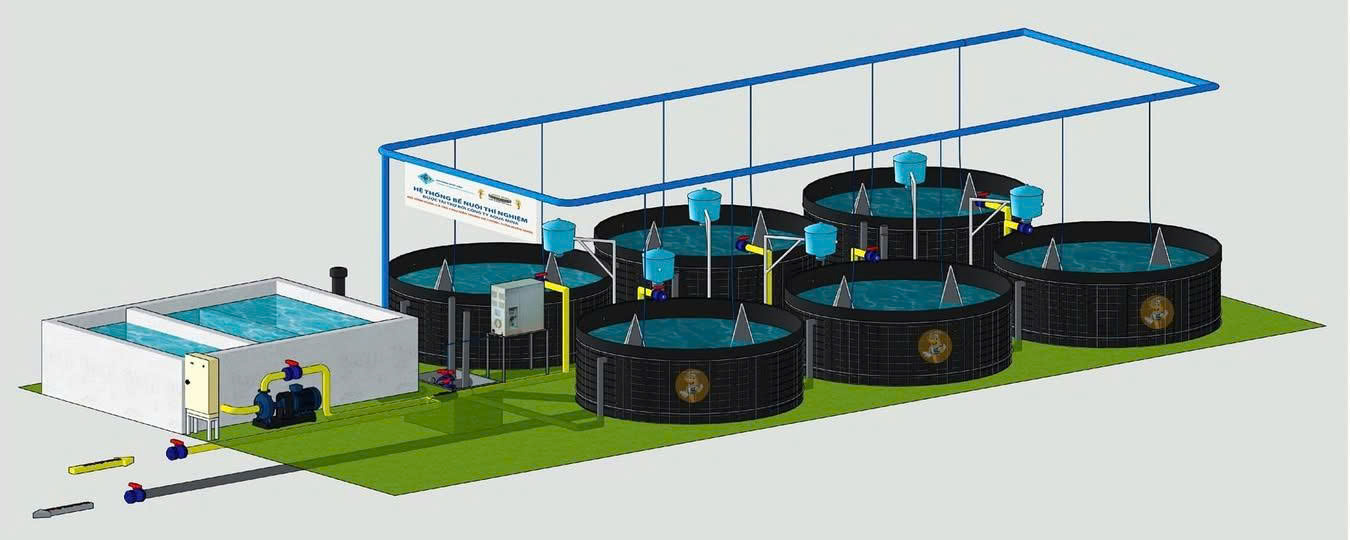
4. Core Technical Parameters When Designing RAS Round Tanks
To maximize the functionality of round tanks in RAS, the design and construction must strictly adhere to physical and technical principles.
Diameter to depth ratio: This is the deciding factor in creating an efficient flow. The ideal ratio is usually recommended to be between 3:1 and 5:1 (diameter is 3 to 5 times the depth).
Bottom slope: The tank bottom needs a slope towards the center (usually from 2% to 5%) to support gravitational force, making it easier for waste to slide toward the central drain.
Water inlet position: The water inlet pipe should be placed close to the tank wall and spray in a tangential direction. Splitting the inlet water jets along the depth of the tank also helps make the vortex more even and stable.
5. Conclusion
The combination of modern RAS technology and round tank design is a strategic, long-term investment. Although it requires a slightly larger footprint compared to rectangular tanks placed side-by-side, the value round tanks bring in terms of survival rate, growth rate, and optimization of operational costs (especially in water treatment) is completely superior.
For current high-tech intensive farming models, the application of round tanks is not just an option, but has become a prerequisite to ensure successful harvests.
AQUA MINA CO., LTD
– Address: 685 Le Duc Anh Street, Quarter 39, Binh Hung Hoa Ward, Ho Chi Minh City
– Phone: 1800 6071 (Toll-free hotline)
– Email: sales@aquamina.com.vn or oversea@aquamina.com.vn
– Aqua Mina’s Official Distributor in Japan: REX INDUSTRIES CO., LTD
– Address: 1-9-3 Hishiya-Higashi, Higashi-Osaka 578-0948, JAPAN
– Email: kimakubo@rexind.co.jp
– Phone: +81-(0)72-961-9893
– Website: www.rexind.co.jp/e/
WE WORK FOR THE SUCCESS
Ngày đăng : 22/07/2026
1367 View


Other Articles
Ca Mau, Can Tho and An Giang Play a Leading Role in Vietnam’s Shrimp Industry
Protecting rice-shrimp yields against environmental fluctuations caused by prolonged rain
AQUA MINA Turbo Blower: Quiet, Energy-Efficient Air Supply for Aquaculture Ponds
AQUA MINA has accompanied the experimental tank system project at Can Tho University from its very early days
AQUA MINA AMONG 20 OUTSTANDING PRESENTATIONS AT THE WORKSHOP ON APPLYING SCIENCE AND TECHNOLOGY TO IMPROVE THE QUALITY OF VIETNAM’S AQUATIC PRODUCTS
Vietnam’s Shrimp Farming Industry Enters the High-Tech Race
The U.S. market relies heavily on imported shrimp to bridge its domestic supply gap
The 2028 supply crisis: The shrimp industry is projected to face a 400,000-ton material shortage
High profits from high-tech shrimp farming come with persistent risks
Intensifying El Niño Effect: Climate Change Risks Threaten the Global Shrimp Supply Chain
Evaluating Gaps in the Circular Economy Value Chain of the Shrimp Industry
A Comprehensive Overview of the Vietnamese Shrimp Industry


.jpg)