

Artificial intelligence for ethical and sustainable shrimp farming
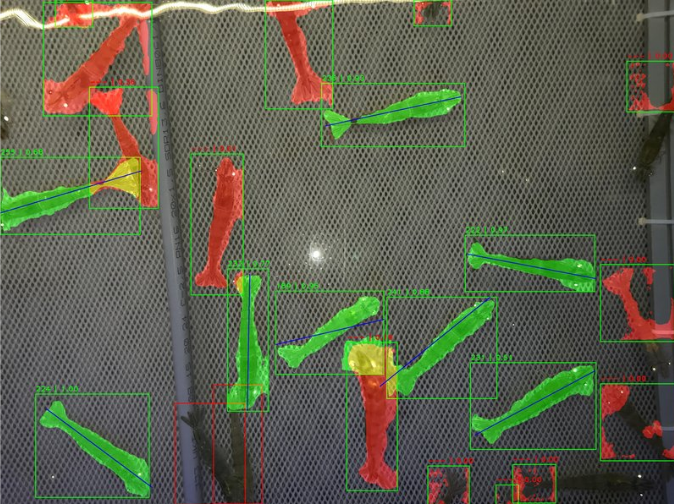
Under the leadership of the AWl, a team of researchers and engineers, together with Oceanloop, a pioneer in shrimp farming, have developed a computer-vision-based system that can count the number of shrimp and measure their length at up to 95% accuracy. This was achieved in real-time and under actual farming conditions, i.e., under high stock densities and in cloudy water. The system offers aquaculture companies a better understanding of how their livestock are performing, but also of how to farm them ethically. The new technology was developed to meet the needs of Europe's land-based shrimp farms, which are increasingly focused on improving sustainability and animal welfare.
The first prototyp was tested at Oceanloop's R&D farm in Kiel, Germany, in 2022. A modern smartphone, installed above the water's surface, automatically photographed the shrimp once a minute and transferred the live data to a local server. Then, computer-vision-based algorithms were used to count the number of shrimp in each image and measure the lengths of individual shrimp. The resulting information was to be provided to the fish-farming software package AquaManager°, making it possible to optimize growth and feeding models based on live data.
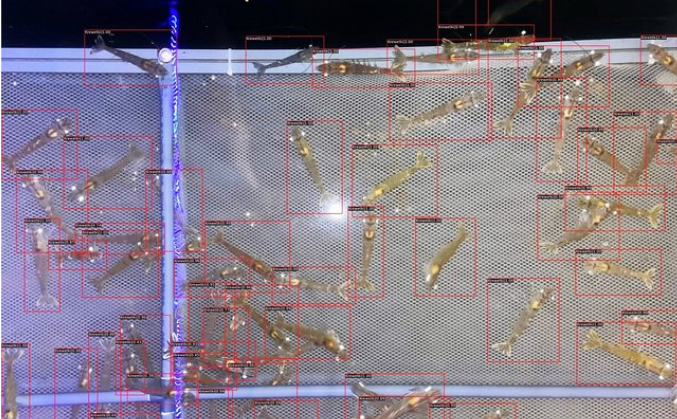
Body length determination to calculate individual length (red = length not measured, green = length measured)
In addition, the group was able to visually detect stress symptoms in shrimp. This function is used as an early warning system, but also to validate our stock density model. This bleeding-edge technology allows us to determine the density for each size group, which improves survival rates, growth, and feed efficiency, said Bert Wecker, co-CEO of Oceanloop.
Stephan Ende, the project's coordinator at the AWl, stressed the importance of monitoring livestock mortality, especially in aquaculture. “The mortality rates, which can range from 13-26% in salmon and can be up to 50% in shrimp, are substantially higher than with any other type of livestock. Online monitoring allows aquaculture companies to more quickly respond to signs of stress among their stock.
According to Tomasz Kowalczyk, founder and CEO of NeuroSYS, which contributed to algorithm development for the project, technological advances can change companies and entire sectors. We're ready to be part of that transformation and are working to introduce the advantages of Artificial Intelligence and Deep Learning to the shrimp-farming sector.
In the view of the consortium's members, the development of this technology represents an important milestone on the road to industrial-scale shrimp farming. Oceanloop plans to significantly expand its capacities in Europe by 2027 by building the largest and most sustainable land-based shrimp farm in the world, with an annual production volume of more
than 2,000 metric tons. “The ability to monitor the shrimp's growth and health with live data in real-time will on the one hand help to reduce risk in aquaculture. At the same time, it will offer complete transparency regarding biomass, making it possible to optimize the value chain from farming to processing to sale, said Fabian Riedel, co-founder and Co-CEO of
Oceanloop.
Another goal for the consortium is to expand cooperation with other interest groups to spur the digitalization of shrimp farming. When leading industrial partners work hand in hand with the scientific community, it can pave the way for a range of essential innovations in terms of sustainable and ethical shrimp farming. In this regard, the members plan to continue their close collaboration with NeuroSYS.
The project is supported by funds from the Federal Ministry of Food and Agriculture (BMEL) based on a decision of the Parliament of the Federal Republic of Germany via the Federal Office for Agriculture and Food (BLE) under the innovation support programme. In 2023, the initial partner MonitorFish left the project.
Cre: Hatchery Feed Management


Ca Mau, Can Tho and An Giang Play a Leading Role in Vietnam’s Shrimp Industry
Protecting rice-shrimp yields against environmental fluctuations caused by prolonged rain
AQUA MINA Turbo Blower: Quiet, Energy-Efficient Air Supply for Aquaculture Ponds
AQUA MINA has accompanied the experimental tank system project at Can Tho University from its very early days
AQUA MINA AMONG 20 OUTSTANDING PRESENTATIONS AT THE WORKSHOP ON APPLYING SCIENCE AND TECHNOLOGY TO IMPROVE THE QUALITY OF VIETNAM’S AQUATIC PRODUCTS
Vietnam’s Shrimp Farming Industry Enters the High-Tech Race
The U.S. market relies heavily on imported shrimp to bridge its domestic supply gap
The 2028 supply crisis: The shrimp industry is projected to face a 400,000-ton material shortage
High profits from high-tech shrimp farming come with persistent risks
Intensifying El Niño Effect: Climate Change Risks Threaten the Global Shrimp Supply Chain
Evaluating Gaps in the Circular Economy Value Chain of the Shrimp Industry
A Comprehensive Overview of the Vietnamese Shrimp Industry



.jpg)