


White-leg shrimp facing WSSV: When density and environment fluctuate together
English Translation
Stocking density has a significant impact on the virulence of White Spot Syndrome Virus (WSSV)
White-leg shrimp (g) were collected from a farm in Geoje (South Korea) and tested for WSSV using one-step PCR. Before the experiment, the shrimp Litopenaeus vannamei (3.26 ± 1.75 g) were acclimated for two weeks in a 250-L tank filled with UV-treated seawater (25 ± 0.5°C) and fed commercial feed. The virus source was the WSSV-Te-14 strain, isolated from diseased shrimp in Taean (2014), prepared and quantified prior to storage at –80°C. DNA was extracted from pleopods and rearing water (500 mL) after concentrating the virus using ferric coagulation and quantified using real-time PCR with an LOD95% of 4.67 copies/µL. Three stocking densities were tested: low (70 ind/m²), medium (140 ind/m²), and high (210 ind/m²), in 30–60 L tanks with a water depth of 0.25 m. Five temperature conditions were applied: constant 20°C, 25°C, 30°C, and fluctuating (30–20°C; 20–30°C). Two experiments were conducted—Exp. 1 at 25°C and Exp. 2 under all other temperature scenarios.
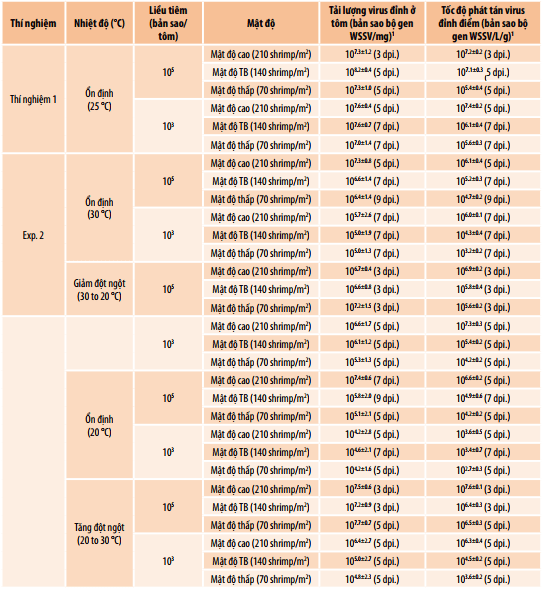
Table 1. Peak viral loads in shrimp and virus shedding rates in Experiments 1 and 2
¹ Viral copies in shrimp and shedding rates are presented as mean ± standard deviation (SD).
Infection and monitoring: Shrimp were intramuscularly injected with 0.1 mL of WSSV suspension at either a high dose (10⁵ copies/shrimp) or a low dose (10³ copies/shrimp). Control groups were injected with PBS. After infection, shrimp were monitored for 14 days to record cumulative mortality (2 replicates). Rearing water (500 mL, 3 samples/time point) was collected at 1, 3, 5, 7, 9, and 11 days post-infection for quantification of viral shedding. At the same time, three shrimp from each group were periodically sampled to analyze viral loads.
Results: Pathogenicity of WSSV under different stocking densities and temperature conditions
Across both experiments, stocking density had a clear effect on WSSV disease progression. At 25°C, shrimp stocked at high density died earlier and reached 100% mortality faster than those at low density; even at low viral doses, mortality increased with density. Under other temperature scenarios—especially fluctuating conditions (30–20°C, 20–30°C)—this trend became more pronounced. In contrast, constant conditions (20°C and 30°C) resulted in lower mortality rates. Viral loads and shedding rates increased rapidly and peaked earlier at high density, coinciding with the onset of mass mortality. Thus, high stocking density not only increased mortality but also accelerated WSSV transmission, elevating the risk of disease outbreaks in intensive systems.
Results: WSD risk assessment across different stocking densities
Analysis showed that stocking density strongly influenced WSD risk levels under varying temperature conditions. At medium density, mortality patterns varied with temperature but were not tightly linked to risk scenarios. In contrast, at high and low densities, vulnerable temperature scenarios (stable 25°C, increasing or decreasing 20–30°C) resulted in significantly higher mortality compared to less vulnerable scenarios (stable 20°C and 30°C). Specifically, in vulnerable scenarios, survival probability was very low (0.07–0.17) and median lethal time (LT50) occurred within 4–6 days, while in less vulnerable scenarios, survival probability was higher (0.26–0.41) and LT50 extended to 6–9 days. However, some density–temperature combinations showed no significant differences, reflecting the complex interaction between stocking density and environmental conditions in WSD progression.
Results: Changes in virus shedding under different WSD risk scenarios and stocking densities
The results indicated a positive correlation between shedding rate and WSSV load in shrimp under all conditions. However, at high density and under vulnerable temperature scenarios, shedding rates increased more sharply, evidenced by steeper slopes compared with low-density groups and less risky scenarios. This demonstrates that high stocking density combined with temperature fluctuations substantially increases the risk of transmission and outbreak of WSD.
Conclusion
This study demonstrates that high stocking density increases cumulative mortality and promotes faster transmission of WSSV compared to low density. Survival analysis showed that shrimp stocked at high density died more rapidly under high-risk WSD scenarios. Additionally, virus shedding rates were directly correlated with density, increasing proportionally regardless of environmental scenario. Therefore, high-density stocking not only induces stress in shrimp but also increases WSSV exposure risk through enhanced viral shedding, exacerbating outbreak severity. These findings provide a basis for epidemiological modeling and disease management strategies in intensive shrimp farming systems.
AQUA MINA CO., LTD
– Address: 685 Le Duc Anh Street, Quarter 39, Binh Hung Hoa Ward, Ho Chi Minh City
– Phone: 1800 6071 (Toll-free hotline)
– Email: sales@aquamina.com.vn or oversea@aquamina.com.vn
– Aqua Mina’s Official Distributor in Japan: REX INDUSTRIES CO., LTD
– Address: 1-9-3 Hishiya-Higashi, Higashi-Osaka 578-0948, JAPAN
– Email: kimakubo@rexind.co.jp
– Phone: +81-(0)72-961-9893
– Website: www.rexind.co.jp/e/

WE WORK FOR THE SUCCESS
Ngày đăng : 24/11/2025
1793 View


Other Articles
Ca Mau, Can Tho and An Giang Play a Leading Role in Vietnam’s Shrimp Industry
Protecting rice-shrimp yields against environmental fluctuations caused by prolonged rain
AQUA MINA Turbo Blower: Quiet, Energy-Efficient Air Supply for Aquaculture Ponds
AQUA MINA has accompanied the experimental tank system project at Can Tho University from its very early days
AQUA MINA AMONG 20 OUTSTANDING PRESENTATIONS AT THE WORKSHOP ON APPLYING SCIENCE AND TECHNOLOGY TO IMPROVE THE QUALITY OF VIETNAM’S AQUATIC PRODUCTS
Vietnam’s Shrimp Farming Industry Enters the High-Tech Race
The U.S. market relies heavily on imported shrimp to bridge its domestic supply gap
The 2028 supply crisis: The shrimp industry is projected to face a 400,000-ton material shortage
High profits from high-tech shrimp farming come with persistent risks
Intensifying El Niño Effect: Climate Change Risks Threaten the Global Shrimp Supply Chain
Evaluating Gaps in the Circular Economy Value Chain of the Shrimp Industry
A Comprehensive Overview of the Vietnamese Shrimp Industry



.jpg)