


How to Get Rid of Moss in Shrimp Farms
How to Get Rid of Moss in Farms
1. Improving and maintaining pond water quality
Poor water quality, with a salinity level that is too low (below 15 ppm) and an overly high organic matter concentration (over 90 ppm), can lead to moss growth. Therefore, farmers need to regularly and accurately conduct water quality checks to anticipate drastic changes in water parameters. Moss also grows well in lower water pH (below 7.5). Farmers can overcome this by giving dolomite treatment. Installing sufficient aerators also helps maintain oxygen circulation in the pond.
2. Installing netting fences
Moss is an organism that photosynthesizes to survive. Thus, it thrives in farm environments with ample sunlight intensity. Installing netting fences to reduce sunlight exposure in the farm can help to get rid of moss.
3. Using biological agents
Biological agents can be another way to get rid of moss in farms. Application of probiotics or decomposing bacteria in the pond can break down organic matter in the water to hinder moss growth. Increasing plankton population by giving just enough fertilizers also help reduce the clarity of pond water, controlling the sunlight intensity. Moreover, keeping moss-eating fish like milkfish and rabbitfish can help reduce existing moss growth.
4. Cleaning and disinfecting the pond
Cleaning the pond is essential during cultivation as well as when transitioning to a new cycle. Apply disinfectant during pond preparation to prevent moss growth. During cultivation, clean the walls and bottom of the pond regularly. Remove leftover feed and shrimp waste to prevent buildup, which can promote moss growth. Additionally, conduct siphoning to remove mud from the bottom of the pond.
5. Implementing feed management
Another important step to get rid of moss is through proper feed management. Adjust the amount of feed according to shrimp’s needs to prevent overfeeding, which causes a buildup of feed waste and decreases the water quality. Check feeding trays to monitor shrimp appetite and help determine the right amount of feed.
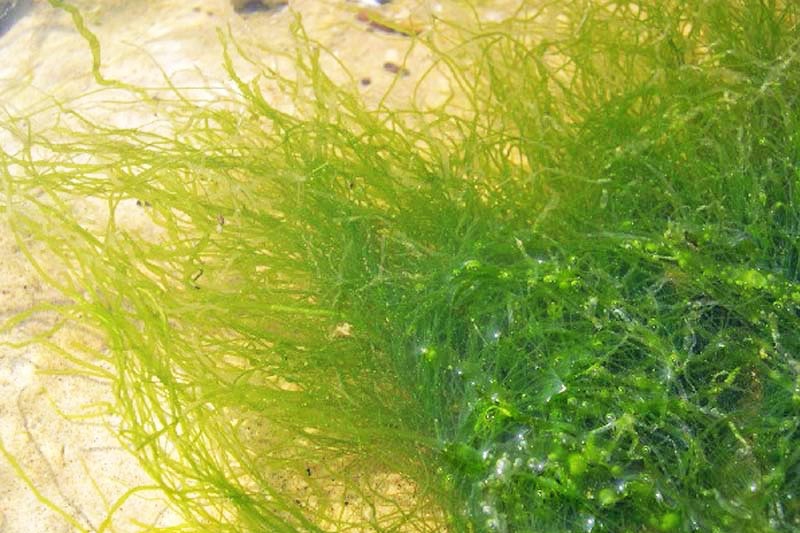
Causes of Moss in Shrimp Ponds
Moss in shrimp ponds can be caused by several factors. High sunlight intensity and an overly high water clarity can accelerate moss growth. Also, accumulated leftover feed and shrimp waste that are not cleaned out also support moss growth, as these organic materials become a nutrient source for moss.
Dangers of Moss in Shrimp Farms
Although it does not directly cause diseases, excessive moss can affect shrimp health. Moss can serve as a host for various pathogens like White Spot Syndrome Virus (WSSV) and Vibrio bacteria.
Besides pathogens, moss can also be a breeding ground for parasitic protozoa. These parasites can enter the shrimp’s gills, blocking respiration and reducing appetite.
Conclusion
Uncontrolled moss growth in shrimp farms is one of the causes of cultivation loss. Here are the ways to get rid of moss:
- Improving and maintaining pond water quality
- Installing netting fences
- Using biological agents
- Cleaning and disinfecting the pond
- Implementing feed management
Aqua Mina's distributor in Japan: REX INDUSTRIES CO., LTD
- Address: 1-9-3 Hishiya-Higashi, Higashi-Osaka 578-0948 JAPAN
- Email: kimakubo@rexind.co.jp
- Phone: +81-(0)72-961-9893
- Website: http://www.rexind.co.jp/e/
WE WORK FOR YOUR SUCCESS!
Ngày đăng : 31/03/2025
2187 View


Other Articles
Ca Mau, Can Tho and An Giang Play a Leading Role in Vietnam’s Shrimp Industry
Protecting rice-shrimp yields against environmental fluctuations caused by prolonged rain
AQUA MINA Turbo Blower: Quiet, Energy-Efficient Air Supply for Aquaculture Ponds
AQUA MINA has accompanied the experimental tank system project at Can Tho University from its very early days
AQUA MINA AMONG 20 OUTSTANDING PRESENTATIONS AT THE WORKSHOP ON APPLYING SCIENCE AND TECHNOLOGY TO IMPROVE THE QUALITY OF VIETNAM’S AQUATIC PRODUCTS
Vietnam’s Shrimp Farming Industry Enters the High-Tech Race
The U.S. market relies heavily on imported shrimp to bridge its domestic supply gap
The 2028 supply crisis: The shrimp industry is projected to face a 400,000-ton material shortage
High profits from high-tech shrimp farming come with persistent risks
Intensifying El Niño Effect: Climate Change Risks Threaten the Global Shrimp Supply Chain
Evaluating Gaps in the Circular Economy Value Chain of the Shrimp Industry
A Comprehensive Overview of the Vietnamese Shrimp Industry





.jpg)