



Plan 628 and a Journey Yet to Reach Its End
Facing the continuing complexity of violations of biodiversity laws, close coordination in management, conservation, administrative enforcement, and the fight against environmental crimes has become an urgent necessity. The signing and implementation of Plan No. 628/KH-BCA-BNN&MT between the Ministry of Public Security and the Ministry of Agriculture and Environment has marked a significant turning point, delivering notable achievements while also highlighting challenges that require continued attention in the coming years.
1. Inter-agency Cooperation and the “Numbers That Speak for Themselves”
On October 17, 2025, the Ministry of Public Security and the Ministry of Agriculture and Environment signed Plan No. 628/KH-BCA-BNN&MT. This important legal framework was established to mobilize coordinated efforts from central to local authorities in communication, prevention, detection, investigation, enforcement, and handling of violations related to wildlife protection, biodiversity conservation, and aquatic resource protection.
To implement the plan at the departmental level, on November 3, 2025, the Environmental Crime Prevention Police Department (Ministry of Public Security), the Border Guard Command (Ministry of National Defense), the Department of Nature Conservation and Biodiversity, and the Department of Forestry and Forest Protection (Ministry of Agriculture and Environment) signed a joint action plan. Shortly afterward, subordinate agencies under both ministries issued guidance documents and urged local authorities to actively implement the plan.
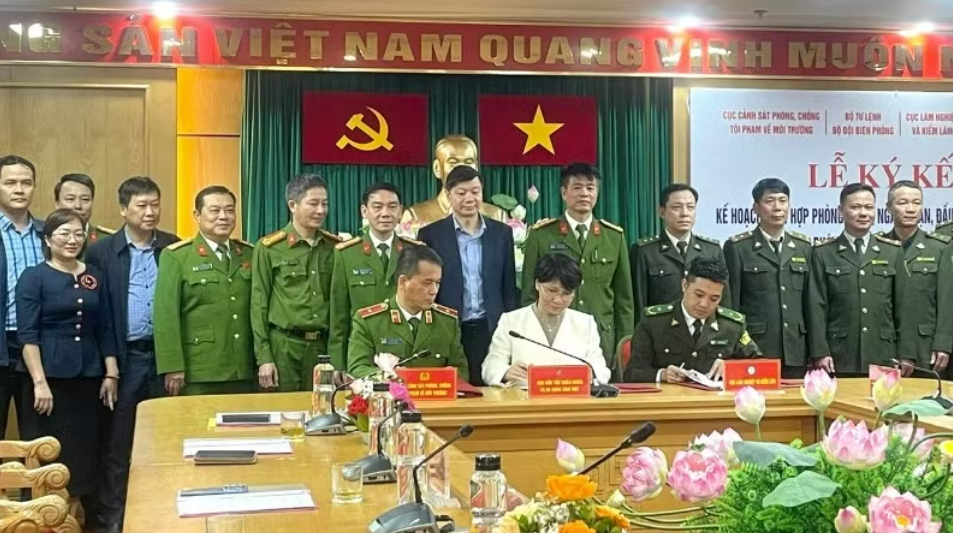
Leaders of the Environmental Crime Prevention Police Department, the Department of Forestry and Forest Protection, and the Department of Nature Conservation and Biodiversity signed the cooperation agreement.
The greatest achievement of Plan 628 after nearly eight months of implementation is reflected in the impressive figures recorded in the fight against environmental crimes and legal violations.
In intelligence gathering and information collection, inter-agency forces reviewed and identified 127 hotspots and 2,135 organizations and individuals showing signs of violations for monitoring and management. Authorities also detected and monitored 2,568 organizations and individuals suspected of illegally trading, advertising, or conducting business involving wildlife through cyberspace.
More than 9,000 awareness campaigns and 15,084 meetings, conferences, and seminars were organized, attracting over 300,000 participants. Approximately 9,000 organizations and individuals signed compliance commitments.
Joint forces conducted over 11,700 patrols and inspections, detecting 3,151 violations. Of these, 112 cases involving 190 suspects were criminally prosecuted, while 1,145 administrative violations resulted in fines totaling VND 6.737 billion. Authorities confiscated more than 14,300 wild animals, released nearly 3,700 back into the wild, rescued over 1,800 animals, and seized tens of thousands of hunting tools, equipment, and illegal fishing gear.
Nationwide, police forces alone handled 634 cases, including 47 criminal cases involving 59 suspects and 414 administrative cases with fines totaling VND 2.5 billion. Nearly 10,000 wild animals were successfully rescued and released back into their natural habitats.
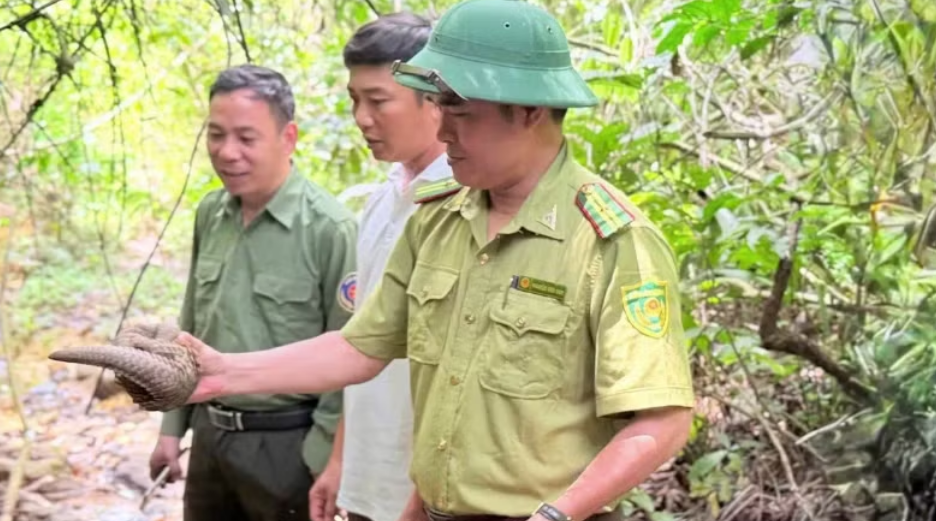
A C05 task force, in coordination with forest rangers, conducted a surprise inspection and recorded violations at a bird trading business in Tam Da Bird Market (Hanoi) for selling birds of unknown origin.
Among these efforts, the Environmental Crime Prevention Police Department (C05) directly investigated and handled 11 major cases, transferring one case for criminal prosecution and imposing administrative sanctions in ten cases. Recognizing the migration of criminal activities to cyberspace, C05 worked closely with the Cybersecurity and High-Tech Crime Prevention Department to investigate and strictly handle 19 personal accounts and 18 online groups engaged in violations, while referring 17 related individuals to local police authorities for further investigation.
The Dak Lak Elephant Conservation, Animal Rescue, and Forest Protection Management Center coordinated with relevant agencies to release rare and endangered wildlife into Chu Yang Sin National Park. Positive Signals from the Wildlife Protection Campaign
2. From Awareness to Practical Change at the Local Level
Under the close direction of leaders from both ministries and guidance from C05, local police forces actively advised Party committees and local governments to target violation hotspots directly. As a result, illegal hunting activities have significantly declined, while public awareness has improved markedly.
The movement “No Hunting – No Consumption” has spread widely. Many citizens voluntarily surrendered wild animals and shifted from hunting to conservation-related livelihoods. The criminal prosecution of several illegal wild bird trading cases has created a strong deterrent effect.
As a result, ecosystems across the country have shown initial signs of recovery. Migratory birds and rare wildlife species have gradually returned to many localities, including Hanoi, Bac Ninh, Hai Phong, Nghe An, Quang Tri, Quang Ngai, and Dong Thap. A notable example is the return of the Spot-billed Pelican to Tram Chim National Park after six years of absence.
In Hai Phong City, where ecological development is closely linked to environmental protection, key forces from the Economic Police Division and local police units conducted more than 1,000 awareness activities and three legal seminars within seven months, securing commitments from over 500 businesses and households.
Inter-agency teams carried out 853 patrols, uncovered 67 violations involving 70 offenders, released three monkeys and more than 9,000 wild birds back into nature, initiated four criminal cases, and imposed administrative fines exceeding VND 400 million across 54 cases.
After confiscation, Hai Phong police and forest rangers released migratory birds back into their natural habitats.
According to Colonel Ngo Duy Cuong, Head of the Police Division for Investigation of Corruption, Economic, Smuggling, and Environmental Crimes of Hai Phong Police, these achievements demonstrate the strong political commitment of the city’s police force and relevant agencies in environmental protection, biodiversity conservation, and combating violations against natural resources.
However, he noted that violations remain potentially complex. Some offenders continue exploiting vast forested areas, coastal zones, estuaries, and cyberspace to commit illegal activities.
In the future, alongside awareness campaigns, police forces will advise local authorities to support sustainable livelihoods such as reforestation and community-based ecotourism, encouraging greater public participation in conservation efforts.
Training programs will also be expanded for commune-level police officers, integrating wildlife protection topics into village meetings and community activities. Every commune-level police officer should become an effective local communicator who stays close to the people and understands community concerns.
Despite encouraging results, enforcement efforts continue to face significant obstacles as offenders constantly adopt more sophisticated methods to evade detection and complicate inspection efforts.
In particular, following intensified enforcement operations, violators have developed increasingly sophisticated ways to circumvent regulations. One common tactic is falsifying documents to legitimize illegally sourced wildlife, transforming illegal animals into seemingly legal ones. This represents one of the most serious violations.
Another issue is the intentional keeping of rare and endangered wildlife species without proper declaration.
A wild bird was successfully rescued by a joint task force comprising environmental police and forest rangers in Bac Ninh Province.
Lieutenant Colonel Nguyen Ngoc Quynh, Deputy Head of Division 3 of C05, stated that the greatest challenge today lies in the anonymity and high level of security offered by social media platforms. Offenders use unregistered SIM cards, fake accounts, frequently rename closed groups, and even employ encryption technologies. Delivery addresses are constantly changed, making it extremely difficult to identify senders and recipients.
He also pointed out that inspection and monitoring efforts have not kept pace with the rapidly evolving nature of violations. Many cases discovered through surprise inspections conducted by C05 reveal limitations in proactive prevention.
Commune-level police forces often find themselves reacting to incidents rather than controlling offenders from the outset. In some areas, individuals who had signed commitments not to hunt, trap, trade, or consume wildlife still proceeded to violate the law.
3. A Journey Far from Over
Major General Ha Xuan Duy, Deputy Director of the Environmental Crime Prevention Police Department, emphasized that combating crimes against wildlife and aquatic resources in Vietnam is a long-term mission requiring persistence and determination not only from law enforcement agencies but also from the entire political system and the support of the public.
To enhance the effectiveness of Plan No. 628/KH-BCA-BNN&MT, the Ministry of Public Security has instructed police units nationwide to address existing bottlenecks comprehensively and substantively, avoiding superficial implementation or symbolic campaigns. All violations must be handled strictly under the principle of “no forbidden zones and no exceptions.”
A cooperation agreement was also signed between C05 and the Border Guard Command.
Accordingly, four key solution groups have been identified:
- C05 will closely coordinate with relevant agencies to implement Plan No. 01 signed with the Central Committee of the Vietnam Buddhist Sangha, aiming to eliminate wildlife trading hotspots associated with illegal animal release activities or spiritual profiteering.
- Strengthen accountability among leaders and grassroots authorities while enhancing the role of local governments and commune-level police in monitoring localities and encouraging businesses to commit to not consuming wildlife.
- Intensify efforts to dismantle illegal networks involved in hunting, transporting, and trading migratory birds and wildlife; tighten management and strictly handle violations involving hunting rifles and homemade firearms. In the fisheries sector, authorities will decisively prevent destructive fishing practices using electric shocks, explosives, and prohibited fishing gear.
- Maintain joint patrols among police, forest rangers, border guards, and local authorities while proactively developing sustainable livelihood solutions for local communities through reforestation and community-based ecotourism models. At the same time, fishermen and ethnic minority communities will be equipped with knowledge to identify endangered species and avoid accidental hunting.
Source: Nhan Dan Newspaper.

WE WORK FOR THE SUCCESS


Ca Mau, Can Tho and An Giang Play a Leading Role in Vietnam’s Shrimp Industry
Protecting rice-shrimp yields against environmental fluctuations caused by prolonged rain
AQUA MINA Turbo Blower: Quiet, Energy-Efficient Air Supply for Aquaculture Ponds
AQUA MINA has accompanied the experimental tank system project at Can Tho University from its very early days
AQUA MINA AMONG 20 OUTSTANDING PRESENTATIONS AT THE WORKSHOP ON APPLYING SCIENCE AND TECHNOLOGY TO IMPROVE THE QUALITY OF VIETNAM’S AQUATIC PRODUCTS
Vietnam’s Shrimp Farming Industry Enters the High-Tech Race
The U.S. market relies heavily on imported shrimp to bridge its domestic supply gap
The 2028 supply crisis: The shrimp industry is projected to face a 400,000-ton material shortage
High profits from high-tech shrimp farming come with persistent risks
Intensifying El Niño Effect: Climate Change Risks Threaten the Global Shrimp Supply Chain
Evaluating Gaps in the Circular Economy Value Chain of the Shrimp Industry
A Comprehensive Overview of the Vietnamese Shrimp Industry











.jpg)