



Round HDPE Tanks – The Optimal Solution for Nursery Systems
Round HDPE Tanks – The Optimal Solution for Nursery Systems
In modern high-tech shrimp farming processes, the trend toward 2-stage or 3-stage rearing is gradually replacing the traditional direct-stocking method entirely. Among these, the nursery stage (stage 1) plays a decisive role, accounting for more than 50% of the success or failure of the entire crop.
To optimize this sensitive stage, round HDPE-lined tanks (floating tanks/raised tanks) have emerged as the most optimal pond architecture solution. Why is this model so highly regarded by experts and large farms? Let's find out in the article below.
1. What is a Round HDPE Tank?
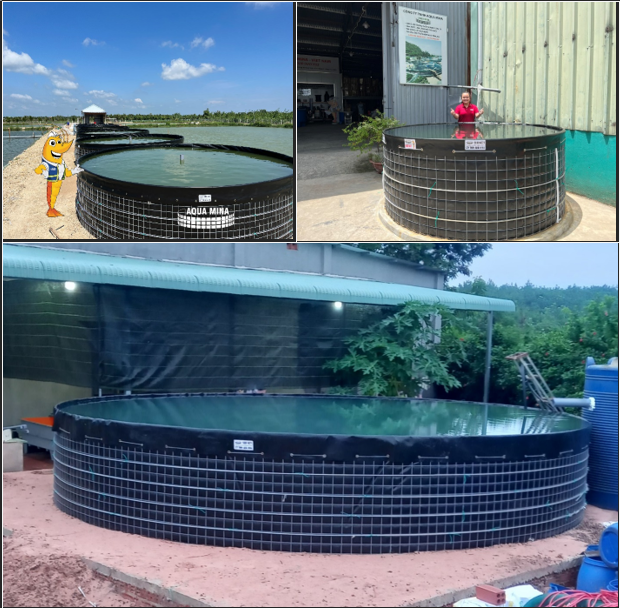
A round HDPE tank is a floating-style pond built above ground using a hot-dip galvanized steel frame (rust-resistant), enclosed by steel mesh or corrugated sheeting, with the tank floor and walls lined with a layer of virgin HDPE (High-Density Polyethylene) liner ranging from 0.75mm to 1mm in thickness.
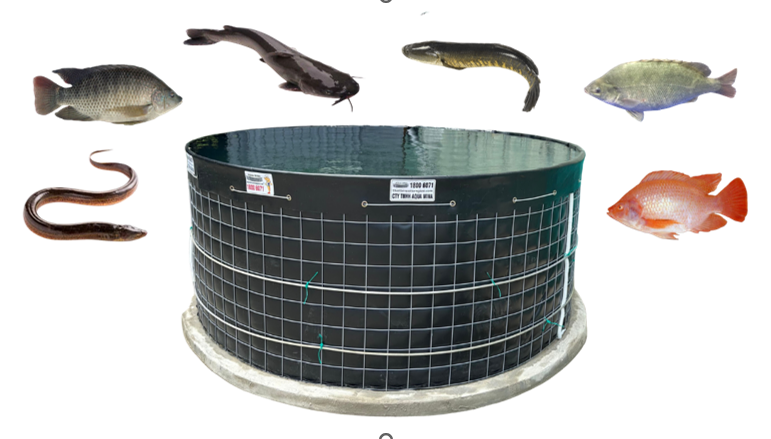
Tanks typically come in flexible diameters from 5m to 15m (water volume of roughly 20m³ to 200m³), making them extremely well-suited for managing and caring for post-larvae during their first 15–25 days of life.
2. Outstanding Advantages That Make Round HDPE Tanks Dominate Nursery Systems
2.1. Absolute Waste Collection Through Centrifugal Force
Unlike square or rectangular ponds, which often have dead corners with poor circulation, round tanks combined with water paddlewheel or bottom aeration systems create a perfect centripetal centrifugal force.
All shrimp feces, leftover feed, and dead algae are continuously pushed toward the center of the tank, where the siphon drain is located. This allows waste discharge to be virtually 100% complete, keeping the nursery water environment consistently clean and preventing the formation of dangerous toxic gases such as H₂S and NO₂ at the source.
2.2. Absolute Control Over Environmental Parameters and Disease
Post-larvae (PL) shrimp have very immature immune systems, making them highly vulnerable to weather changes and bacteria. The compact size of round HDPE tanks makes it easy for farmers to:
- Cover with shade netting or a greenhouse structure: Prevents heavy rain from causing a pH crash, and prevents intense sun from causing sudden temperature spikes.
- Disinfect and sterilize: Maximizes savings on chemicals and probiotics for water treatment thanks to the tank's small volume.
- Isolate pathogens: If a tank unfortunately becomes infected, disposal or isolation is far easier than with large ponds, minimizing risk to the entire farm.
2.3. Optimized Water Flow and Dissolved Oxygen
Due to its perfectly circular structure, water movement from paddlewheels or bottom aeration flows very smoothly with no obstructions, saving energy for equipment. At the same time, dissolved oxygen (DO) is distributed extremely evenly with no low-oxygen zones, allowing post-larvae to thrive even at ultra-high densities (1,000–3,000 shrimp/m²).
2.4. Cost Savings, Easy Installation, and Reusability
- No excavation needed: Round HDPE tanks are built entirely on flat ground, eliminating pond-digging costs and concerns about bank erosion or acid-contaminated groundwater intrusion.
- Fast construction: A round tank can be fully installed in just 1–2 days.
- High flexibility: When farm layout changes are needed, owners can easily disassemble the steel frame joints and roll up the liner to relocate it without losing asset value.
3. The Strategic Role of Round HDPE Tanks in Multi-Stage Farming
By applying round HDPE tanks to the nursery stage, farmers gain major competitive advantages:
- Higher survival rate: With specialized care in a clean environment, survival rates during the first 20 days typically reach above 90–95%.
- Shorter grow-out period: Shrimp transferred from round tanks to larger ponds have already passed through the sensitive stage, have stronger resistance, and grow much faster — shortening the subsequent grow-out period by 15–20 days.
- Faster crop turnover: While a grow-out pond is being harvested and prepared, the round HDPE tank can already begin nursing the next batch. Once the large pond is ready, shrimp can simply be transferred over to start a new crop, maximizing farm capacity year-round.
Conclusion:
The round HDPE-lined tank is the perfect cradle that protects post-larvae through their most sensitive stage. Investing in a properly built HDPE nursery tank system not only helps you master multi-stage farming technology, but also serves as a solid foundation for a bountiful harvest — minimizing risk right from the starting line.
AQUA MINA CO., LTD
WE WORK FOR THE SUCCESS


Ca Mau, Can Tho and An Giang Play a Leading Role in Vietnam’s Shrimp Industry
Protecting rice-shrimp yields against environmental fluctuations caused by prolonged rain
AQUA MINA Turbo Blower: Quiet, Energy-Efficient Air Supply for Aquaculture Ponds
AQUA MINA has accompanied the experimental tank system project at Can Tho University from its very early days
AQUA MINA AMONG 20 OUTSTANDING PRESENTATIONS AT THE WORKSHOP ON APPLYING SCIENCE AND TECHNOLOGY TO IMPROVE THE QUALITY OF VIETNAM’S AQUATIC PRODUCTS
Vietnam’s Shrimp Farming Industry Enters the High-Tech Race
The U.S. market relies heavily on imported shrimp to bridge its domestic supply gap
The 2028 supply crisis: The shrimp industry is projected to face a 400,000-ton material shortage
High profits from high-tech shrimp farming come with persistent risks
Intensifying El Niño Effect: Climate Change Risks Threaten the Global Shrimp Supply Chain
Evaluating Gaps in the Circular Economy Value Chain of the Shrimp Industry
A Comprehensive Overview of the Vietnamese Shrimp Industry












.jpg)
