

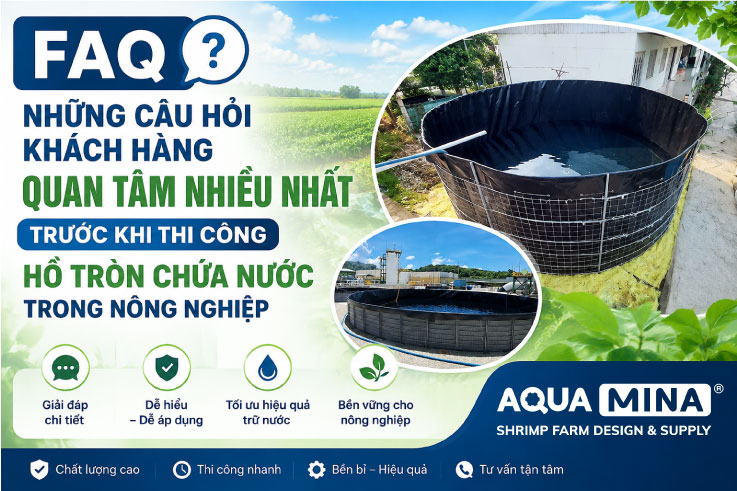
FAQ: The Most Frequently Asked Questions Customers Ask Before Constructing Circular Agricultural Water Storage Tanks
In recent years, the demand for investing in circular water storage tanks for agriculture has increased rapidly across many regions. Not only large-scale farms but also small growers are actively seeking long-term water storage solutions to cope with droughts, irrigation water shortages, and increasingly unpredictable weather conditions.
However, before making an investment decision, most customers share similar concerns regarding durability, storage capacity, cost, and the practical applications of water storage systems. Below are the questions AQUA MINA receives most frequently during real-world consultation and installation projects.
1. What are circular water storage tanks commonly used for?
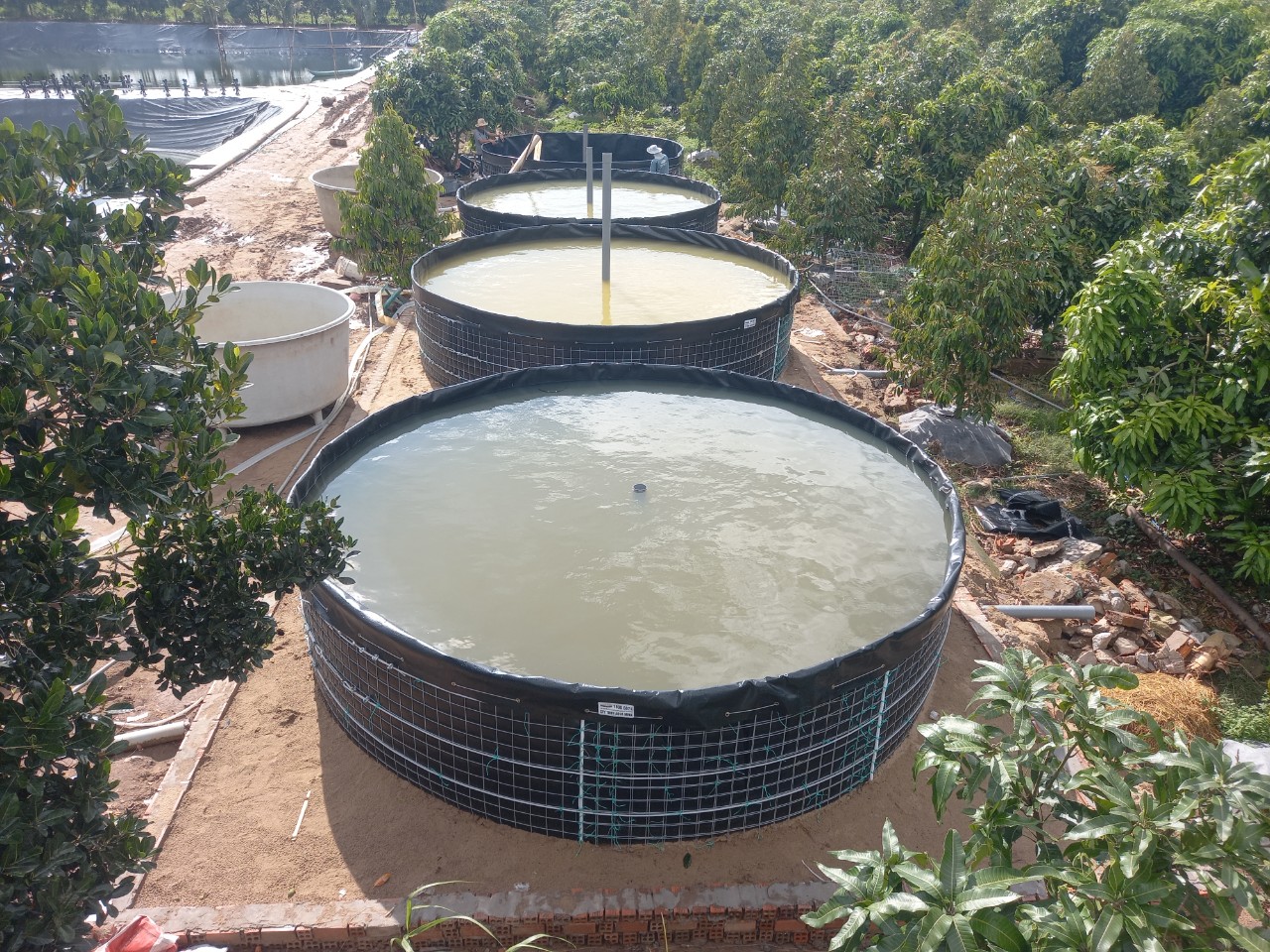
Today, circular water storage tanks are widely used in both agriculture and residential applications due to their large storage capacity and flexible installation options.
Many growers use them to store irrigation water during the dry season, reducing dependence on natural water sources. In addition, these systems are suitable for domestic water storage, aquaculture, fire protection reserves, and industrial facilities that require large volumes of water.
One of the most appreciated advantages is their fast installation, expandable capacity, and adaptability to various terrains.
2. What materials are AQUA MINA circular water tanks made of?
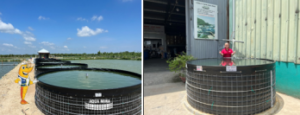
AQUA MINA circular water tanks are available in diameters ranging from 7m to 16m, with frame heights of 2m or 2.4m, making them suitable for irrigation, domestic water storage, fire protection, aquaculture, and construction projects.
The tank structure consists of:
Layer 1: Heavy-duty galvanized steel vertical frames manufactured from Hoa Phat cold-dip galvanized steel, combined with galvanized horizontal supports.
Layer 2: Galvanized welded steel mesh reinforcement for enhanced strength, with the frame coated in black anti-corrosion paint.
Layer 3: 0.75mm HDPE liner with excellent waterproof performance and durability. The liner is covered by a natural aging warranty of up to 5 years, providing reliable outdoor performance under harsh weather conditions.
As an added benefit, AQUA MINA includes free outlet flanges in sizes Ø114mm, Ø140mm, and Ø168mm to support efficient water discharge.
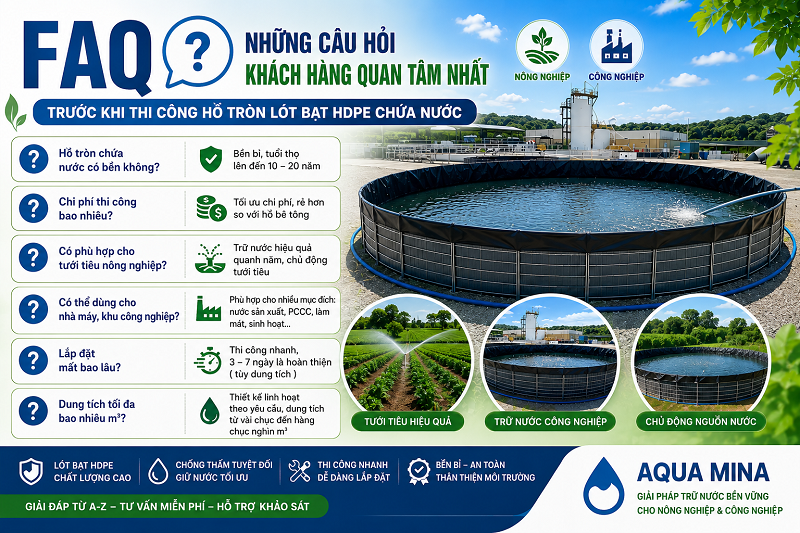
3. What sizes are available for circular water storage tanks?
Circular water storage tanks are available in various sizes to meet different operational needs.
Popular models include D16, D27, and D35, with heights ranging from 1.2m to 2.4m.
Depending on requirements, customers can select capacities ranging from a few cubic meters to several hundred cubic meters. Small households and home gardens often choose systems with capacities between 5–10 cubic meters, while large-scale agricultural operations may require dozens or even hundreds of cubic meters for long-term irrigation needs.
4. Are circular water storage tanks durable?
This is one of the most frequently asked questions before investment.
The lifespan of a tank depends on several factors, including the quality of the steel frame, HDPE liner thickness, installation workmanship, and operating conditions.
High-quality agricultural HDPE liners offer excellent waterproofing, UV resistance, and outdoor durability. When installed correctly and used appropriately, the system can operate reliably for many years without significant leakage issues.
5. Are circular water tanks easy to install?
Compared with traditional concrete reservoirs, modular circular tanks offer a major advantage in installation speed.
The system does not require complex construction work, can be deployed on various terrains, and may be dismantled and relocated when necessary.
This flexibility is one of the key reasons many customers prefer this solution over permanent reservoirs, especially for projects that may expand in the future.
6. How is the installation cost calculated?
Installation costs depend on several factors, including:
- Tank diameter
- Tank height
- HDPE liner thickness
- Installation location
- Total storage capacity
Customers are typically advised based on:
- Available investment budget
- Installation area
- Intended application
- Dry-season water storage requirements
Many customers prefer to calculate costs based on the required cubic meters of water storage rather than tank dimensions alone, as it provides a clearer understanding of actual water usage.
7. Do you provide transportation and on-site installation?
Yes. Most professional suppliers provide transportation and installation services directly at the project site.
This allows customers to save time and labor while minimizing installation errors.
Many providers also offer operational guidance and post-installation inspections to ensure long-term system reliability.
8. Do circular water storage tanks come with a warranty?
Warranty policies for the steel structure and liner materials may vary depending on the supplier.
Customers should prioritize suppliers that offer:
- Clear warranty policies
- Dedicated technical support
- Proven experience in HDPE reservoir installation
- Professional consultation based on actual needs
Choosing a reliable supplier can significantly reduce future maintenance and repair costs.
9. Should I choose a circular tank or an HDPE-lined earth reservoir?
Each solution is suitable for different requirements.
Circular tanks are ideal for projects requiring:
- Fast installation
- Limited land area
- High flexibility
Meanwhile, HDPE-lined earth reservoirs are generally more suitable for locations with large available land areas and extremely high water storage requirements.
The decision should be based on:
- Available land area
- Water demand
- Investment budget
- Long-term operational plans
10. What is the current trend in agricultural water storage?
As weather patterns become increasingly unpredictable, the current trend is to proactively store water during the rainy season instead of searching for solutions when drought arrives.
Systems such as:
- Circular water storage tanks
- HDPE-lined reservoirs
- Modular water storage tanks
are becoming increasingly popular because they offer:
- Cost efficiency
- Flexible storage capacity
- Fast installation
- Long-term water security
In regions frequently affected by water shortages, drought, or saltwater intrusion, maintaining reserves of dozens or even hundreds of cubic meters of water has become a critical strategy for reducing agricultural production risks.
Choose a Water Storage Solution – Choose AQUA MINA
Store Water During the Rainy Season – Thrive Through the Dry Season
From residential circular water tanks to large-scale HDPE reservoir solutions for agriculture, AQUA MINA is ready to provide expert consultation tailored to your specific requirements.
Committed to Quality – Optimized Capacity – Designed for Real Water Storage Needs.

WE WORK FOR THE SUCCESS


Ca Mau, Can Tho and An Giang Play a Leading Role in Vietnam’s Shrimp Industry
Protecting rice-shrimp yields against environmental fluctuations caused by prolonged rain
AQUA MINA Turbo Blower: Quiet, Energy-Efficient Air Supply for Aquaculture Ponds
AQUA MINA has accompanied the experimental tank system project at Can Tho University from its very early days
AQUA MINA AMONG 20 OUTSTANDING PRESENTATIONS AT THE WORKSHOP ON APPLYING SCIENCE AND TECHNOLOGY TO IMPROVE THE QUALITY OF VIETNAM’S AQUATIC PRODUCTS
Vietnam’s Shrimp Farming Industry Enters the High-Tech Race
The U.S. market relies heavily on imported shrimp to bridge its domestic supply gap
The 2028 supply crisis: The shrimp industry is projected to face a 400,000-ton material shortage
High profits from high-tech shrimp farming come with persistent risks
Intensifying El Niño Effect: Climate Change Risks Threaten the Global Shrimp Supply Chain
Evaluating Gaps in the Circular Economy Value Chain of the Shrimp Industry
A Comprehensive Overview of the Vietnamese Shrimp Industry



.jpg)