

Factors that Affect the Change of Salinity Level in Shrimp Ponds
Although vannamei shrimp can live in a wide range of salinity levels, an overly high or low salinity can cause losses in cultivation as it disrupts shrimp growth. What are the factors that affect the change of salinity lvel in shrimp ponds? How to overcome these factors?

A. What is shrimp pond salinity?
Salinity is the level of mineral salts dissolved in water. In order for shrimp to grow, the pond must have ideal salinity levels. According to Suriawan and Soermadjati (2007), vannamei shrimp can grow well or optimally at the salinity of 15-25 ppt, they can even still grow at 5 ppt. Salinity levels that go over or under the threshold can cause stress or even death to shrimp.
Changes of salinity level in shrimp ponds need to be a concern even when shrimp are still at the fry or postlarval stage. Thus, farmers should routinely monitor their farm salinity to anticipate unwanted changes.
B. Factor that affects the salinity level of shrimp ponds
1. Water evaporation
The evaporation of water due to hot weather is one of the factors that can change the salinity of shrimp ponds. Although evaporation reduces the water volume in the ponds, it does not cause the salts to evaporate along with it, thus increasing salinity. The size of the pond area also affects the rate of evaporation. The larger the pond, the faster evaporation can occur.
2. Rainwater
Rain can cause vannamei shrimp pond salinity to decrease as it has low salt content and pH. Rainwater also has a lower density than pond water, causing it to stay on the pond surface.
C. How to increase pond water salinity?
1. Adding seawater
Low salinity in shrimp ponds can be tackled by adding water with high salinity levels or seawater. Conduct salinity checks until the value matches the desired salinity. Add the seawater gradually to avoid a drastic change in salinity, which may cause stress in shrimp. Also, ensure the water has been sterilized in the water tank to minimize pathogen entry to the farm.
2. Discarding surface water
This is especially crucial when it rains. Freshwater and rainwater have a lower density compared to saltwater, so they will be on the surface of the pond. Therefore, farmers can also maintain salinity by discarding the water on the surface of the pond, which is essential during rainy periods.
D. How to decrease pond water salinity?
Adding freshwater: Freshwater with zero salinity (0 ppt) can be added to the pond to reduce salinity to the desired level. If the increase in salinity is due to evaporation, add water according to the amount lost due to evaporation.
For example, if the water in the pond is reduced by 5 cm in a day, farmers can add freshwater equivalent to the volume of water that has evaporated.
Conclusion
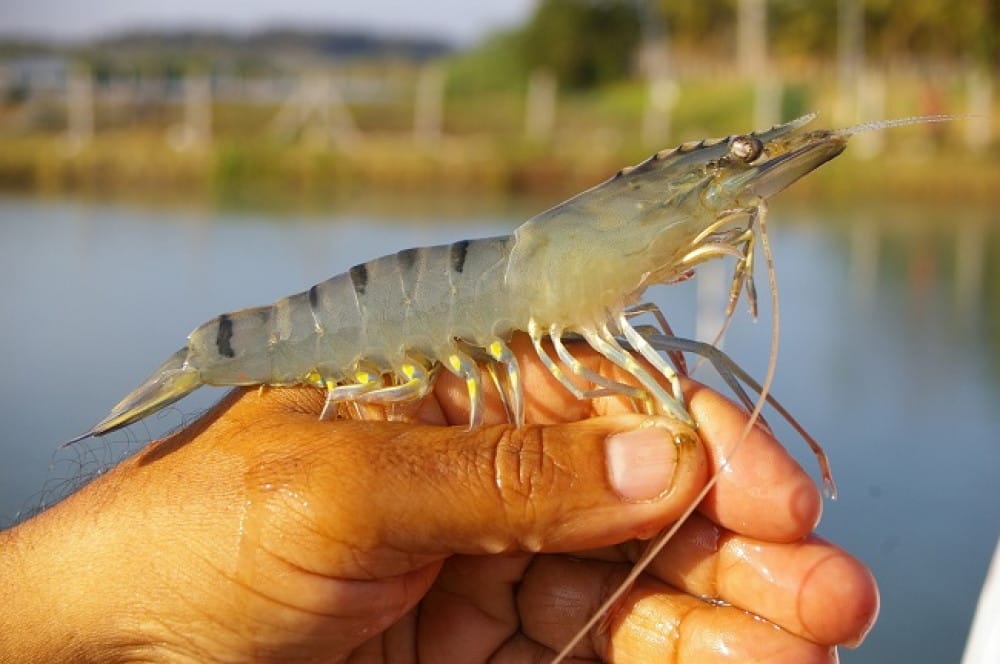
Salinity is one of the water quality parameters farmers should pay attention to as it affects shrimp growth in the farm. Salinity can change due to evaporation or rain. To increase salinity, farmers can add seawater or discard surface water. To reduce salinity, add freshwater.
Cre: jala.tech
Aqua Mina's distributor in Japan: REX INDUSTRIES CO., LTD
- Address: 1-9-3 Hishiya-Higashi, Higashi-Osaka 578-0948 JAPAN
- Email: kimakubo@rexind.co.jp
- Phone: +81-(0)72-961-9893
- Website: http://www.rexind.co.jp/e/
WE WORK FOR YOUR SUCCESS!
Ngày đăng : 31/03/2025
2709 View


Other Articles
Ca Mau, Can Tho and An Giang Play a Leading Role in Vietnam’s Shrimp Industry
Protecting rice-shrimp yields against environmental fluctuations caused by prolonged rain
AQUA MINA Turbo Blower: Quiet, Energy-Efficient Air Supply for Aquaculture Ponds
AQUA MINA has accompanied the experimental tank system project at Can Tho University from its very early days
AQUA MINA AMONG 20 OUTSTANDING PRESENTATIONS AT THE WORKSHOP ON APPLYING SCIENCE AND TECHNOLOGY TO IMPROVE THE QUALITY OF VIETNAM’S AQUATIC PRODUCTS
Vietnam’s Shrimp Farming Industry Enters the High-Tech Race
The U.S. market relies heavily on imported shrimp to bridge its domestic supply gap
The 2028 supply crisis: The shrimp industry is projected to face a 400,000-ton material shortage
High profits from high-tech shrimp farming come with persistent risks
Intensifying El Niño Effect: Climate Change Risks Threaten the Global Shrimp Supply Chain
Evaluating Gaps in the Circular Economy Value Chain of the Shrimp Industry
A Comprehensive Overview of the Vietnamese Shrimp Industry






.jpg)