

Should you choose a circular tank or a geomembrane-lined reservoir? How many years can an HDPE-lined reservoir last?
1. What is an Agricultural HDPE Geomembrane-Lined Reservoir?
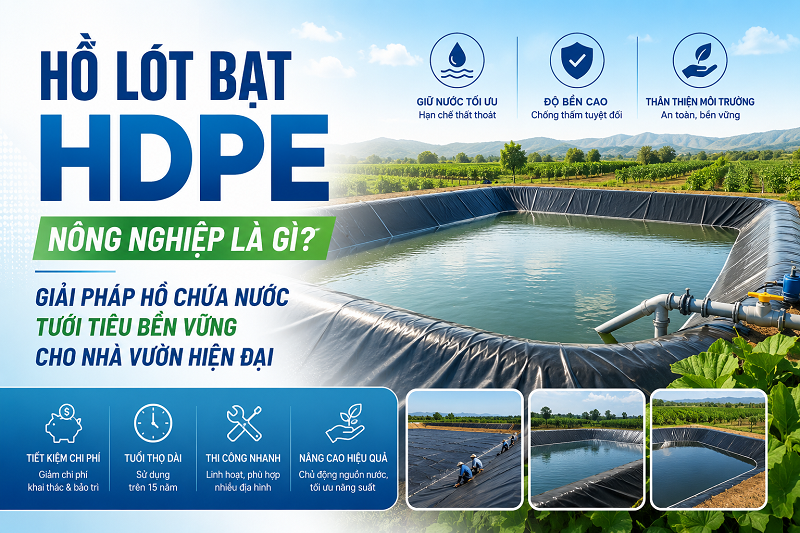
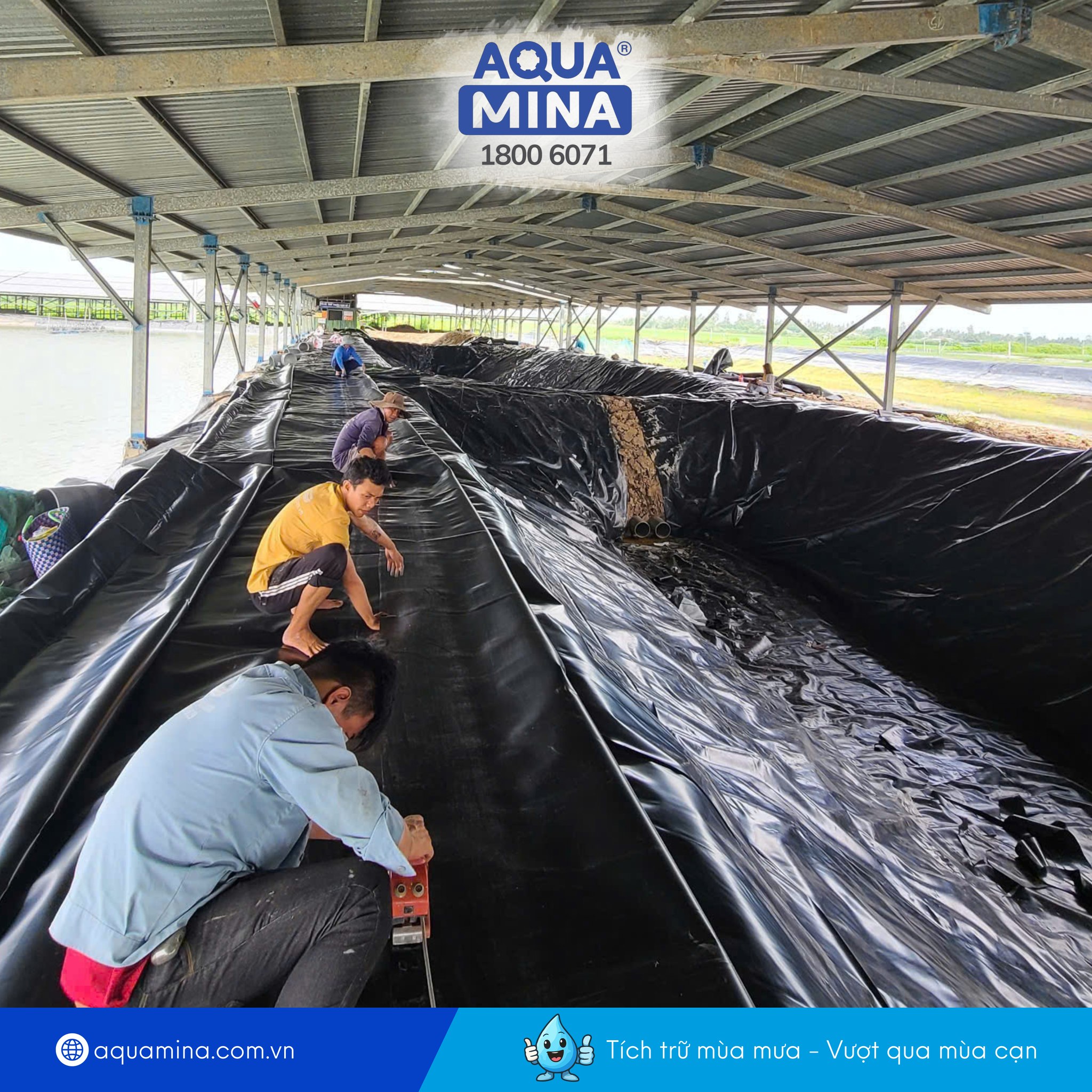
An agricultural HDPE-lined reservoir is a water storage system constructed by excavating a pond in the ground and then using a waterproof HDPE geomembrane liner to cover the entire bottom and slopes to prevent water from seeping into the soil.
Unlike traditional earthen ponds, this model creates a watertight irrigation reservoir, maintaining a stable capacity and minimizing water loss during long-term use.
This is currently a popular solution in modern agriculture, especially in regions facing a shortage of irrigation water during the dry season.
2. Why are Agricultural HDPE-Lined Reservoirs Increasingly Used?
In practical agricultural production, the biggest challenge is not just having a water source, but the capability to retain water stably over a long period.
Traditional earthen ponds often face issues such as water seepage, erosion, sedimentation, and a reduction in capacity over time. This escalates operational costs and lowers irrigation efficiency.
In contrast, agricultural HDPE geomembrane-lined reservoirs directly overcome these limitations thanks to their near-absolute waterproofing capability and high durability in outdoor environments.
3. Advantages of Waterproof HDPE Liners in Irrigation Reservoirs
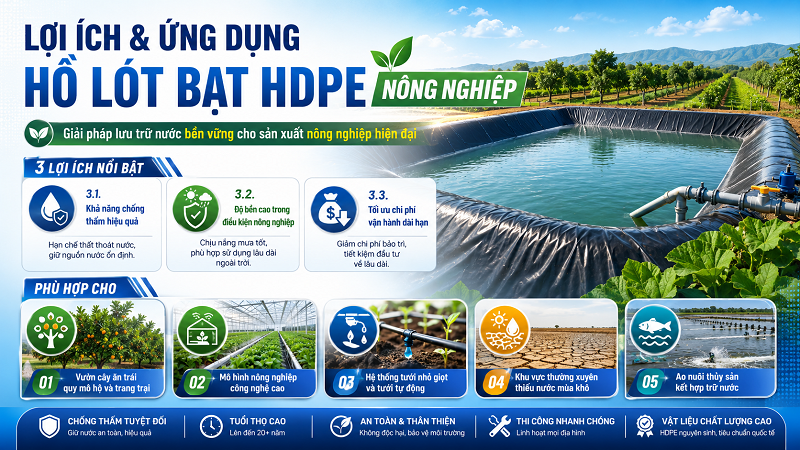
3.1. Effective Waterproofing Capability
Waterproof HDPE liners feature a high-density molecular structure that prevents water from seeping into the ground.
As a result, the irrigation reservoir can maintain a stable volume over long periods, minimizing water loss, especially during prolonged dry seasons.
3.2. High Durability under Agricultural Conditions
The lifespan of an HDPE-lined reservoir depends on the material quality and installation techniques.
In practical application:
-
Average lifespan ranges from 8 to 15 years.
-
UV-resistant HDPE liners can last from 15 to 20 years.
-
Properly engineered and installed projects can be utilized for over 20 years.
-
Compared to earthen ponds, this is a highly stable solution that is less affected by environmental conditions.
3.3. Optimizing Long-Term Operational Costs
Although the initial investment cost of an HDPE-lined reservoir is higher than that of an earthen pond, considering the entire service life cycle, the overall cost is lower due to:
-
Reduced water loss.
-
Lower costs for supplementary water pumping.
-
Reduced dredging and reinforcement expenses.
-
Lower routine maintenance costs.
-
Consequently, the long-term investment efficiency is significantly higher.
4. Applications of HDPE-Lined Irrigation Reservoirs
HDPE geomembrane-lined irrigation reservoirs are widely applied across various agricultural models, such as:
-
Household and commercial-scale orchards and fruit gardens.
-
High-tech agricultural models.
-
Drip and automated irrigation systems.
-
Regions frequently lacking water during the dry season.
-
Aquaculture ponds combined with water storage.
-
The reservoir capacity can be flexibly designed according to usage needs, ranging from 10 cubic meters, 50 cubic meters, 100 cubic meters, up to thousands of cubic meters.
5. Comparison: Earthen Ponds vs. Agricultural HDPE-Lined Reservoirs
| Criteria | Traditional Earthen Ponds | Agricultural HDPE-Lined Reservoirs |
| Water Retention | Low, prone to seepage | High, excellent waterproofing |
| Stability | Decreases over time | Long-term stability |
| Maintenance Costs | High | Low |
| Lifespan | Unstable | 8 to 20+ years |
| Long-term Efficiency | Low | High |
6. When Should You Use an Agricultural HDPE-Lined Reservoir?
You should invest in an agricultural HDPE-lined reservoir when:
-
Water storage demands range from medium to large.
-
The region frequently faces water scarcity during the dry season.
-
Water pumping costs are high.
-
Cultivating perennial crops that require a stable water source.
-
Aiming to reduce long-term operational costs.
-
For small-scale or temporary needs, circular tanks or portable water bladders can be utilized.
7. Long-Term Investment Efficiency of HDPE-Lined Reservoirs
Considering a service life cycle of 10 to 20 years, HDPE-lined reservoirs deliver clear economic efficiency:
-
Initial investment cost: Medium to high.
-
Operational cost: Low.
-
Water loss: Virtually negligible.
-
Maintenance cost: Minimal.
-
The utilization efficiency increases over time, particularly in medium-to-large-scale agricultural models.
An agricultural HDPE-lined reservoir is a modern water storage solution that aligns perfectly with the trend of proactive water management and long-term cost savings.
Compared to traditional earthen ponds, this solution offers distinct advantages in waterproofing, durability, and lifecycle investment efficiency.
It is an ideal choice for medium-to-large-scale agricultural models where a stable water source and optimized operational costs are required over the long term.
Solutions from AQUA MINA: Store in the rainy season – Overcome the dry season
AQUA MINA provides solutions for:
-
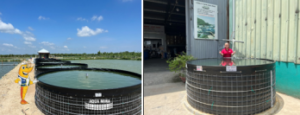
Domestic circular water tanks.
-
Agricultural-scale HDPE geomembrane-lined reservoirs.
-
Design consultation customized to the actual needs of each farm/garden.
Our Commitment:
-
Optimized storage volume.
-
Tailored solutions for every single farming model.
-
High durability – stable long-term operation.
Toll-Free Hotline: 1800.6071 for rapid consultation!
AQUA MINA CO., LTD

WE WORK FOR THE SUCCESS


Ca Mau, Can Tho and An Giang Play a Leading Role in Vietnam’s Shrimp Industry
Protecting rice-shrimp yields against environmental fluctuations caused by prolonged rain
AQUA MINA Turbo Blower: Quiet, Energy-Efficient Air Supply for Aquaculture Ponds
AQUA MINA has accompanied the experimental tank system project at Can Tho University from its very early days
AQUA MINA AMONG 20 OUTSTANDING PRESENTATIONS AT THE WORKSHOP ON APPLYING SCIENCE AND TECHNOLOGY TO IMPROVE THE QUALITY OF VIETNAM’S AQUATIC PRODUCTS
Vietnam’s Shrimp Farming Industry Enters the High-Tech Race
The U.S. market relies heavily on imported shrimp to bridge its domestic supply gap
The 2028 supply crisis: The shrimp industry is projected to face a 400,000-ton material shortage
High profits from high-tech shrimp farming come with persistent risks
Intensifying El Niño Effect: Climate Change Risks Threaten the Global Shrimp Supply Chain
Evaluating Gaps in the Circular Economy Value Chain of the Shrimp Industry
A Comprehensive Overview of the Vietnamese Shrimp Industry


.jpg)