


SHARING HOW TO IDENTIFY SHRIMP INFECTED WITH SLOW-GROWTH EHP DISEASE
Question: Is EHP disease contagious? Is there a way to identify shrimp infected with EHP?
How to identify shrimp infected with EHP slow-growth disease
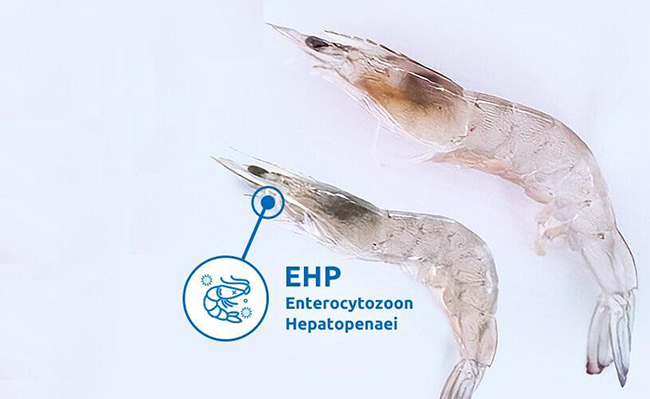
*Enterocytozoon hepatopenaei* (EHP) is an intestinal pathogen affecting both whiteleg shrimp and black tiger shrimp in aquaculture. EHP was first reported in 2016 in farmed whiteleg shrimp in Venezuela. EHP damages the intestinal walls, causing slow growth. It also infects the hepatopancreas tubules in shrimp, damaging organs that absorb nutrients from food.
Salinity affects EHP infection rates
In practice, EHP is more common in commercial ponds with high salinity (>15 parts per thousand (ppt)) compared to those with low salinity (<5 ppt). Since whiteleg shrimp are euryhaline (capable of surviving in both low and high salinity), scientists have conducted experiments to see if EHP can infect shrimp under low salinity conditions.
The experiment results indicate that shrimp feces are one of the main sources of EHP transmission. EHP transmission can occur at salinities below 2 ppt; however, the infection rate, speed, and severity are higher in ponds with high salinity, typically between 25–30 ppt.
Identifying EHP in shrimp through observation
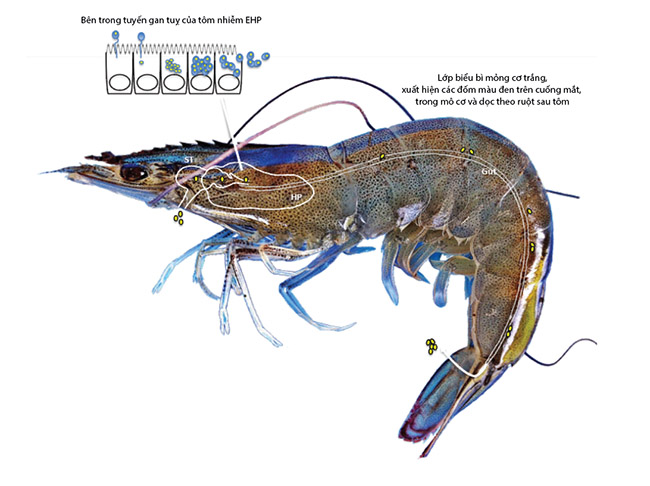
If you lack access to reliable lab services or facilities in your farming area, you can still visually assess the likelihood of EHP infection in your shrimp through careful observation and monitoring for the following signs:
- Thin epidermis under the shell, and the shell itself may also be thin.
- White muscle tissue due to ongoing stress caused by EHP.
- Black spots on the eyestalks, in the muscle tissue, and along the hindgut.
- Slower-than-normal growth rate.
- Reduced appetite, with no increase in food intake over time.
- Delayed molting and minimal growth following molting.
Source: VPAS
Contact AQUA MINA for consultation and supply of aquaculture round tanks and aquaculture equipment for high-tech shrimp farming.
- Address: 685 National Highway 1A, Binh Hung Hoa Ward, Binh Tan District, Ho Chi Minh City
- Phone: 1800 6071 (Toll-free hotline)
- Email: sales@aquamina.com.vn or oversea@aquamina.com.vn
Aqua Mina's distributor in Japan:
REX INDUSTRIES CO., LTD
- Address: 1-9-3 Hishiya-Higashi, Higashi-Osaka 578-0948 JAPAN
- Email: kimakubo@rexind.co.jp
- Phone: +81-(0)72-961-9893
- Website: http://www.rexind.co.jp/e/
Ngày đăng : 16/11/2024
3553 View


Other Articles
Ca Mau, Can Tho and An Giang Play a Leading Role in Vietnam’s Shrimp Industry
Protecting rice-shrimp yields against environmental fluctuations caused by prolonged rain
AQUA MINA Turbo Blower: Quiet, Energy-Efficient Air Supply for Aquaculture Ponds
AQUA MINA has accompanied the experimental tank system project at Can Tho University from its very early days
AQUA MINA AMONG 20 OUTSTANDING PRESENTATIONS AT THE WORKSHOP ON APPLYING SCIENCE AND TECHNOLOGY TO IMPROVE THE QUALITY OF VIETNAM’S AQUATIC PRODUCTS
Vietnam’s Shrimp Farming Industry Enters the High-Tech Race
The U.S. market relies heavily on imported shrimp to bridge its domestic supply gap
The 2028 supply crisis: The shrimp industry is projected to face a 400,000-ton material shortage
High profits from high-tech shrimp farming come with persistent risks
Intensifying El Niño Effect: Climate Change Risks Threaten the Global Shrimp Supply Chain
Evaluating Gaps in the Circular Economy Value Chain of the Shrimp Industry
A Comprehensive Overview of the Vietnamese Shrimp Industry


.jpg)