

KEY CRITERIA FOR ASSESSING THE QUALITY OF SHRIMP POSTLARVAE
1. Choosing the Right Postlarval Stage
The ideal stage for stocking shrimp post larvae (PL) is PL10, as the gills are fully developed, allowing the shrimp to better withstand packing, transportation, acclimation, and stocking stress. For areas with low salinity (below 5 ppt), PL12 is recommended.
Typically, farmers calculate PL age by days—for example, PL10 means 10 days after hatching. However, the correct stage should be determined based on rostrum spine count and gill development.
Rostrum-based identification:
PL10: has 3 fully developed spines and a budding 4th spine.
PL12: has 4 fully developed rostral spines. (See Figure 1 for visual reference.)
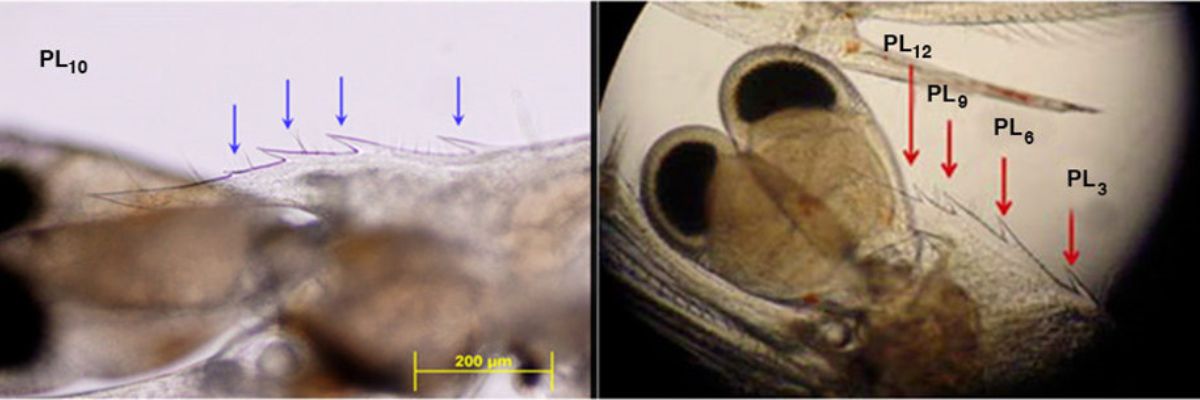
Gill-based identification:
At the PL stage, the gills begin developing branches. The degree of branching indicates the specific PL stage. (See Figure 2 for gill development stages.)
Size and weight reference at hatchery:
Day 14 (PL4–5): ≤ 1,000 PL / gram
Day 16 (PL7–8): ≤ 700 PL / gram
Day 18 (PL10): ≤ 300 PL / gram
2. Microbiological Testing
A crucial quality indicator is the microbial health of the postlarvae, ensuring no pathogens are introduced into the grow-out ponds.
PCR-negative results for major viral diseases such as:
White Spot Syndrome Virus (WSSV)
Taura Syndrome Virus (TSV)
Yellow Head Virus (YHV)
Other serious pathogens: EMS (Early Mortality Syndrome), EHP (Enterocytozoon hepatopenaei)
Negative results for Vibrio harveyi, the luminous bacteria
Total Vibrio count: < 1.0 × 10³ CFU/gram
Yellow-pigmented colonies should account for >90%. If these criteria are not met, the post larvae should not be stocked.
3. Visual (Organoleptic) Assessment
Sensory evaluation should be performed before packing and transport to grow-out ponds. Key parameters include:
Swimming activity:
Postlarvae should swim actively and against the current.
If >20% of the sample clusters in the center during agitation, they should not be packed.
Hepatopancreas (HP) observation:
Under a microscope, the HP should be large, dark, and rich in lipid droplets.
Small, pale HP with few lipids may indicate disease or poor health.
Signs of necrosis and fouling:
Poor water quality can cause infestations from parasites like Lagenidium (fungi) and ciliates (Zoothamnium, Epistylis, Vorticella).
These attach to the gills, carapace, and appendages, creating entry points for Leucothrix fungal infections, which can lead to mortality.
Early detection and treatment are critical.

Gut observation:
Healthy postlarvae show active peristalsis and a muscle-to-gut ratio of 4:1 at the 6th abdominal segment.
A poor ratio suggests weakness or health issues.
4. Transport Conditions
Transport plays a key role in maintaining post larvae quality. Key parameters include:
Transport duration < 4 hours: maintain normal temperature
4–12 hours: maintain 24–28°C
>12 hours: maintain 18–23°C
Dissolved oxygen: minimum 5 mg/L
Feed during transport: Use artemia (15–20 nauplii per postlarvae)
If packing and transport conditions are inadequate, ammonia levels can rise, causing stress and vulnerability to bacterial infections. Severe cases result in high mortality inside transport bags.
Source: nguoinuoitom.vn
Aqua Mina's distributor in Japan: REX INDUSTRIES CO., LTD
- Address: 1-9-3 Hishiya-Higashi, Higashi-Osaka 578-0948 JAPAN
- Email: kimakubo@rexind.co.jp
- Phone: +81-(0)72-961-9893
- Website: http://www.rexind.co.jp/e/
WE WORK FOR YOUR SUCCESS!
Ngày đăng : 16/05/2025
2569 View


Other Articles
Ca Mau, Can Tho and An Giang Play a Leading Role in Vietnam’s Shrimp Industry
Protecting rice-shrimp yields against environmental fluctuations caused by prolonged rain
AQUA MINA Turbo Blower: Quiet, Energy-Efficient Air Supply for Aquaculture Ponds
AQUA MINA has accompanied the experimental tank system project at Can Tho University from its very early days
AQUA MINA AMONG 20 OUTSTANDING PRESENTATIONS AT THE WORKSHOP ON APPLYING SCIENCE AND TECHNOLOGY TO IMPROVE THE QUALITY OF VIETNAM’S AQUATIC PRODUCTS
Vietnam’s Shrimp Farming Industry Enters the High-Tech Race
The U.S. market relies heavily on imported shrimp to bridge its domestic supply gap
The 2028 supply crisis: The shrimp industry is projected to face a 400,000-ton material shortage
High profits from high-tech shrimp farming come with persistent risks
Intensifying El Niño Effect: Climate Change Risks Threaten the Global Shrimp Supply Chain
Evaluating Gaps in the Circular Economy Value Chain of the Shrimp Industry
A Comprehensive Overview of the Vietnamese Shrimp Industry


.jpg)