

Is the investment cost of a water reservoir really more expensive than the risks of water shortage?
In the past, many businesses and construction units often viewed water storage systems as merely a minor component of the overall project. However, in recent years, as water shortages, weak water pressure, or prolonged droughts have occurred more frequently, many projects have begun to realize that failing to actively secure a water source can lead to significant hidden costs later on.
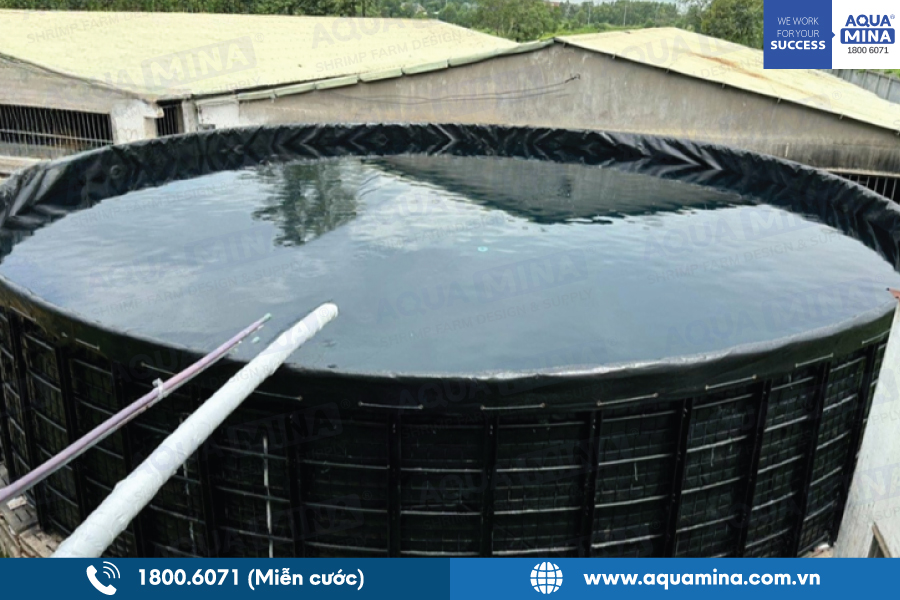
Particularly for construction projects, production areas, factories, farms, or large-scale developments, even a few days of water disruption can directly impact operational and construction schedules, as well as labor costs. This is the reason why more and more businesses are choosing to invest in Water Reservoirs right from the start rather than waiting for a shortage to look for temporary solutions.
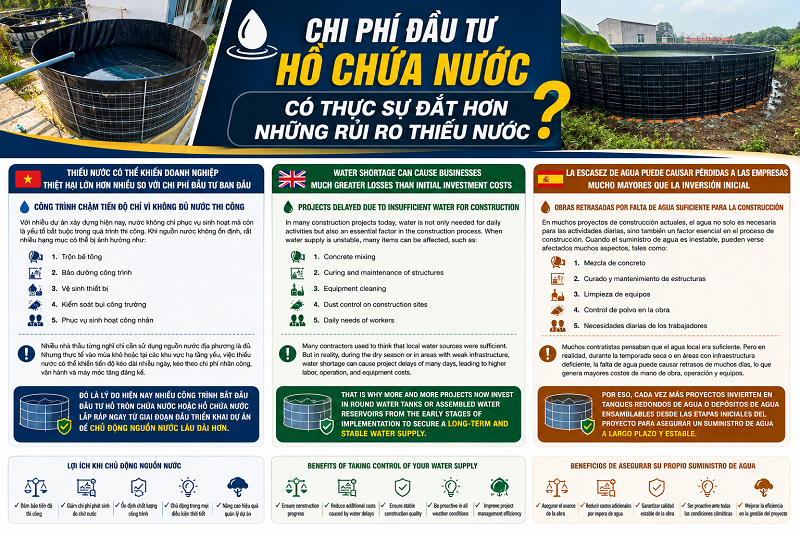
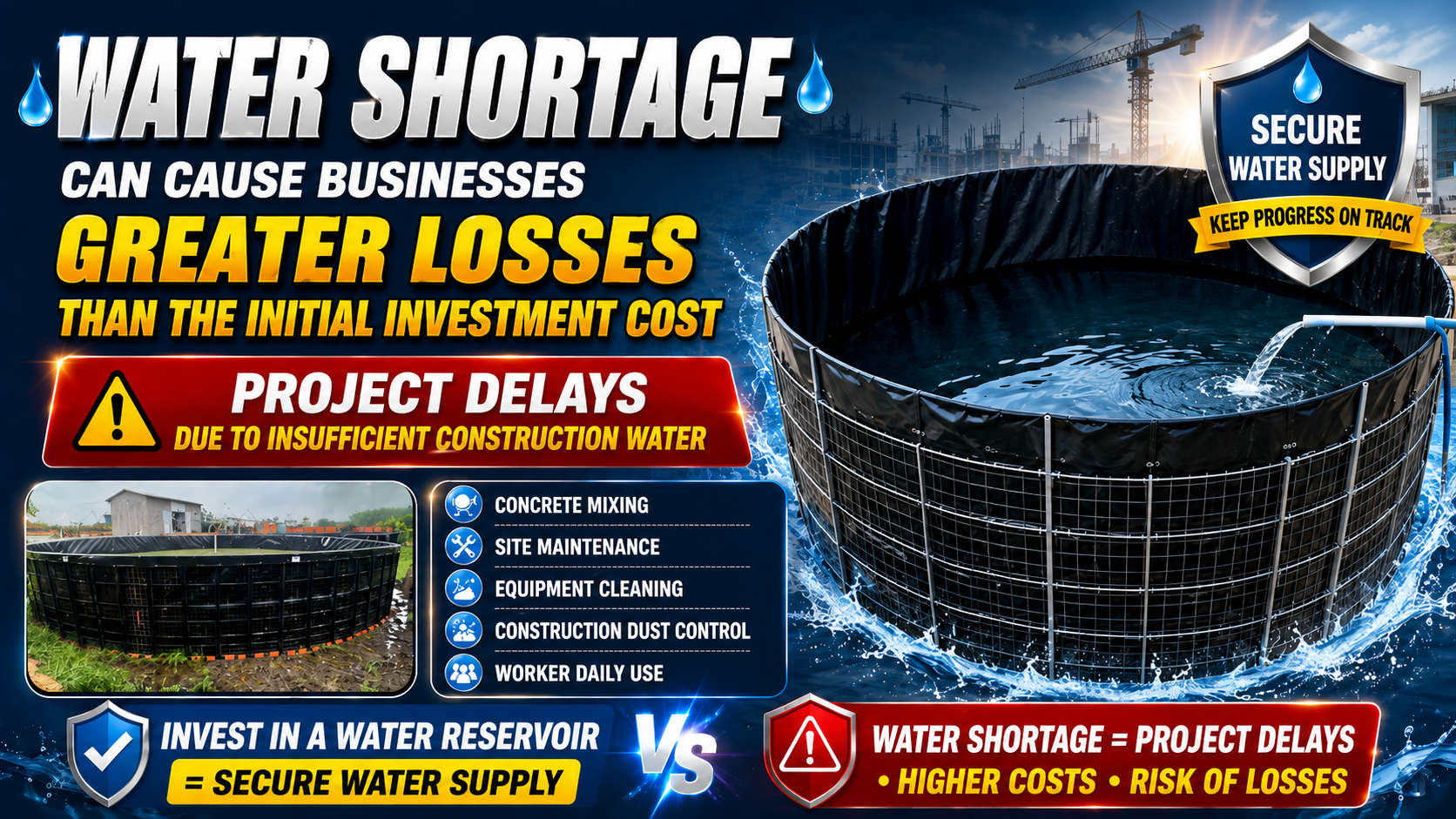
Water shortages can cause businesses much greater losses than the initial investment cost.
Construction projects delayed simply due to a lack of water
For many current construction projects, water is not only essential for daily staff use but is also a mandatory requirement during construction. When the water supply is unstable, numerous items can be affected, such as:
-
Concrete mixing
-
Project curing (concrete watering)
-
Equipment cleaning
-
Site dust control
-
Workers' daily activities
Many contractors used to think that relying on the local water supply was enough. However, during the dry season or in areas with weak infrastructure, water scarcity can delay schedules for days, leading to a significant increase in labor, operational, and machinery costs.
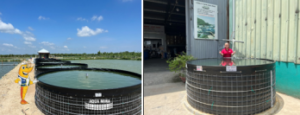
That is why many projects are now investing in Circular Water Tanks or Modular Water Reservoirs right from the initial phase of the project to ensure a long-term, proactive water source.
Manufacturing businesses face similar risks
Not only construction sites, but many factories and production facilities today also require a huge volume of reserve water to ensure continuous operations.
Particularly for:
-
Workshops
-
Industrial parks
-
Livestock farms
-
Processing plants
-
Logistics warehouses
-
Energy projects
A lack of water can disrupt the entire operational workflow.
Many businesses today are no longer just asking whether there is water to use, but are focusing on:
-
How many cubic meters of water need to be stored?
-
If water is lost for 2–3 days, will it affect operations?
-
Does the firefighting system have a sufficient backup supply?
Consequently, the demand for Firefighting Water Storage Tanks and large-scale water reservoirs has risen sharply over the past few years.
Why do many current projects prioritize modular water reservoirs?
More flexible than traditional concrete tanks
While businesses previously had to build fixed concrete tanks with high costs and long construction times, modern solutions like Portable Water Tanks and HDPE Pond Construction offer significantly more flexibility and optimization.
Many units select modular systems because of:
-
Fast installation/construction
-
Easy capacity expansion
-
Investment budget optimization
-
Adaptability to various terrains
-
Ease of disassembly or relocation when needed
Especially for temporary projects or phased construction, this solution saves much more money compared to investing in a permanent, fixed system from day one.
Businesses now care about actual water storage capacity
A clear shift in today's market is that corporate clients no longer just ask about the tank dimensions; they focus more on the actual storage capability.
For example:
-
How many cubic meters of water can the reservoir hold?
-
How long can it sustain operations?
-
Is it enough for both production and firefighting at the same time?
Many projects now choose:
-
Tanks holding dozens of cubic meters for small projects
-
Reservoirs holding hundreds of cubic meters for factories and production
-
Large-scale reservoirs for agriculture or industrial zones
This allows businesses to be much more proactive during peak periods or prolonged dry seasons.
Securing a water source is becoming the new standard for many projects
Reality shows that the cost of investing in an Irrigation Water Tank or a water reservoir is usually a one-time expense, but the risk of water shortage can persist throughout the entire operational lifespan.
Especially in the context of:
-
Erratically shifting weather
-
Prolonged droughts
-
Overloaded water supply infrastructure
-
Ever-increasing operational costs
Having a water storage system ready is no longer just a backup measure; it is becoming a critical part of the long-term operational strategy for many businesses and projects.
Many developers are willing to invest early, understanding that securing dozens or hundreds of cubic meters of water can sometimes prevent much larger losses down the line.
Choose a Water Storage Solution – Choose AQUA MINA Store in the rainy season – Overcome the dry season
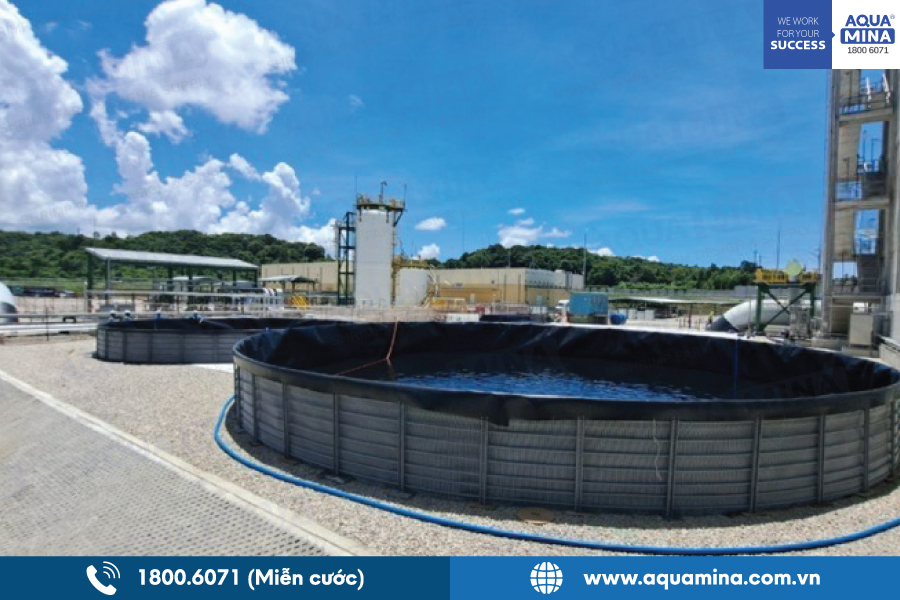
From circular water tanks for domestic use to large-scale HDPE reservoir solutions for agriculture, AQUA MINA is ready to consult and provide the right solution based on your actual usage needs. Commitment to Quality – Optimized Volume – Tailored to Actual Water Storage Needs.
AQUA MINA CO., LTD

WE WORK FOR THE SUCCESS


Ca Mau, Can Tho and An Giang Play a Leading Role in Vietnam’s Shrimp Industry
Protecting rice-shrimp yields against environmental fluctuations caused by prolonged rain
AQUA MINA Turbo Blower: Quiet, Energy-Efficient Air Supply for Aquaculture Ponds
AQUA MINA has accompanied the experimental tank system project at Can Tho University from its very early days
AQUA MINA AMONG 20 OUTSTANDING PRESENTATIONS AT THE WORKSHOP ON APPLYING SCIENCE AND TECHNOLOGY TO IMPROVE THE QUALITY OF VIETNAM’S AQUATIC PRODUCTS
Vietnam’s Shrimp Farming Industry Enters the High-Tech Race
The U.S. market relies heavily on imported shrimp to bridge its domestic supply gap
The 2028 supply crisis: The shrimp industry is projected to face a 400,000-ton material shortage
High profits from high-tech shrimp farming come with persistent risks
Intensifying El Niño Effect: Climate Change Risks Threaten the Global Shrimp Supply Chain
Evaluating Gaps in the Circular Economy Value Chain of the Shrimp Industry
A Comprehensive Overview of the Vietnamese Shrimp Industry


.jpg)