


White Spot Disease (WSD) in Shrimp: Causes, Symptoms, and Accurate Diagnostic Methods
According to epidemiological studies, White Spot Disease (WSD) has a broad host range, affecting many important farmed shrimp species such as the black tiger shrimp (Penaeus monodon), whiteleg shrimp (Litopenaeus vannamei), and Kuruma shrimp (Penaeus japonicus). It also infects various wild crustaceans such as crabs, fiddler crabs, and wild shrimp, which serve as reservoirs of the pathogen. Shrimp can be infected at all developmental stages, from post-larvae to adults, with the most susceptible periods occurring between 20–45 days and 60–65 days after stocking.
The disease often outbreaks during seasonal transitions when environmental conditions change abruptly. In Vietnam, the occurrence varies by region: from May to July in the North, from February to May in the Central region, and from November to March of the following year in the South. Notably, WSD has a global distribution and accounts for approximately 40–50% of the shrimp disease outbreaks reported annually.
Regarding transmission, WSSV spreads through both horizontal and vertical routes. Horizontal transmission occurs via contaminated water, pond sediments, untreated fresh feed, dead shrimp, as well as through equipment, vehicles, and human activities. Additionally, intermediate carriers such as small crustaceans, polychaete worms, bivalve mollusks, squid, and shrimp-eating birds can disseminate the pathogen between ponds. Vertical transmission occurs from broodstock to eggs and larvae; even asymptomatic individuals can carry and transmit the virus to subsequent generations.
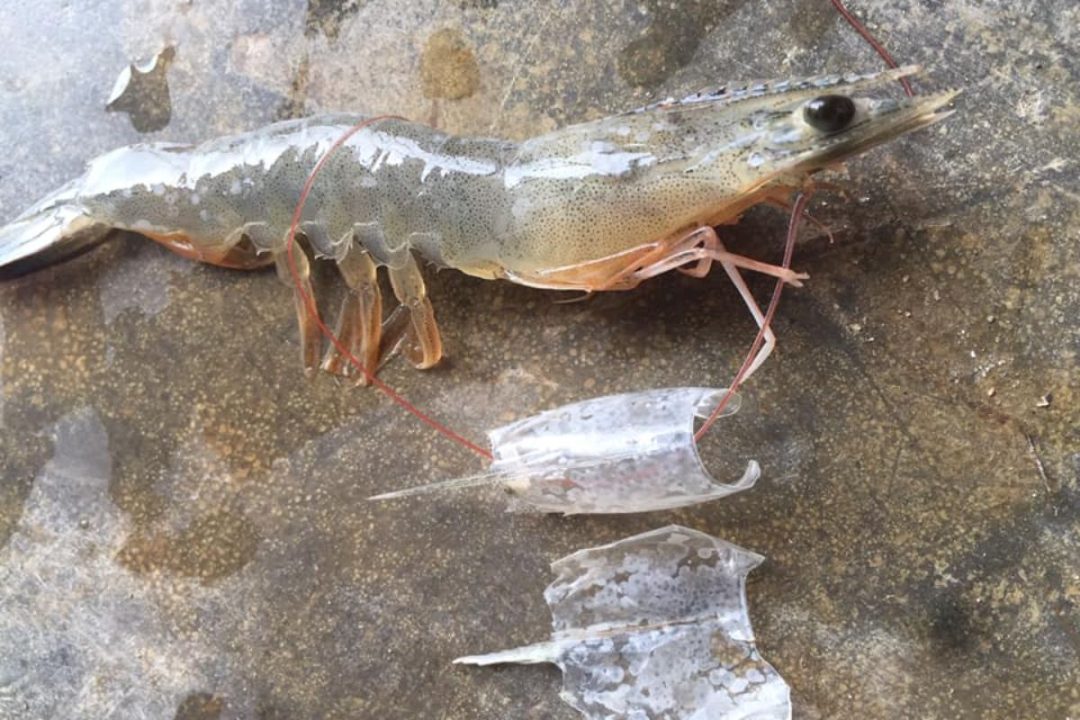
Clinical manifestations of WSD are highly evident during the acute stage. Infected shrimp typically exhibit reduced or sudden cessation of feeding, lethargic swimming, disorientation, and aggregation near pond edges. The body turns pinkish-red, the shell becomes fragile and easily detached, and the hemolymph becomes diluted with delayed clotting. The characteristic sign is the presence of circular white spots, measuring 0.5–2 mm in diameter, densely distributed beneath the carapace and abdominal segments. Mortality rates can reach 80–100% within just 2–5 days. In contrast, during the chronic stage, shrimp may carry the virus without showing obvious symptoms, particularly when environmental conditions are stable and stress levels are low.
For accurate diagnosis, samples such as gills, pleopods, or whole shrimp should be immediately preserved in 90–95% ethanol at a ratio of 1:10. Diagnostic methods such as PCR or Real-time PCR are conducted in accordance with the Vietnamese standard TCVN 8710-3:2019 at accredited laboratories.
White Spot Disease caused by WSSV represents a major threat to the shrimp farming industry due to its rapid transmission and extremely high mortality rates. Understanding its epidemiological characteristics, transmission routes, and clinical signs is essential for early detection, proactive prevention, and effective disease control in aquaculture production.
Source: nguoinuoitom
AQUA MINA CO., LTD
– Address: 685 Le Duc Anh Street, Quarter 39, Binh Hung Hoa Ward, Ho Chi Minh City
– Phone: 1800 6071 (Toll-free hotline)
– Email: sales@aquamina.com.vn or oversea@aquamina.com.vn
– Aqua Mina’s Official Distributor in Japan: REX INDUSTRIES CO., LTD
– Address: 1-9-3 Hishiya-Higashi, Higashi-Osaka 578-0948, JAPAN
– Email: kimakubo@rexind.co.jp
– Phone: +81-(0)72-961-9893
– Website: www.rexind.co.jp/e/

WE WORK FOR THE SUCCESS
Ngày đăng : 10/04/2026
2075 View


Other Articles
Ca Mau, Can Tho and An Giang Play a Leading Role in Vietnam’s Shrimp Industry
Protecting rice-shrimp yields against environmental fluctuations caused by prolonged rain
AQUA MINA Turbo Blower: Quiet, Energy-Efficient Air Supply for Aquaculture Ponds
AQUA MINA has accompanied the experimental tank system project at Can Tho University from its very early days
AQUA MINA AMONG 20 OUTSTANDING PRESENTATIONS AT THE WORKSHOP ON APPLYING SCIENCE AND TECHNOLOGY TO IMPROVE THE QUALITY OF VIETNAM’S AQUATIC PRODUCTS
Vietnam’s Shrimp Farming Industry Enters the High-Tech Race
The U.S. market relies heavily on imported shrimp to bridge its domestic supply gap
The 2028 supply crisis: The shrimp industry is projected to face a 400,000-ton material shortage
High profits from high-tech shrimp farming come with persistent risks
Intensifying El Niño Effect: Climate Change Risks Threaten the Global Shrimp Supply Chain
Evaluating Gaps in the Circular Economy Value Chain of the Shrimp Industry
A Comprehensive Overview of the Vietnamese Shrimp Industry







.jpg)