



Differentiating White Muscle Disease and Muscle Necrosis - IMNV in Vannamei
White Muscle Disease:
Typically appears in shrimp starting at 10 days old through adulthood.
Symptoms include the shrimp’s muscle tissue turning opaque along the length of its body, often accompanied by a curved body.
If left untreated, it can negatively affect the survival rate of shrimp.
This condition is caused by a deficiency of essential minerals in the water, leading to muscle opacity and body curvature.
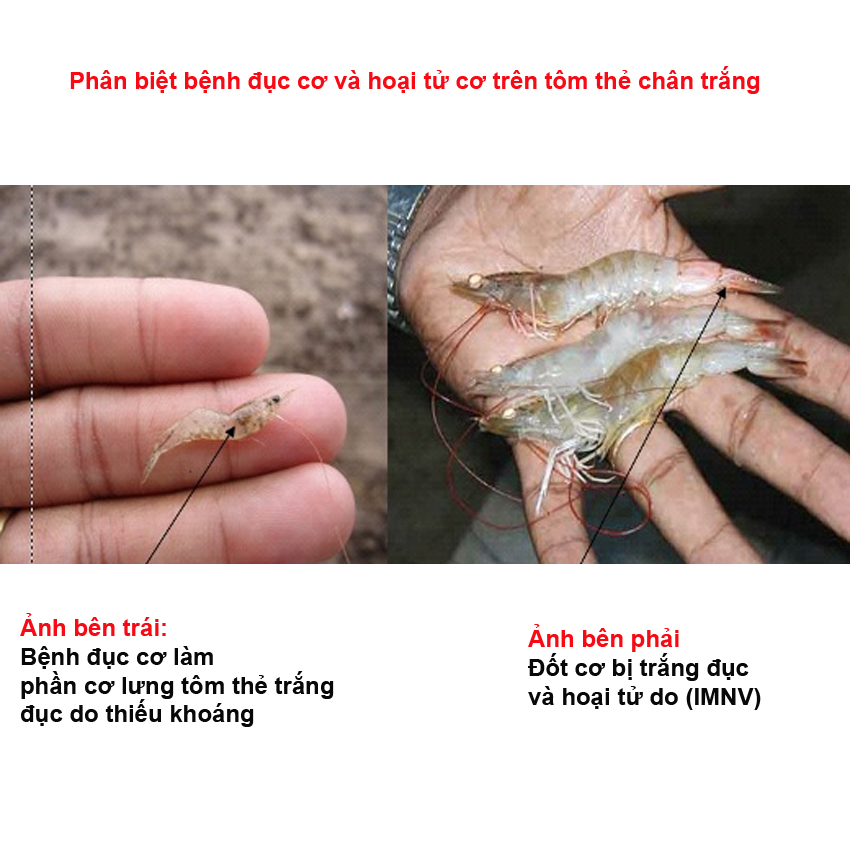
Muscle Necrosis:
Caused by the Infectious Myonecrosis Virus (IMNV).
Usually occurs in shrimp over 45 days old, with the initial symptom being opaque muscle tissue in the tail, which gradually spreads throughout the body.
In severe cases, necrosis and reddening of the muscles may occur, leading to shrimp death with a high mortality rate.
Currently, there is no treatment for this disease, and prevention is key.
Prevention Methods:
White Muscle Disease: Regular mineral supplementation.
Muscle Necrosis: Routine disinfection and avoiding environmental disturbances.
Contact AQUA MINA for consultation and supply of aquaculture round tanks and aquaculture equipment for high-tech shrimp farming.
- Address: 685 National Highway 1A, Binh Hung Hoa Ward, Binh Tan District, Ho Chi Minh City
- Phone: 1800 6071 (Toll-free hotline)
- Email: sales@aquamina.com.vn or oversea@aquamina.com.vn
Aqua Mina's distributor in Japan:
REX INDUSTRIES CO., LTD
- Address: 1-9-3 Hishiya-Higashi, Higashi-Osaka 578-0948 JAPAN
- Email: kimakubo@rexind.co.jp
- Phone: +81-(0)72-961-9893
- Website: www.rexind.co.jp/e/](http://www.rexind.co.jp/e/
Ngày đăng : 28/10/2024
2427 View


Other Articles
Ca Mau, Can Tho and An Giang Play a Leading Role in Vietnam’s Shrimp Industry
Protecting rice-shrimp yields against environmental fluctuations caused by prolonged rain
AQUA MINA Turbo Blower: Quiet, Energy-Efficient Air Supply for Aquaculture Ponds
AQUA MINA has accompanied the experimental tank system project at Can Tho University from its very early days
AQUA MINA AMONG 20 OUTSTANDING PRESENTATIONS AT THE WORKSHOP ON APPLYING SCIENCE AND TECHNOLOGY TO IMPROVE THE QUALITY OF VIETNAM’S AQUATIC PRODUCTS
Vietnam’s Shrimp Farming Industry Enters the High-Tech Race
The U.S. market relies heavily on imported shrimp to bridge its domestic supply gap
The 2028 supply crisis: The shrimp industry is projected to face a 400,000-ton material shortage
High profits from high-tech shrimp farming come with persistent risks
Intensifying El Niño Effect: Climate Change Risks Threaten the Global Shrimp Supply Chain
Evaluating Gaps in the Circular Economy Value Chain of the Shrimp Industry
A Comprehensive Overview of the Vietnamese Shrimp Industry












.jpg)
