



Shrimp Farming Costs Decline in China Thanks to Automation Technology
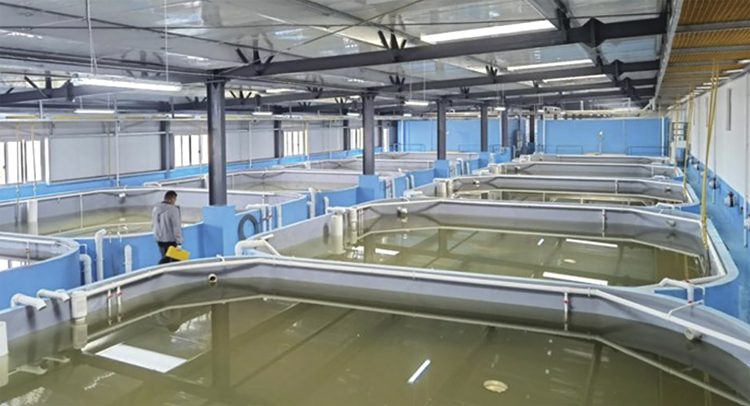
Domestically farmed shrimp are now able to compete with imports, largely thanks to improved cost efficiency. A key factor in this shift is the widespread adoption of greenhouse shrimp farming, which now accounts for 35–40% of China’s total shrimp output.
However, despite the reduced costs, profitability remains a challenge. In 2024, the average production cost for greenhouse-farmed shrimp (60 pcs/kg size) was around CNY 26/kg (USD 3.63/kg)—essentially equal to the market price in Jiangsu province, leaving farmers with almost no profit margin.
Profit Margins Depend on Stocking Density
To improve profit margins, farmers must increase stocking densities, as this is the only realistic way to boost productivity and efficiency under current conditions. Even so, average returns on investment for greenhouse shrimp farms in China reached only around 9% last year.
Market Price and Structure Are Changing
One notable shift has been the change in China’s shrimp market dynamics. Previously, prices would spike significantly around holidays such as Lunar New Year and National Day. Now, these seasonal increases are less pronounced.
Li observed that “price hikes are now moderate and much shorter in duration.” In 2024, shrimp prices in China fell by 15%, equivalent to around CNY 4/kg. Additionally, the price gap between large shrimp (40 pcs/kg) and medium shrimp (60 pcs/kg) has narrowed considerably.
Technology Enhances Efficiency in Shrimp Farming
Automation and smart technologies are now central to China’s shrimp farming advancements. Automatic feeders are widely used, reducing labor costs by 30–50%. Li also emphasized that improving feed conversion ratios (FCR) is critical to cutting production costs. Even a 0.1-point improvement in FCR can result in a 4–6% reduction in overall farming costs.
In more advanced regions like Guangdong and Fujian, the adoption rate of automation equipment has reached 90%. Key technologies include:
Automated aeration systems to reduce energy costs
Night-vision cameras for continuous pond monitoring
Smart water quality monitoring systems to optimize farming decisions
These innovations not only cut costs but also improve survival rates, positioning China’s shrimp industry for stronger international competitiveness.
Thanks to automation and technological innovation, China's shrimp farming sector is making significant progress in cost reduction, productivity gains, and global market readiness.
Source: nguoinuoitom.vn
Aqua Mina's distributor in Japan: REX INDUSTRIES CO., LTD
- Address: 1-9-3 Hishiya-Higashi, Higashi-Osaka 578-0948 JAPAN
- Email: kimakubo@rexind.co.jp
- Phone: +81-(0)72-961-9893
- Website: http://www.rexind.co.jp/e/
WE WORK FOR YOUR SUCCESS!
Ngày đăng : 02/08/2025
1824 View


Other Articles
Ca Mau, Can Tho and An Giang Play a Leading Role in Vietnam’s Shrimp Industry
Protecting rice-shrimp yields against environmental fluctuations caused by prolonged rain
AQUA MINA Turbo Blower: Quiet, Energy-Efficient Air Supply for Aquaculture Ponds
AQUA MINA has accompanied the experimental tank system project at Can Tho University from its very early days
AQUA MINA AMONG 20 OUTSTANDING PRESENTATIONS AT THE WORKSHOP ON APPLYING SCIENCE AND TECHNOLOGY TO IMPROVE THE QUALITY OF VIETNAM’S AQUATIC PRODUCTS
Vietnam’s Shrimp Farming Industry Enters the High-Tech Race
The U.S. market relies heavily on imported shrimp to bridge its domestic supply gap
The 2028 supply crisis: The shrimp industry is projected to face a 400,000-ton material shortage
High profits from high-tech shrimp farming come with persistent risks
Intensifying El Niño Effect: Climate Change Risks Threaten the Global Shrimp Supply Chain
Evaluating Gaps in the Circular Economy Value Chain of the Shrimp Industry
A Comprehensive Overview of the Vietnamese Shrimp Industry












.jpg)
