


Improving growth and feeding behavior of farmed whiteleg shrimp
This study focuses on the feeding behavior of whiteleg shrimp (Penaeus vannamei). According to previous literature, feeding stimulates exploratory, crawling, and foraging behaviors. These behaviors are influenced by hunger levels and the molting cycle. Although shrimp appear to prefer small, frequent meals, optimal feeding timing and frequency remain widely debated. Moreover, how shrimp interact as a group during feed distribution remains unclear and is difficult to observe in real conditions due to water turbidity.
Materials and Methods
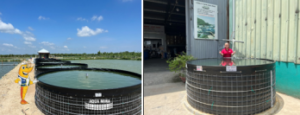
A 16-day experiment was conducted in Honduras using whiteleg shrimp with an average initial weight of 4.0 g and a final average weight of 9.0 g. Shrimp were stocked in two raceways at a density of 25 shrimp/m², each equipped with two automatic feeders.
Although the total daily feed amount was identical in both raceways, the feeding patterns differed:
Tank D (Day): Feeding once per hour from 6:00 AM to 6:00 PM only
Tank DN (Day & Night): Feeding once per hour continuously over 24 hours
Water quality data were collected in both tanks: dissolved oxygen and temperature were measured four times daily; salinity, pH, nitrite, ammonia, and alkalinity were recorded once daily.
Every two days, the health status of approximately 52–91 shrimp per tank was assessed through group weighing. Additionally, 20 shrimp per tank were evaluated daily at three locations (near feeders and at the outlet) using a scoring system based on eight criteria: antennae, rostrum, eyes, gills, hepatopancreas, shell, appendages, and muscle (health score from 1 to 3).
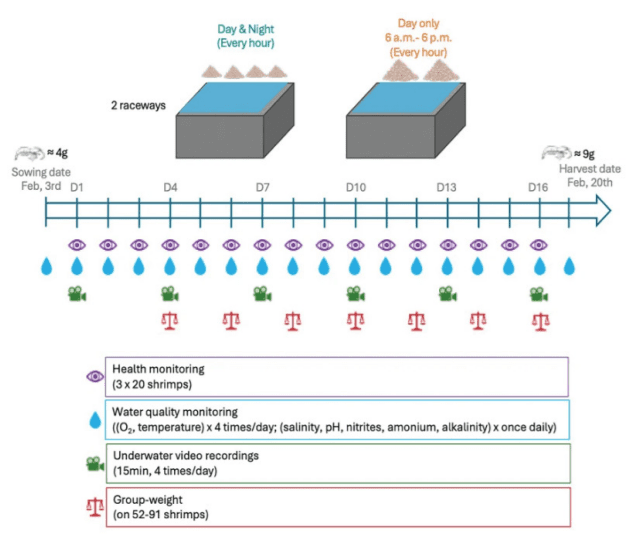
From top to bottom, left to right:
– Day & night feeding (hourly)
– Daytime only (6 AM – 6 PM, hourly)
– 2 raceways – stocking date 03/02 – harvest date 20/02
– Health monitoring (3 × 20 shrimp)
– Water quality monitoring ((O₂, temperature) × 4/day; (salinity, pH, nitrite, ammonia, alkalinity) × 1/day)
– Underwater video recording (15 min, 4 times/day)
– Group weighing (52–91 shrimp)
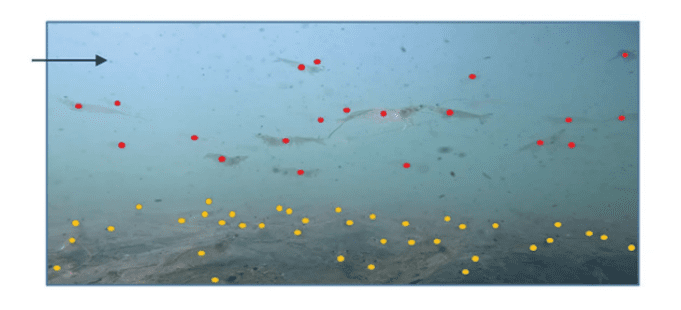
Underwater videos were recorded at the bottom of each raceway, next to one feeder, for 15 minutes (5 minutes before and 10 minutes after feeding), four times daily (7 AM, 9 AM, 12 PM, and 3 PM), every three days. In each video, shrimp at the bottom versus swimming in the water column were counted every 30 seconds (scan sampling). Individual shrimp behaviors were also recorded.
Behavioral parameters included: time in camera frame, time at bottom vs swimming, trajectory type (linear or not), frequency of interactions with other shrimp, grooming behavior, and tail redness. Data were analyzed by comparing tanks D and DN. Continuous variables were tested using Student’s t-test or Wilcoxon test, while categorical variables were analyzed using Chi-square tests.
Results and Discussion
Water quality parameters showed no differences between tanks D and DN, indicating that increased feeding frequency did not affect water quality.
Feeding continuously over 24 hours did not affect health scores, although shrimp in tank DN showed a trend toward better shell condition. However, increased feeding frequency significantly improved growth performance, as shrimp fed day and night gained more weight than those fed only during the day (p < 0.001).
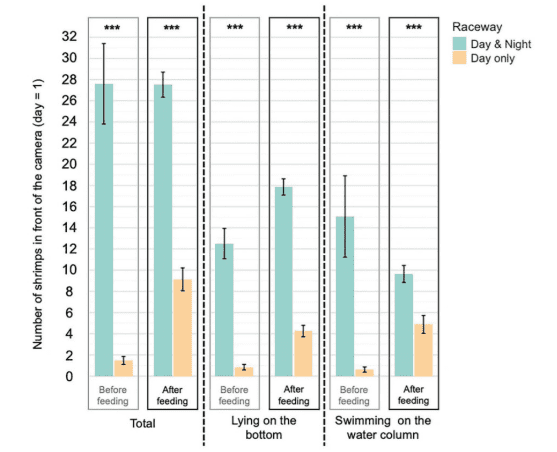
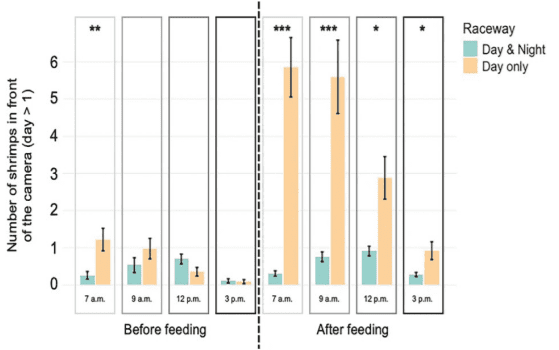
Feedingfrequency also influenced shrimp presence near feeders. On day 1, more shrimp gathered around feeders in tank DN both before and after feeding (p < 0.001), suggesting rapid learning of feeding location and anticipatory behavior.
Before the first feeding at 7 AM, more shrimp were swimming in the water column in tank D (p < 0.01), likely reflecting higher hunger due to lack of night feeding.
After feeding (from day 2 onward), shrimp in tank D showed increased swimming activity shortly after feeding, especially after morning meals (p < 0.001), indicating stronger hunger and competition, potentially leading to higher stress.
Moreover, significantly more shrimp in tank D never rested on the bottom (p < 0.001), suggesting reduced resting behavior due to nighttime feed deprivation.
Grooming behavior was more frequent in tank DN (only 7% of grooming events occurred in tank D; p < 0.05). Additionally, fewer shrimp showed tail redness in tank DN (p < 0.001). In tank D, tail redness increased throughout the day, indicating higher stress levels.
Conclusion
This pioneering study provides one of the first behavioral analyses of shrimp in commercial farms without the use of AI.
Results show that shrimp fed continuously day and night exhibit higher weight gain and more natural behaviors such as resting and grooming, without negatively impacting water quality. These findings suggest improved feed conversion ratio (FCR) and/or reduced competition and stress.
These hypotheses are not mutually exclusive. A better understanding of shrimp feeding behavior will help farmers improve productivity, health, and welfare in commercial aquaculture systems.
Source: Nguoinuoitom
>AQUA MINA CO., LTD
– Address: 685 Le Duc Anh Street, Quarter 39, Binh Hung Hoa Ward, Ho Chi Minh City
– Phone: 1800 6071 (Toll-free hotline)
– Email: sales@aquamina.com.vn or oversea@aquamina.com.vn
– Aqua Mina’s Official Distributor in Japan: REX INDUSTRIES CO., LTD
– Address: 1-9-3 Hishiya-Higashi, Higashi-Osaka 578-0948, JAPAN
– Email: kimakubo@rexind.co.jp
– Phone: +81-(0)72-961-9893
– Website: www.rexind.co.jp/e/

WE WORK FOR THE SUCCESS
Ngày đăng : 08/04/2026
1004 View


Other Articles
Đồng Tháp: Canal bank erosion causes over 5 billion VND in property damage to residents
Indonesia accelerates the expansion of its global seafood market share
Secrets to Enhancing the Durability of TURBO AQUA MINA Aquaculture Air Blowers
Vietnam’s shrimp exports to the UK: Growth potential in a highly competitive market
Shrimp prices drop sharply, farmers worry about unprofitable farming
AQUA MINA | CELEBRATING THE 67TH ANNIVERSARY OF VIETNAM’S TRADITIONAL FISHERIES DAY
Restructuring seed production to enhance the competitiveness of the aquaculture industry
AQUA MINA COMMITS TO NO PRICE INCREASE – 15% OFF PVC Knife Gate Valves, Double Flanges, and Elbow Flanges TO SUPPORT SHRIMP AND FISH FARMERS
Global shrimp prices – Week 12: Ecuador shrimp prices recover, while India and Indonesia remain stable
The global surimi market is projected to grow strongly.
Cà Mau: Expanding the RAS-IMTA model toward sustainable, zero-discharge shrimp farming.
From seed stock to farming equipment, high-tech aquaculture attracts strong interest in Ho Chi Minh City


.jpg)