

Standard Installation Process of HDPE Liners for Aquaculture Ponds
In today's intensive and high-tech shrimp and fish farming models, lining the pond bottom with HDPE geomembranes is an almost mandatory requirement. However, to maximize the liner system's lifespan, prevent leaks, and facilitate easy siphon cleaning, the HDPE liner installation process must be executed systematically and accurately right from the very first steps.
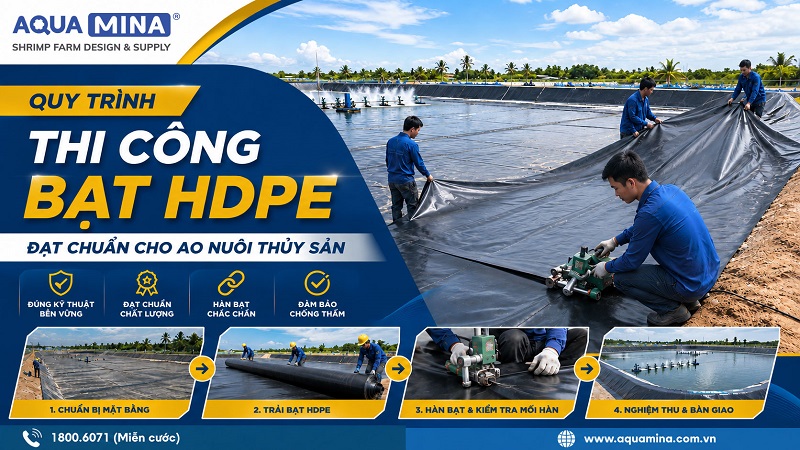
Below is a detailed guide on the standard technical installation process to help optimize the efficiency of your aquaculture pond.
1. The Importance of Proper HDPE Liner Installation
A superficial approach to unrolling and welding the liner will lead to severe consequences during operation, such as: the liner blistering due to toxic gas accumulation at the bottom, tearing at the corners and edges, or water leakage that alters the pond's environment. A standard installation process will ensure:
-
Absolutely sealed welds that can withstand high water pressure.
-
The liner lies flat against the bottom surface without wrinkling or trapping stagnant water and debris.
-
The lifespan of the liner is maximized, saving long-term investment costs.
2. Steps in the HDPE Pond Liner Installation Process
-
Step 1: Site Preparation and Anchor Trench Excavation This is the foundation that determines the durability of the entire liner system.
-
Site clearance: The pond bottom and embankments must be cleared of sharp objects such as boulders, tree roots, snail shells, and debris that could puncture the liner.
-
Compaction: The subgrade surface (both the bottom and the slope) must be leveled and thoroughly compacted. The pond bottom is typically designed with a slight slope towards the central siphon pit for efficient waste collection.
-
Excavating the anchor trench: Along the pond's edge, an anchor trench (usually about 40 - 50cm deep and 40 - 50cm wide) is excavated to secure the edges of the liner, preventing wind uplift and the liner from slipping when filled with water.
-
-
Step 2: HDPE Liner Deployment Plan
-
Positioning: Based on the farm design drawings, the deployment positions of the liner rolls will be calculated to be most optimal, minimizing the number of cross-seams.
-
Unrolling the liner: Use specialized equipment or manual labor to unroll and spread the liner. Note that liner deployment should be carried out during cool weather (early morning or late afternoon) to limit thermal expansion due to high temperatures. The liner must be laid flat against the substrate, with edges overlapping by about 10 - 15cm in preparation for the welding phase.
-
-
Step 3: HDPE Liner Welding Techniques This is the stage that requires the highest level of technical skill and specialized equipment:
-
Double Hot-Wedge Welding: Utilize automatic hot-wedge welding machines for straight seams connecting the liner panels. The machine creates a double weld track (with an air channel in the middle), ensuring a strong bond and facilitating later pressure testing.
-
Extrusion Welding: Applied for tight corners, complex details, bank edges, or where the liner connects to PVC/HDPE pipe systems (such as the siphon pit). A hot air tool is used to preheat the surface, then the extrusion welder pumps molten HDPE resin to completely seal the joint.
-
-
Step 4: Backfilling the Anchor Trench and Securing the Liner After completing the deployment and edge welding, the liner edges will be placed into the pre-dug anchor trench from Step 1. Proceed to backfill with soil and compact it tightly to lock the liner edges in place. Securely anchoring the liner ensures the entire pond remains stable against the impacts of storms and water pressure.
-
Step 5: Quality Inspection and Acceptance The seam inspection step cannot be skipped to ensure there are no leaks before filling the pond with water:
-
Air Pressure Testing: Pump air into the channel between the double hot-wedge welds. If the pressure remains stable for the specified time, the weld meets the standard.
-
Vacuum Box Testing: Applied to extrusion welds at the siphon pit or blind corners by applying a soapy solution and using a vacuum box to detect any leaking air bubbles.
-
3. Choosing a Professional Design and Installation Unit
Installing HDPE liners is not just about joining plastic sheets together; it is also a perfect combination with the design of water flow, siphon pit structure, and aeration systems to create the most ideal habitat for shrimp and fish.
As a unit specializing in providing equipment and comprehensive farm design consulting, Aqua Mina brings optimal solutions ranging from site planning and new-generation paddlewheel aerator systems for water flow, to supporting the most accurate pond lining technical solutions. Synchronizing everything from pond design to equipment will help your farm operate smoothly, easily manage risks, and save long-term costs.
Contact Aqua Mina immediately for advice on high-tech shrimp farm design and to select the highest quality aquaculture equipment!
AQUA MINA CO., LTD
WE WORK FOR THE SUCCESS


Ca Mau, Can Tho and An Giang Play a Leading Role in Vietnam’s Shrimp Industry
Protecting rice-shrimp yields against environmental fluctuations caused by prolonged rain
AQUA MINA Turbo Blower: Quiet, Energy-Efficient Air Supply for Aquaculture Ponds
AQUA MINA has accompanied the experimental tank system project at Can Tho University from its very early days
AQUA MINA AMONG 20 OUTSTANDING PRESENTATIONS AT THE WORKSHOP ON APPLYING SCIENCE AND TECHNOLOGY TO IMPROVE THE QUALITY OF VIETNAM’S AQUATIC PRODUCTS
Vietnam’s Shrimp Farming Industry Enters the High-Tech Race
The U.S. market relies heavily on imported shrimp to bridge its domestic supply gap
The 2028 supply crisis: The shrimp industry is projected to face a 400,000-ton material shortage
High profits from high-tech shrimp farming come with persistent risks
Intensifying El Niño Effect: Climate Change Risks Threaten the Global Shrimp Supply Chain
Evaluating Gaps in the Circular Economy Value Chain of the Shrimp Industry
A Comprehensive Overview of the Vietnamese Shrimp Industry


.jpg)