

Common Mistakes in Positioning Paddlewheel Aerators That Reduce Pond Efficiency
The paddlewheel aerator system is often likened to the lungs of intensive shrimp and fish farming ponds. Beyond dissolving oxygen, aerators play a core role in creating circulating water currents and accumulating waste. However, if improperly positioned and operated, this system not only consumes a massive amount of electricity but also poses significant risks to the water environment.
Below are the most common mistakes farmers make when installing paddlewheel aerators and effective solutions to overcome them.
.png)
1. Incorrect Positioning and Flow Direction
One of the most serious errors is installing aerators in a way that their forces cancel each other out. When positioned improperly, the generated water currents collide, disrupting the circular flow, resulting in waste (shrimp feces, molted shells, uneaten feed) failing to accumulate in the central siphon pit of the pond.
-
Solution: The aeration system must be arranged to create a unified rotational flow. In standard farm design engineering, the entire impeller system must be set to consistently rotate in a counter-clockwise direction. This helps generate perfect centrifugal force, cleanly sweeping waste into the pond's center while eliminating oxygen-deprived dead zones.
2. Using Hollow, Low-Quality Impeller
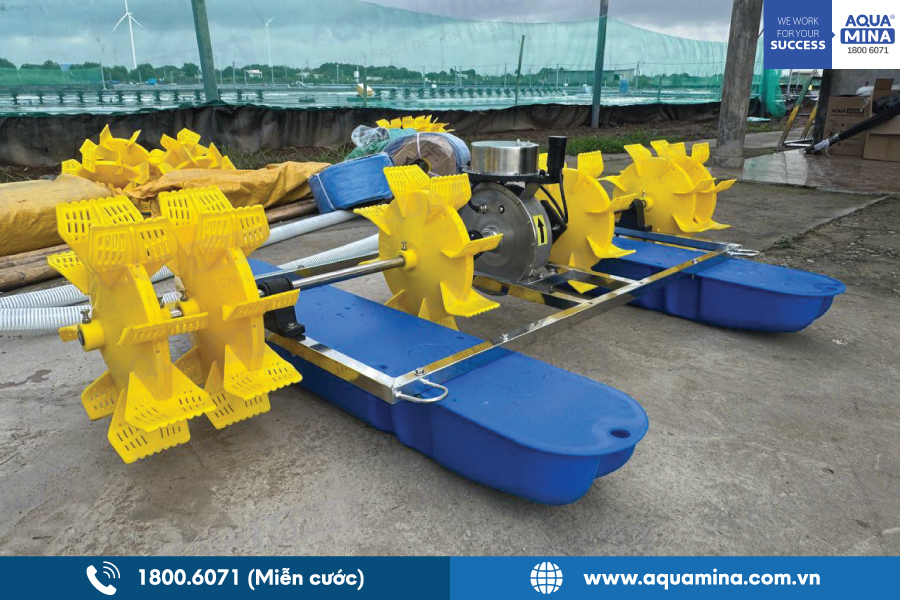
s To save initial costs, many farmers often use hollow plastic impellers. However, this is a mistake that significantly reduces aeration efficiency. Lightweight hollow impellers have a weak water-striking force, unable to push oxygen bubbles deep into the bottom layer. Furthermore, under the impact of intense heat and saltwater, hollow blades quickly become brittle, crack, and allow water to seep inside, throwing the rotating shaft out of balance.
-
Solution: A mandatory technical requirement for modern aeration systems is the use of solid casted impellers (monolithic) instead of hollow ones. Solid casted blades possess standard weight and an optimal water resistance cross-section, generating a powerful paddling force, high mechanical durability, and keeping the motor shaft running smoothly and stably over a long period.
3. Incorrect Impeller Submersion Depth
The submersion depth of the impellers directly affects the motor's load index (Amperage) and the efficiency of current generation.
-
Too shallow: The blades only skim the water surface, creating loud noise but lacking the power to create a bottom current, meaning oxygen cannot diffuse deeply.
-
Too deep: Causes motor overload, leading to a sudden spike in power consumption, and potentially causing electrical fires.
-
Solution: Adjust the submersion depth to a moderate level (typically submerging 1 blade hole) and combine this with a staggered (alternating) arrangement of the impellers on the shaft. Staggered installation helps evenly distribute water resistance, keeping the motor's load current stable (recommended to run at 80-85% of design capacity).
4. Inadequate Number of Aerators for the Pond Area and Stocking Density
Undercalculating the number of aerators will cause severe oxygen shortages in the pond at night or during bad weather days. Conversely, installing too many aerators relative to the water volume will cause unnecessary electricity waste and create excessively strong currents, causing shrimp to become stressed and expend too much energy swimming against the flow.
-
Solution: It is necessary to accurately calculate the total aeration capacity based on the pond volume (m3) and the expected shrimp/fish harvest yield. This should be consulted with professional aquaculture engineers to determine the most suitable configuration of motors, speed reducers, and the number of impellers.
Accurate Aeration System Design and Installation Solutions from Aqua Mina
Positioning the paddlewheel aerator system is a technical challenge that requires combining pond structure design with hydrodynamic principles.
As a professional unit in supplying equipment and designing aquaculture farms, Aqua Mina provides the most optimal solutions for your aeration system. We offer high-quality equipment lines, from energy-saving motor systems to ultra-durable solid casted impeller assemblies. Aqua Mina's team of engineers will assist in calculating and designing accurate aerator layout diagrams, ensuring perfect water flow, optimizing power consumption, and maximizing profit margins for your farming crop.
Check your farm's paddlewheel water system today. If adjustments or upgrades are needed, contact Aqua Mina for the most effective solution consulting!
AQUA MINA CO., LTD

WE WORK FOR THE SUCCESS


Ca Mau, Can Tho and An Giang Play a Leading Role in Vietnam’s Shrimp Industry
Protecting rice-shrimp yields against environmental fluctuations caused by prolonged rain
AQUA MINA Turbo Blower: Quiet, Energy-Efficient Air Supply for Aquaculture Ponds
AQUA MINA has accompanied the experimental tank system project at Can Tho University from its very early days
AQUA MINA AMONG 20 OUTSTANDING PRESENTATIONS AT THE WORKSHOP ON APPLYING SCIENCE AND TECHNOLOGY TO IMPROVE THE QUALITY OF VIETNAM’S AQUATIC PRODUCTS
Vietnam’s Shrimp Farming Industry Enters the High-Tech Race
The U.S. market relies heavily on imported shrimp to bridge its domestic supply gap
The 2028 supply crisis: The shrimp industry is projected to face a 400,000-ton material shortage
High profits from high-tech shrimp farming come with persistent risks
Intensifying El Niño Effect: Climate Change Risks Threaten the Global Shrimp Supply Chain
Evaluating Gaps in the Circular Economy Value Chain of the Shrimp Industry
A Comprehensive Overview of the Vietnamese Shrimp Industry


.jpg)