


Georgia Senate Resoundingly Passes Shrimp Transparency Bill
Blake Price, deputy director of the Southern Shrimp Alliance (SSA) welcomed the vote, stating, “This bill adds transparency that benefits consumers, the local restaurants supporting U.S. shrimpers, and hardworking fishing families that are the economic backbone of coastal communities. We thank Senator Ben Watson and Representative Jesse Petrea for acting to help consumers make informed choices when ordering seafood at restaurants.”
Pervasive Fraud Drives State Action
Senator Ben Watson spoke forcefully in favor of the legislation, specifically citing the results of SSA-funded genetic testing of shrimp dishes from Savannah restaurants. In February 2025, SeaD Consulting found that 77% of sampled Savannah restaurants (33 of 44) falsely marketed their shrimp as U.S. wild-caught, even though they served farm-raised, imported shrimp. U.S. shrimp fishermen cannot compete against imported farm-raised shrimp that is explicitly or implicitly marketed as authentic U.S. wild-caught shrimp.
The problem extends far beyond Georgia. Testing across the Southeast has exposed systematic consumer deception in major coastal markets:
Tampa/St. Petersburg, FL: 96% inauthenticity rate
Charleston, SC: 90% inauthenticity rate
Biloxi, MS: 88% inauthenticity rate
Wilmington, NC: 77% inauthenticity rate
Galveston and Kemah, TX: 59% inauthenticity rate
In stark contrast, testing in markets with state labeling and disclosure laws shows consumers receive correctly labeled shrimp more than two-thirds of the time.
American shrimpers provide a high-quality, flavorful shrimp from local waters to our country’s markets, supporting fishing communities across the Southeast. U.S. fishermen follow strict U.S. environmental, labor, and food safety rules while competing against countries known to use forced labor, banned antibiotics, and harmful environmental practices in their shrimp supply chains. But none of that matters if customers can’t tell U.S. wild-caught shrimp apart from farm-raised imports when they go to make their purchase.
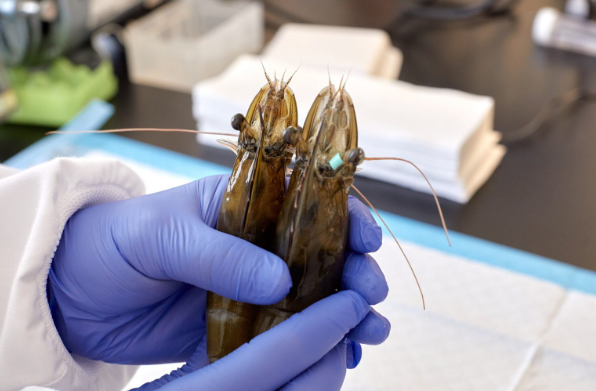
“We know that 27% of shrimp are consumed while people visit coastal communities, like Savannah. That isn’t because tourists want to eat foreign, pond-raised shrimp closer to American fishermen and our abundant oceans,” stated Price. “Our testing is driving awareness, and as more people learn that 94% of their seafood is imported, the more they are asking how to find authentic U.S. wild-caught shrimp. That’s where the market needs labeling laws and strong enforcement.”
Four States Now Have Transparency Laws
Georgia joins a growing list of Southern states in seeking a legislative solution to help consumers identify the source of their shrimp in restaurants:
Alabama (effective Oct. 2024): Requires all food establishments to disclose whether seafood is imported or domestic and farm-raised or wild-caught.
Louisiana (strengthened in Jan. 2025): Mandates explicit labeling and disclosure and prohibits misrepresentation of foreign seafood as domestic
Mississippi (effective July 2025): Requires all seafood labeled as imported or domestic
Texas (effective Sept. 2025): Prohibits misrepresenting imported shrimp as “Texas,” “Gulf” or “Domestic” shrimp, while requiring disclosure of imported shrimp
Florida and South Carolina are currently advancing similar legislation.
In addition, federal legislators are acting to help consumers identify the source of seafood. The Let Americans Buy with Explicit Labeling (LABEL) Act, introduced by Senators Cindy Hyde Smith (R-MS) and Tommy Tuberville (R-AL), would require clear, readable country-of-origin labels in retail markets.
Georgia Bill Details and Next Steps
The Georgia Senate substitute bill removes “commercial” from the House version, broadening coverage to all food service establishments while exempting state agency-operated establishments. The bill mandates that establishments serving imported shrimp must “conspicuously display on their menus a disclosure by each menu item containing shrimp stating ‘FOREIGN IMPORTED,’ or display ‘FOREIGN IMPORTED SHRIMP’ on placards visible to the public.”
In a notable development, Senator Watson reported that the Georgia Restaurant Association “dropped” its opposition to the bill.
The substitute bill now returns to the House, which passed the original version in February 2025 by an overwhelming 165-7 margin. The House legislation has been championed by Representative Jesse Petrea, along with bipartisan co-sponsors Al Williams, Rick Townsend, Buddy DeLoach, and Lehman Franklin.
Source: shrimpalliance
AQUA MINA CO., LTD
– Address: 685 Le Duc Anh Street, Quarter 39, Binh Hung Hoa Ward, Ho Chi Minh City
– Phone: 1800 6071 (Toll-free hotline)
– Email: sales@aquamina.com.vn or oversea@aquamina.com.vn
– Aqua Mina’s Official Distributor in Japan: REX INDUSTRIES CO., LTD
– Address: 1-9-3 Hishiya-Higashi, Higashi-Osaka 578-0948, JAPAN
– Email: kimakubo@rexind.co.jp
– Phone: +81-(0)72-961-9893
– Website: www.rexind.co.jp/e/

WE WORK FOR THE SUCCESS
Ngày đăng : 22/02/2026
1111 View


Other Articles
AQUA MINA | CELEBRATING THE 67TH ANNIVERSARY OF VIETNAM’S TRADITIONAL FISHERIES DAY
Restructuring seed production to enhance the competitiveness of the aquaculture industry
AQUA MINA COMMITS TO NO PRICE INCREASE – 15% OFF PVC Knife Gate Valves, Double Flanges, and Elbow Flanges TO SUPPORT SHRIMP AND FISH FARMERS
Global shrimp prices – Week 12: Ecuador shrimp prices recover, while India and Indonesia remain stable
The global surimi market is projected to grow strongly.
Cà Mau: Expanding the RAS-IMTA model toward sustainable, zero-discharge shrimp farming.
From seed stock to farming equipment, high-tech aquaculture attracts strong interest in Ho Chi Minh City
Shrimp industry enterprises proactively adapt to global fluctuations
DAY 3 – AQUA MINA | STRONG CONNECTIONS – A MEMORABLE CLOSING AT VIETSHRIMP AISA 2026
DAY 2 – AQUA MINA | DEEP INSIGHTS & SMART SOLUTIONS FOR MODERN AQUACULTURE
DAY 1 – AQUA MINA | A POWERFUL OPENING AT VIETSHRIMP ASIA 2026
OFFICIAL OPENING of the International-Scale Aquaculture Exhibition Series | See You Again with AQUA MINA at VietShrimp Asia 2026




.jpg)