

The dry season in the Mekong Delta will have 5 waves of saltwater intrusion

Mr. Mai Van Khiem - Director of the National Center for Hydrometeorological Forecasting
According to Mr. Mai Van Khiem - Director of the National Center for Hydrometeorological Forecasting, from now until the end of the dry season in 2024, due to the impact of the Elnio phenomenon, the Mekong Delta region has almost no rain, long sunny days, and hot weather has appeared and will appear many times in the area until May 2024. Along with that, the amount of flow from the Mekong upstream to the Mekong Delta is 5-12% short of the average of many years. Therefore, drought combined with saltwater intrusion will cause water shortages, affecting domestic water as well as water for agricultural production. It is forecasted that from now until the end of the 2024 dry season there will be about 5 waves of saltwater intrusion, of which the peak saltwater intrusion will fall around March 7-12 and April 7-12 with a saline level of 4g/l at river mouths, a level higher than the average for many years and higher than in 2023. Specifically, on the Vam Co river the salinity line is from 80-90km, the Mekong River estuary is from 45-65km, and the Cai Lon river is from 40-50km. The most affected provinces are Tien Giang, Ben Tre, Hau Giang, Tra Vinh, and Soc Trang.
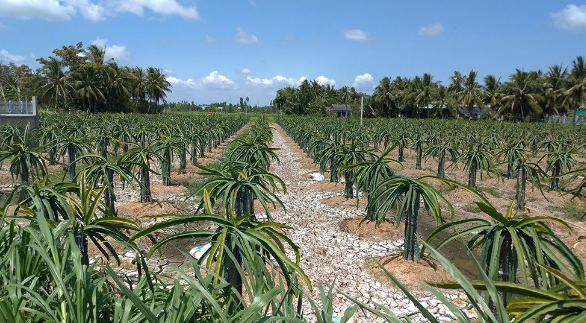
Saltwater intrusion in Tien Giang
Recommendations of the National Center for Hydrometeorological Forecasting during the upcoming period of both saltwater intrusion and hot weather
First of all, we recommend that local authorities and people regularly follow the salinity intrusion forecast newsletter to proactively use water. Currently, our Hydrometeorological Department regularly provides periodic salinity intrusion forecast and warning information to the local Natural Disaster Prevention Steering Committee. When salinity suddenly increases, there is an enhanced newsletter to serve promptly. Information is conveyed on Zalo, Facebook, and local disaster prevention groups.
The weekly forecast newsletter October 7-10/day predicts the highest salinity at each monitoring point, the salinity boundary is forecast at 1 part per thousand and 4 parts per thousand, for each main river in the province, updated salinity data are sent to localities daily at monitoring points. Long-term 1-2 month forecasts are updated every 10 days.
Note that in areas not often affected by saltwater intrusion, especially fruit growing areas, people should pay attention to checking the salinity when using water to avoid damage caused by saltwater intrusion during this peak period.
Cre: Khí Tượng Thủy Văn Việt Nam
Ngày đăng : 29/04/2024
2357 View


Other Articles
Ca Mau, Can Tho and An Giang Play a Leading Role in Vietnam’s Shrimp Industry
Protecting rice-shrimp yields against environmental fluctuations caused by prolonged rain
AQUA MINA Turbo Blower: Quiet, Energy-Efficient Air Supply for Aquaculture Ponds
AQUA MINA has accompanied the experimental tank system project at Can Tho University from its very early days
AQUA MINA AMONG 20 OUTSTANDING PRESENTATIONS AT THE WORKSHOP ON APPLYING SCIENCE AND TECHNOLOGY TO IMPROVE THE QUALITY OF VIETNAM’S AQUATIC PRODUCTS
Vietnam’s Shrimp Farming Industry Enters the High-Tech Race
The U.S. market relies heavily on imported shrimp to bridge its domestic supply gap
The 2028 supply crisis: The shrimp industry is projected to face a 400,000-ton material shortage
High profits from high-tech shrimp farming come with persistent risks
Intensifying El Niño Effect: Climate Change Risks Threaten the Global Shrimp Supply Chain
Evaluating Gaps in the Circular Economy Value Chain of the Shrimp Industry
A Comprehensive Overview of the Vietnamese Shrimp Industry


.jpg)