


Benefits of Exogenous Protease in Whiteleg Shrimp Farming
The study by Santigosa and colleagues evaluated the effects of exogenous protease on growth performance, digestion, and nitrogen excretion in whiteleg shrimp. A basal diet was formulated to simulate commercial feed, containing 34.4% crude protein, 8% lipid, and 18.3 MJ of energy per kilogram of feed. Based on this diet, the researchers supplemented protease at four levels: no supplementation and supplementation at 100, 200, and 300 mg/kg feed, corresponding to 30,000, 60,000, and 90,000 NFP activity units per kilogram.
The enzyme was applied after extrusion using a vacuum coating method to ensure that enzyme activity was not reduced during feed processing. Enzyme recovery reached approximately 95.2–98.6% of the target level. The experimental design included five replicates per treatment, with 65 shrimp per tank. The culture period lasted 62 days, using shrimp juveniles with an average initial weight of 0.97 g.
Growth results showed that survival rates were stable and did not differ among treatments, ranging from 89.5% to 92.0%. Final shrimp weight ranged from 14.96 to 16.31 g across treatments, with the highest supplementation treatment reaching an average of 16.31 g. The specific growth rate (SGR) ranged from 4.40 to 4.55% per day. However, growth indicators such as final weight and SGR did not show statistically significant differences among treatments. This indicates that when the basal diet already provides sufficient nutrients to support growth, protease supplementation does not produce a clear change in growth rate.
Table 1. Growth performance of shrimp after 62 days of the experiment.
However, clear differences appeared in feed and protein utilization indicators. The feed conversion ratio (FCR) decreased significantly when protease was supplemented at 200 and 300 mg/kg. Specifically, FCR in the control group was 1.41, while it decreased to 1.30 in PRO200 and 1.31 in PRO300, with a statistically significant difference (p < 0.001). Feed intake also decreased in a similar trend, from approximately 3.95% of average body weight per day in the control to 3.65% and 3.70% in PRO200 and PRO300, respectively (p = 0.001).
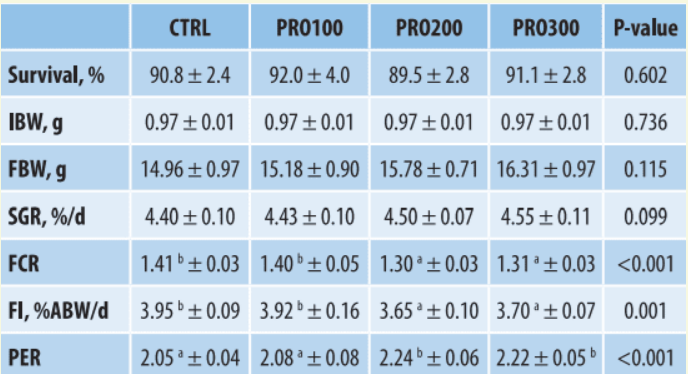
In contrast, the protein efficiency ratio (PER) increased with higher levels of protease supplementation, rising from 2.05 in the control to 2.24 in PRO200 and about 2.22 in PRO300 (p < 0.001). Thus, while protease did not significantly alter growth performance, it had a clear impact on feed conversion efficiency and protein utilization.
Further analysis of nutrient retention in the shrimp body showed that whole-body protein retention slightly increased in treatments supplemented with the enzyme. Protein retention in the control group was 36.40%, increasing to 39.47% in PRO200 and 38.80% in PRO300. Among these, PRO200 was significantly higher than the control (p = 0.030). Lipid and energy retention did not show significant differences among treatments. These results indicate that protease supports more efficient protein utilization, reflected in higher protein retention in the shrimp body.
Digestibility results provided the clearest evidence of the nutritional effects of protease. The apparent digestibility coefficient of dry matter increased from 61.9% in the control to 64.7% in PRO100 and reached about 68.0–67.3% in PRO200 and PRO300 (p < 0.001). Protein digestibility increased from 75.4% in the control to approximately 77.7–78.8% in the protease-supplemented treatments (p = 0.014). Energy digestibility did not change significantly among treatments. When examining amino acid digestibility, most amino acids increased markedly with enzyme supplementation. For example, arginine increased from 82.4% to 86.4–86.1%, lysine from 84.5% to 87.3–86.7%, and threonine from 70.7% to 75.5–74.6%. Two amino acids, isoleucine and leucine, showed no significant differences. Overall, the digestibility data demonstrate that protease improves the utilization of protein and most amino acids in the diet.
Table 2. Whole-body nutrient retention of shrimp (% of intake).
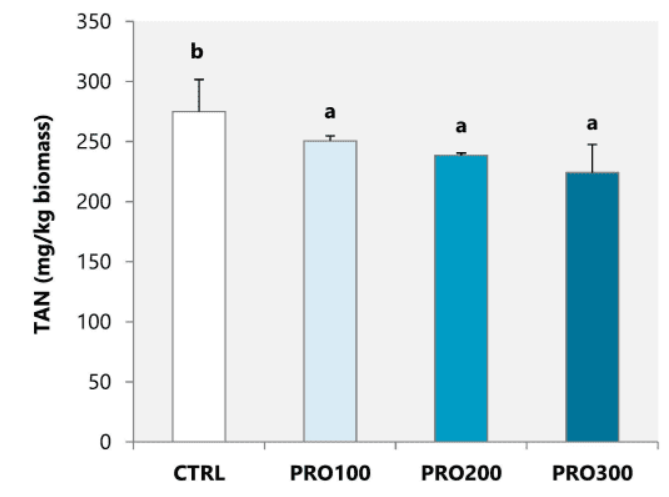
Figure 1. Total ammonia nitrogen excretion (TAN, mg/kg biomass).
In addition to nutritional efficiency, the study also evaluated environmental effects through total ammonia nitrogen (TAN) excretion after feeding. Shrimp fed diets supplemented with protease showed lower TAN excretion than the control group, and the reduction followed a dose-dependent trend. The difference was statistically significant (p ≈ 0.0027). This result is consistent with the observed increase in protein digestibility, higher protein retention, and improved PER. When protein is better digested and utilized, the amount of nitrogen excreted into the environment correspondingly decreases.
Overall, the study shows that supplementing exogenous protease in the diet of whiteleg shrimp does not significantly change growth when the basal diet already meets nutritional requirements. However, it clearly improves feed and protein utilization efficiency. Treatments supplemented with 200 and 300 mg/kg reduced FCR from 1.41 to around 1.30–1.31, increased PER from about 2.05 to above 2.2, and enhanced the digestibility of protein and most amino acids.
Notably, post-feeding TAN excretion decreased in the enzyme-supplemented treatments. From a farming management perspective, these results have practical value because they are directly associated with feed conversion efficiency and nitrogen loading in aquaculture systems. The study also suggests that to more clearly demonstrate growth effects, future experiments should be conducted under more stringent dietary conditions, such as reducing crude protein levels or using lower-quality protein sources.
AQUA MINA CO., LTD
– Address: 685 Le Duc Anh Street, Quarter 39, Binh Hung Hoa Ward, Ho Chi Minh City
– Phone: 1800 6071 (Toll-free hotline)
– Email: sales@aquamina.com.vn or oversea@aquamina.com.vn
– Aqua Mina’s Official Distributor in Japan: REX INDUSTRIES CO., LTD
– Address: 1-9-3 Hishiya-Higashi, Higashi-Osaka 578-0948, JAPAN
– Email: kimakubo@rexind.co.jp
– Phone: +81-(0)72-961-9893
– Website: www.rexind.co.jp/e/

WE WORK FOR THE SUCCESS
Ngày đăng : 07/03/2026
1152 View


Other Articles
AQUA MINA COMMITS TO NO PRICE INCREASE – 15% OFF PVC Knife Gate Valves, Double Flanges, and Elbow Flanges TO SUPPORT SHRIMP AND FISH FARMERS
Global shrimp prices – Week 12: Ecuador shrimp prices recover, while India and Indonesia remain stable
The global surimi market is projected to grow strongly.
Cà Mau: Expanding the RAS-IMTA model toward sustainable, zero-discharge shrimp farming.
From seed stock to farming equipment, high-tech aquaculture attracts strong interest in Ho Chi Minh City
Shrimp industry enterprises proactively adapt to global fluctuations
DAY 3 – AQUA MINA | STRONG CONNECTIONS – A MEMORABLE CLOSING AT VIETSHRIMP AISA 2026
DAY 2 – AQUA MINA | DEEP INSIGHTS & SMART SOLUTIONS FOR MODERN AQUACULTURE
DAY 1 – AQUA MINA | A POWERFUL OPENING AT VIETSHRIMP ASIA 2026
OFFICIAL OPENING of the International-Scale Aquaculture Exhibition Series | See You Again with AQUA MINA at VietShrimp Asia 2026
VietShrimp Asia & Aquaculture Vietnam 2026 | Smart Aquaculture – The AI Revolution in Aquaculture
AQUA MINA AT VIETSHRIMP 2026 – GET UP TO 40 MILLION VND IN DISCOUNTS WHEN PURCHASING AQUA MINA TURBO AQUACULTURE BLOWERS


.jpg)