


Tensions in the Strait of Hormuz: Vietnam’s USD 401 Million Seafood Exports Enter a Challenging Zone
In the final days of February and early March 2026, tensions around the Iran–Israel axis with the involvement of the United States quickly moved beyond the geopolitical sphere, spreading to energy markets, maritime transport, and marine insurance. For the seafood industry, a sector heavily dependent on cold chains and cross-border logistics, this shock has created a chain reaction affecting transportation costs, insurance, price volatility, and market access.
According to the Vietnam Association of Seafood Exporters and Producers (VASEP), geopolitical risks in the Middle East in 2026 transformed into supply chain risks within just a few days, forcing export enterprises to respond rapidly in terms of markets, transportation, and financial strategies.
COLD CHAIN COST SHOCK
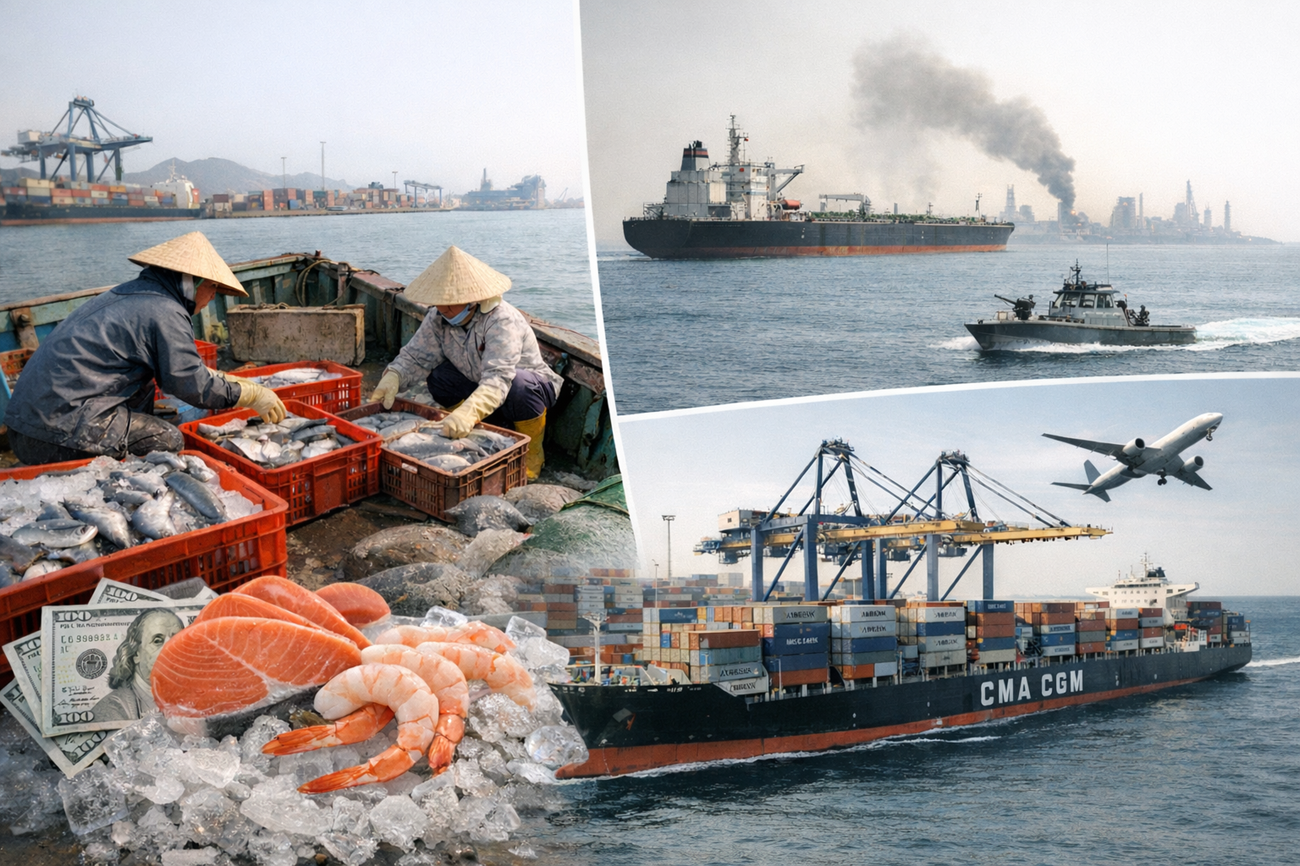
The focal point of risk lies in the Strait of Hormuz, the maritime route connecting the Persian Gulf with the Indian Ocean, through which about 20% of the world’s oil supply is transported. As security alerts intensified, many shipping lines were forced to adjust their routes, diverting around the Cape of Good Hope instead of passing through the Red Sea – Bab el-Mandeb – Suez Canal corridor.
Major container shipping groups such as Maersk, Hapag-Lloyd, CMA CGM, and MSC Mediterranean Shipping Company simultaneously announced temporary suspension of cargo acceptance to several Gulf ports, imposed war-risk surcharges, and tightened the acceptance of refrigerated containers.
The diversion has extended transit times by 7–14 days, reducing fleet utilization capacity and causing shortages of refrigerated containers—equipment with slow turnover and strict technical requirements. Within just a few days, freight rates on the Asia–Dubai route nearly doubled; emergency surcharges ranged from USD 1,500 to USD 4,000 per container, with higher levels applied to refrigerated containers.
At the same time, the marine insurance market reacted strongly. Some war-risk insurers reduced or canceled coverage in the Persian Gulf region within just 72 hours of notice. The International Maritime Organization recommended that commercial vessels exercise maximum caution when transiting the area. In practice, when insurance premiums surge dramatically, many voyages become effectively “closed” even without an official blockade declaration.
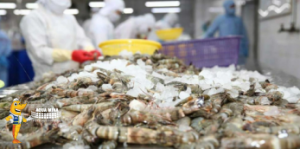
According to VASEP, the cold chain is the most vulnerable link. The Middle East is a major consumption market for salmon, shrimp, tuna, and many high-value seafood products. When air transport is restricted and refrigerated containers are limited, the risk of localized supply shortages emerges quickly, especially in the high-end restaurant and hotel segments.
Dubai, with the Jebel Ali Port operated by DP World, is a major seafood transshipment hub in the region. As vessels are rerouted and transit times increase, the risk of port congestion and shortages of electrical plug-in points for refrigerated containers rises, leading to higher storage costs and increased risks of product quality deterioration.
For Vietnam, the Middle East remains a promising market. In 2025, seafood exports to the region reached USD 401 million, up 9.6% compared to 2024. Of this, pangasius accounted for USD 175.9 million (up 18.6%), shrimp reached USD 54.5 million (up 19.9%), and other fish categories increased by 28.6%. However, according to VASEP, if surcharges and insurance costs remain high for several months, profit margins of enterprises will face significant pressure, forcing them to restructure markets or renegotiate contracts.
DOUBLE PRESSURE FROM THE U.S. MARKET
The impact from the Middle East does not stop in the Gulf region. Brent crude oil prices rose from USD 67–68 per barrel in early February to USD 73 by the end of the month, at one point exceeding USD 82 in early March before settling around USD 77–78. WTI closed at USD 71.23, rising more than 6% in just one day. Rising fuel costs have driven up global logistics expenses.
Geopolitical tensions also pushed the U.S. Dollar Index up nearly 1% in early March, reaching its strongest level in seven months. In Vietnam, the USD/VND exchange rate adjusted upward, with the selling price of USD at commercial banks reaching VND 26,289 per USD, while the reference rate stood at VND 25,038 per USD.
According to VASEP’s analysis, a stronger USD creates a two-way effect: export revenues converted into VND increase, but import costs for inputs and international transportation also rise, increasing exchange-rate risks and narrowing actual profit margins.
Notably, the U.S. market, which relies on imports for about 80% of its seafood supply, is simultaneously tightening its policies. From January 1, 2026, the National Oceanic and Atmospheric Administration (NOAA) imposed a ban on seafood imports from 12 major Vietnamese fishing grounds due to non-compliance with marine mammal protection requirements, narrowing the supply of shrimp and wild-caught seafood to the U.S.
In this context, shipping lines continue adjusting routes and imposing additional surcharges. CMA CGM announced an “Emergency Conflict Surcharge” ranging from USD 2,000 to USD 4,000 per container. Transportation costs for shrimp and pangasius exports to the U.S. have increased, while selling prices are difficult to adjust immediately due to competition from India, Ecuador, and Indonesia.
Nevertheless, consumer demand in the U.S. remains fundamentally strong. More than 90% of shrimp consumed in the country is imported. According to forecasts from the United States Department of Agriculture (USDA), food prices in 2026 may increase by about 3.1%. Consumers are likely to reduc spending on luxury goods while increasing purchases of processed foods for home consumption, creating opportunities for value-added and conveniently packaged seafood products.
VASEP believes that in the context of “dual uncertainty”—both geopolitical and trade policy—logistics, insurance, and exchange-rate risk management capabilities will become decisive factors. Enterprises need to diversify shipping routes, prioritize long-term contracts instead of relying on spot markets, strengthen traceability compliance to meet NOAA requirements, and restructure product portfolios toward higher value-added products while optimizing costs.
The Middle East crisis in 2026 clearly demonstrates one reality: for the seafood industry, geopolitics is no longer a distant variable but one that can directly affect every refrigerated container. In an increasingly globalized market, the ability to adapt quickly will determine which enterprises can maintain export flows and market share in strategic markets such as the Middle East and the United States.
Source: thuonggiaonline
AQUA MINA CO., LTD
– Address: 685 Le Duc Anh Street, Quarter 39, Binh Hung Hoa Ward, Ho Chi Minh City
– Phone: 1800 6071 (Toll-free hotline)
– Email: sales@aquamina.com.vn or oversea@aquamina.com.vn
– Aqua Mina’s Official Distributor in Japan: REX INDUSTRIES CO., LTD
– Address: 1-9-3 Hishiya-Higashi, Higashi-Osaka 578-0948, JAPAN
– Email: kimakubo@rexind.co.jp
– Phone: +81-(0)72-961-9893
– Website: www.rexind.co.jp/e/

WE WORK FOR THE SUCCESS
Ngày đăng : 07/03/2026
1239 View


Other Articles
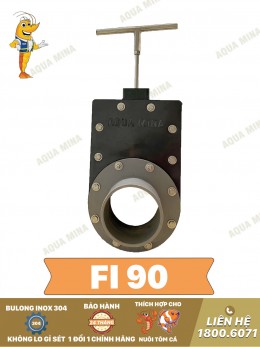
AQUA MINA COMMITS TO NO PRICE INCREASE – 15% OFF PVC Knife Gate Valves, Double Flanges, and Elbow Flanges TO SUPPORT SHRIMP AND FISH FARMERS
Global shrimp prices – Week 12: Ecuador shrimp prices recover, while India and Indonesia remain stable
The global surimi market is projected to grow strongly.
Cà Mau: Expanding the RAS-IMTA model toward sustainable, zero-discharge shrimp farming.
From seed stock to farming equipment, high-tech aquaculture attracts strong interest in Ho Chi Minh City
Shrimp industry enterprises proactively adapt to global fluctuations
DAY 3 – AQUA MINA | STRONG CONNECTIONS – A MEMORABLE CLOSING AT VIETSHRIMP AISA 2026
DAY 2 – AQUA MINA | DEEP INSIGHTS & SMART SOLUTIONS FOR MODERN AQUACULTURE
DAY 1 – AQUA MINA | A POWERFUL OPENING AT VIETSHRIMP ASIA 2026
OFFICIAL OPENING of the International-Scale Aquaculture Exhibition Series | See You Again with AQUA MINA at VietShrimp Asia 2026
VietShrimp Asia & Aquaculture Vietnam 2026 | Smart Aquaculture – The AI Revolution in Aquaculture
AQUA MINA AT VIETSHRIMP 2026 – GET UP TO 40 MILLION VND IN DISCOUNTS WHEN PURCHASING AQUA MINA TURBO AQUACULTURE BLOWERS

.jpg)