


Guidelines for Preventing Fish Diseases During Seasonal Transitions
* Answer: Preventing Fish Diseases During Seasonal Transitions

Clean the Pond Thoroughly Before Each Stocking:
- For earthen ponds: remove weeds, dredge the pond bottom, fill any holes along the pond edges, and apply lime to eliminate pathogens, stabilize pH, and control unwanted organisms.
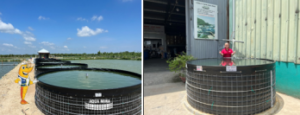
- For raised, tarpaulin-lined ponds from Aqua Mina: this process is simpler and more effective.
Select Suitable Fish Species by Understanding Their Biology:
- Since there are many fish species to choose from, select those suited to the specific ecological conditions of your area.
Quality of Fingerlings:
- Choose healthy, disease-free fingerlings with uniform size, bright colors, quick movement, fast reactions, and no deformities or injuries. It’s best to buy fingerlings from reputable sources. Before stocking, disinfect the fingerlings by bathing them in 2-3% saltwater for 5-10 minutes.
Stocking Density:
- Stock according to the species. Fish without auxiliary respiratory organs (such as tilapia, silver carp, grass carp, and common carp) should be stocked at 3-4 fish/m², while those with such organs (such as catfish, snakehead, and climbing perch) can be stocked at 5-10 fish/m². Proper stocking density promotes healthy growth, minimizes disease, and reduces rearing time.
Polyculture:
- In the same pond, different fish species can be stocked together to optimize the use of water space and available food, as each species occupies different water levels and consumes different food types.
Proper Feeding Techniques:
- Feed fish according to the “Four R’s”: right quantity, right quality, right location, and right timing to ensure fish health and lower disease risk. If using cooked bran as feed, place it in feeding trays for easier monitoring.
Enhancing Nutritional Intake:
- Ensure a balanced diet and supplement with trace elements like Vitamin C to boost fish immunity.
Handle Fish Gently During Catch and Transport:
- Take care to avoid injuring the fish.
Apply Lime Biweekly:
- Every two weeks, sprinkle powdered lime evenly over the pond surface at a rate of 2-3 kg per 100 m³ of water.
Contact AQUA MINA for consultation and supply of aquaculture round tanks and aquaculture equipment for high-tech shrimp farming.
- Address: 685 National Highway 1A, Binh Hung Hoa Ward, Binh Tan District, Ho Chi Minh City
- Phone: 1800 6071 (Toll-free hotline)
- Email: sales@aquamina.com.vn or oversea@aquamina.com.vn
Aqua Mina's distributor in Japan:
REX INDUSTRIES CO., LTD
- Address: 1-9-3 Hishiya-Higashi, Higashi-Osaka 578-0948 JAPAN
- Email: kimakubo@rexind.co.jp
- Phone: +81-(0)72-961-9893
- Website: http://www.rexind.co.jp/e/
Ngày đăng : 11/11/2024
2378 View


Other Articles
Ca Mau, Can Tho and An Giang Play a Leading Role in Vietnam’s Shrimp Industry
Protecting rice-shrimp yields against environmental fluctuations caused by prolonged rain
AQUA MINA Turbo Blower: Quiet, Energy-Efficient Air Supply for Aquaculture Ponds
AQUA MINA has accompanied the experimental tank system project at Can Tho University from its very early days
AQUA MINA AMONG 20 OUTSTANDING PRESENTATIONS AT THE WORKSHOP ON APPLYING SCIENCE AND TECHNOLOGY TO IMPROVE THE QUALITY OF VIETNAM’S AQUATIC PRODUCTS
Vietnam’s Shrimp Farming Industry Enters the High-Tech Race
The U.S. market relies heavily on imported shrimp to bridge its domestic supply gap
The 2028 supply crisis: The shrimp industry is projected to face a 400,000-ton material shortage
High profits from high-tech shrimp farming come with persistent risks
Intensifying El Niño Effect: Climate Change Risks Threaten the Global Shrimp Supply Chain
Evaluating Gaps in the Circular Economy Value Chain of the Shrimp Industry
A Comprehensive Overview of the Vietnamese Shrimp Industry


.jpg)