

CTU-RAS: Recirculating Shrimp Farming for Sustainable Development
Advantages
Fully closed recirculating system:
The system is designed to continuously reuse water within the culture ponds, with almost no discharge to the environment. Throughout the production cycle, only about 10–20% of water needs to be added to compensate for losses due to evaporation, pumping or salinity control. As a result, the same water can be reused for up to three production cycles per year without complex treatment, reducing pressure on water resources and lowering operating costs.
Pond area allocation:
Pond areas are rationally allocated, with 70–75% dedicated to shrimp culture and 25–30% allocated to biological filtration and water-treatment zones. The filtration area is designed to remove suspended solids, sludge and part of the organic load, while suporting the growth of beneficial microorganisms, thereby maintaining stable water quality and limiting waste accumulation.
Location:
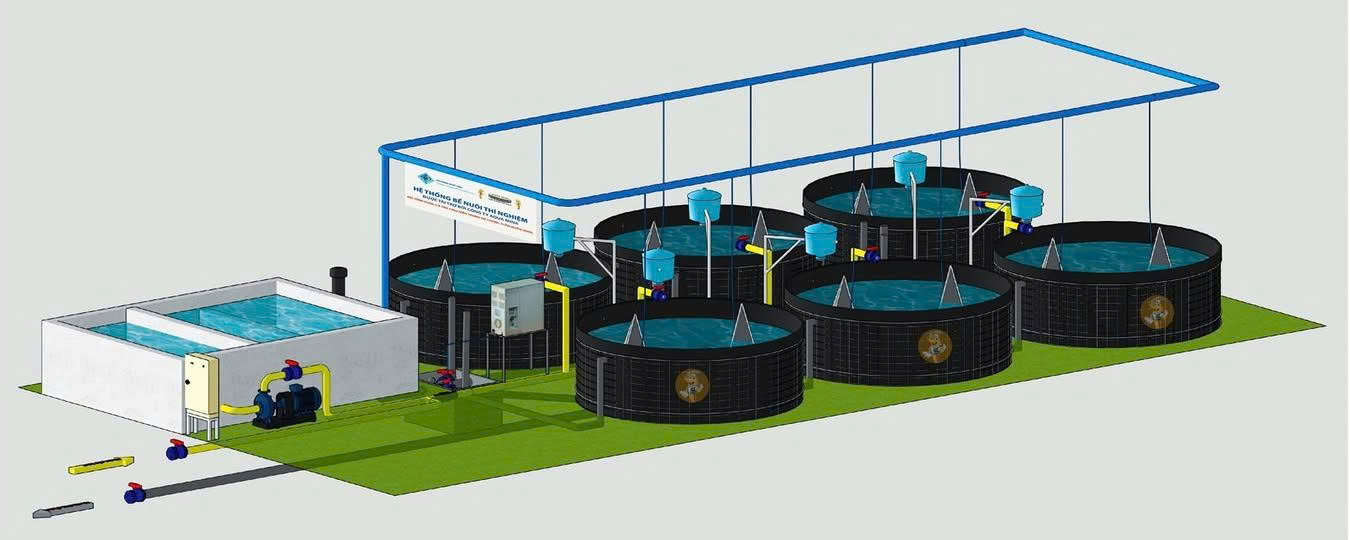
The model can be deployed either outdoors or indoors, depending on local conditions and management requirements. Indoor farming allows better control of temperature, light, rain and wind, reducing disease risks and environmental fluctuations. Outdoor farming reduces initial investment costs but requires careful attention to shading, aeration and continuous water-quality management.
Integrated multi-species system:
Co-cultured species such as tilapia and seaweed act as natural biological filters. Tilapia help remove weak or dead shrimp and disease-carrying crustaceans. Meanwhile, seaweed absorbs excess nutrients in the water such as TAN (ammonia), nitrite, nitrate and phosphate, naturally stabilizing the aquatic environment.
Feed management:
Shrimp are supplemented with natural feeds to partially replace industrial feeds, reducing FCR, enhancing flavor, color and natural shrimp quality. This approach minimizes the use of minerals and chemicals, avoids antibiotics, and ensures food safety.
System Components and Functions

Whiteleg shrimp (L. vannamei):
The main cultured species, releasing organic waste and feces that serve as nutrients for microorganisms and auxiliary species within the system.
Tilapia:
Co-cultured without supplementary feeding, primarily to control suspended solids and reduce organic waste in the water. Tilapia are not a main commercial product but play an ecological support role by converting part of the shrimp waste.
Screen filtration:
Captures suspended solids in the ponds, reduces bottom sludge and improves water quality. Prevents the accumulation of sludge and excess feed, lowering the risk of anaerobic conditions and toxic gas formation.
Biological filter media:
Provides a habitat for beneficial microorganisms that degrade organic matter and convert ammonium (NH₄⁺) → nitrite (NO₂⁻) → nitrate (NO₃⁻). Maintains nitrogen balance in the system and limits toxic effects on shrimp.
Seaweed (macroalgae):
Absorbs nitrate, ammonium and phosphorus from the water, limiting nutrient accumulation and pollution. Although not a primary product, it helps balance the environment and improve overall water quality.
AQUA MINA CO., LTD
– Address: 685 Le Duc Anh Street, Quarter 39, Binh Hung Hoa Ward, Ho Chi Minh City
– Phone: 1800 6071 (Toll-free hotline)
– Email: sales@aquamina.com.vn or oversea@aquamina.com.vn
– Aqua Mina’s Official Distributor in Japan: REX INDUSTRIES CO., LTD
– Address: 1-9-3 Hishiya-Higashi, Higashi-Osaka 578-0948, JAPAN
– Email: kimakubo@rexind.co.jp
– Phone: +81-(0)72-961-9893
– Website: www.rexind.co.jp/e/

WE WORK FOR THE SUCCESS
Ngày đăng : 20/12/2025
1406 View


Other Articles
AQUA MINA | CELEBRATING THE 67TH ANNIVERSARY OF VIETNAM’S TRADITIONAL FISHERIES DAY
Restructuring seed production to enhance the competitiveness of the aquaculture industry
AQUA MINA COMMITS TO NO PRICE INCREASE – 15% OFF PVC Knife Gate Valves, Double Flanges, and Elbow Flanges TO SUPPORT SHRIMP AND FISH FARMERS
Global shrimp prices – Week 12: Ecuador shrimp prices recover, while India and Indonesia remain stable
The global surimi market is projected to grow strongly.
Cà Mau: Expanding the RAS-IMTA model toward sustainable, zero-discharge shrimp farming.
From seed stock to farming equipment, high-tech aquaculture attracts strong interest in Ho Chi Minh City
Shrimp industry enterprises proactively adapt to global fluctuations
DAY 3 – AQUA MINA | STRONG CONNECTIONS – A MEMORABLE CLOSING AT VIETSHRIMP AISA 2026
DAY 2 – AQUA MINA | DEEP INSIGHTS & SMART SOLUTIONS FOR MODERN AQUACULTURE
DAY 1 – AQUA MINA | A POWERFUL OPENING AT VIETSHRIMP ASIA 2026
OFFICIAL OPENING of the International-Scale Aquaculture Exhibition Series | See You Again with AQUA MINA at VietShrimp Asia 2026

.jpg)